Perth Poetry Festival takes place on Whadjuk Noongar Land and it is, was and always will be Aboriginal Land.
Author: ralph.wessman
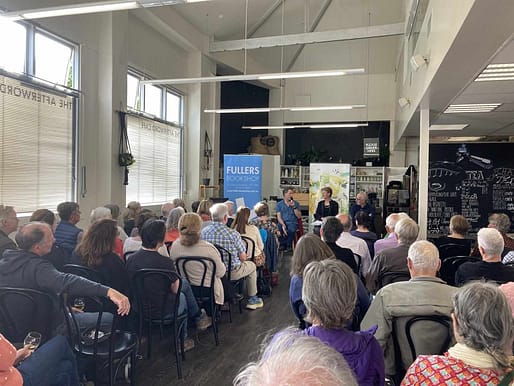
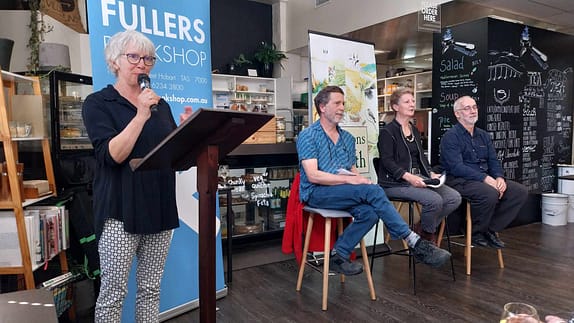
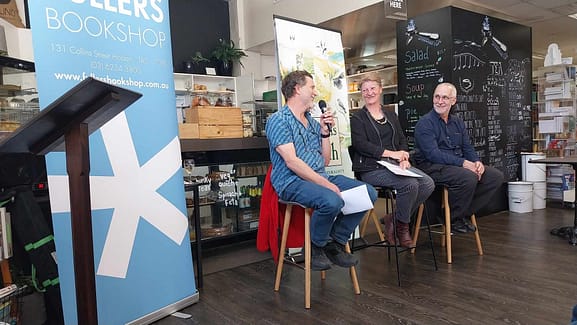
Fullers Poets in Conversation: Esther Ottaway & Susan Austin, 10 August
5.30pm – 6.30pm, Thursday 10 August
Fullers Poets in Conversation – Esther Ottaway and Susan Austin
Venue: Afterword Café, Fullers Bookshop, cnr Collins and Victoria Streets
How intelligent and seemingly social women can be exhausted from undiagnosed autism/ADHD; and how some women end up travelling on unseen, gruelling medical and IVF rollercoasters to become pregnant: Esther and Susan will converse on these issues and on the role of poetry in helping to cope with, and raise awareness about, these challenges. They will read compelling poems from their acclaimed new books, She Doesn’t Seem Autistic and Dancing With Empty Prams.
Join Esther and Susan to go in-depth on these important and unexplored topics in literature, and ask your questions in the Q&A time.
Esther Ottaway is the winner of the Tasmanian Literary Awards Tim Thorne Prize for Poetry and People’s Choice Award, the Tom Collins Poetry Prize, the Queensland Poetry Festival Ekphrasis Award, and has been shortlisted in the international prizes, the MPU, Montreal, Bridport and Mslexia. Her new collection is She Doesn’t Seem Autistic (Puncher & Wattmann).
Susan Austin is a poet, eco-socialist activist and occupational therapist. She facilitates group programs, including a creative writing program, in a mental health clinic in Hobart. Her first poetry collection, Undertow, was published by Walleah Press, an earlier version winning First Commended in the Best First Book category of the IP Picks competition. She was awarded an Australia Council for the Arts grant to work with Gina Mercer on her verse novel Dancing With Empty Prams. In 2021 she won First Prize and Highly Commended in the Fellowship of Australian Writers Tasmania Poetry Prize and was Commended in the Woorilla Poetry Prize. Susan has been a guest performer at various writing festivals and has been widely published in newspapers and journals.
Book here: https://www.fullersbookshop.com.au/event/fullers-poets-womens-untold-stories/
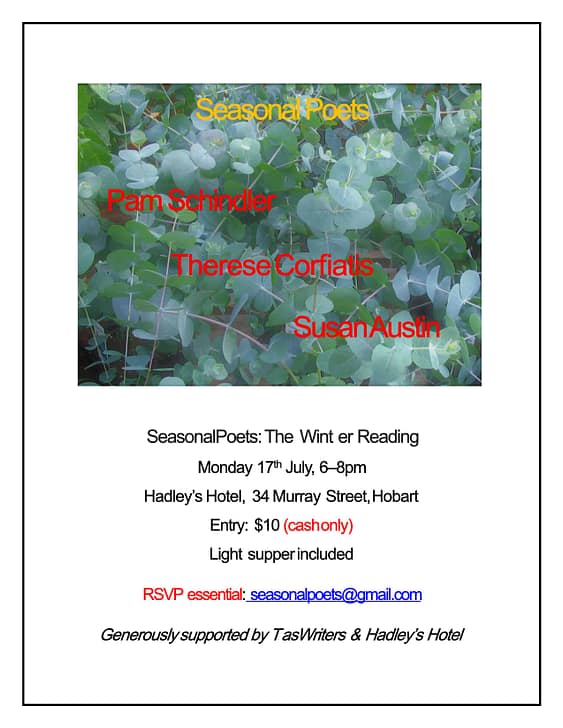
Seasonal Poets, Hobart, 17th July — A Taste of Poems from our Winter Poets
Dear Friends of Seasonal Poets,Each of our featured poets, Pam Schindler, Therese Corfiatis and Susan Austin has provided a poem for you to ‘taste’ before the reading.As usual, RSVPs are essential and admission is $10.00 (cash only) at the door.We look forward to seeing you at Hadley’s on Monday, July 17th at 6:00.Cheers,Irene, Anne and GinaAnne Collins, Gina Mercer, Irene McGuireco-curators: Seasonal Poets at Hadley’s
Silent Hands by Therese Corfiatis
gums form a swaying fabric –
pale grey, silvery olive leaves
meld and merge
into the sky’s blue loom
clouds unwind their threads –
long milky fingers
weave the wind’s rhythms
with silent hands
Half a moon by Pam Schindler
Come and stay,
there’ll be half a moon by Sunday,
a gleaming bowlful of dark
enough to feed
the lover in me, the elusive
heart in you –
all the lost chances,
they are here still,
turning in sleep
in the dark bowl
the new moon comes carrying
like a gift.
Sonnet for lost lasts by Susan Austin
His class lines up in pairs at the berry farm.
His free hand is held out for me to find.
I’m surprised to feel his whole hand in my palm:
he used to curl his fingers round one of mine.
Another little last, like the daytime nap?
Last time I hold his hand to cross a street,
last picture book read snuggled in my lap,
the final time I help him brush his teeth.
When will be the last we share a bath?
No camera will snap the final trolley ride,
the moment plastic cups give way to glass.
His fluffy monkey comforter will slide –
with the glee he gets from using arms to fart –
into that chest of lost lasts in my heart.
Seasonal Poets — Mon 17th July Hobart (Schindler, Corfiatis, Austin)
Devonport poetry event—April 28th
A new Tasmanian blog — Kim Nielsen-Creeley
Artist and poet Kim Nielsen-Creeley has begun a blog on her website, with her first post about her experience of this year’s Cygnet Folk Festival.
The Cygnet Folk Festival 2023 mantra is Back in Full Swing. After such a rich day, I’m feeling it.
Professional comedian Jenny Wynter had a Masterclass, Freeing the Funny from 11 – 3.30 today, so I bit the bullet and joined up, having become very interested in improv, after Cameron and Sonja Hindrum’s Literary Lounge at Junction Art Festival in Launceston.
Vale Charles Simic
Charles Simic (May 9, 1938 – January 9, 2023) was awarded the Pulitzer Prize for Poetry in 1990 for The World Doesn’t End.
what seemed maybe the dorsal fin of a sunfish
I was reading The Guardian’s story today of how ‘Yeah Baby’ was forced out of the Sydney to Hobart yatch race after a collision with a sunfish.
As crew member Louis Ryckmans describes it,
The boat was fantastic in the conditions and we were looking forward to the stronger conditions thinking that the boat is really going to perform, and we had an impact where my immediate thought, was we hit a reef – it was that powerful.
I think the name is incorrect. It’s a sun leviathan, it’s a sun monster, it’s no fish.
And I found myself returning to Anthony Lawrence’s recollection of the time he’d taken a leisurely half-hour dip in the ocean in the company (when he discovered its presence nearby) of what he took initially to be a sunfish.
‘We found our boat surrounded by a school of dolphins. There were at least fifty of them, swimming, diving all around us. They were everywhere. I couldn’t help myself, I stripped and joined them and spent an amazing half an hour in their presence. It was truly memorable.
‘Suddenly, they were gone. Just … took off, disappeared. I didn’t know what to make of it. I began shivering. Felt cold. I swam back to the boat. “Help me in Richard”. “My god mate, you’re white as a sheet, what’s the matter?” “I don’t know.”
‘But we turned to see, a little behind us, what seemed maybe the dorsal fin of a sunfish. “Let’s take a look.’ It was this great white pointer, four or five metres, just lolling there languid. As big as the boat. He wasn’t hungry, no threat at all. But I felt weak, thinking how I’d been treading water twenty-five feet away from a big white. No wonder the dolphins left, they weren’t taking any chances.’
New episode of PoemTalk: on Armand Schwerner with Jerome Rothenberg, Pierre Joris & Charles Bernstein

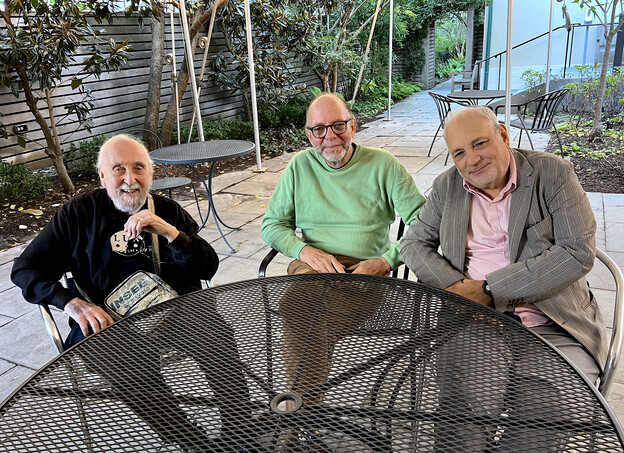
From left: Jerome Rothenberg, Pierre Joris, and Charles Bernstein in the garden of the Kelly Writers House. Photo by Al Filreis.
Al Filreis gathered together Jerome Rothenberg, Charles Bernstein, and Pierre Joris to talk about two poems by Armand Schwerner. The first was written near the end of Schwerner’s life, for his major series titled The Tablets. The poem discussed here is “Tablet XXV” [TEXT; AUDIO] and, along with all the other sections, it can be found in the complete edition published by the National Poetry Foundation in 1999. The second poem is an earlier one, “‘daddy, can you staple these two stars together to make an airplane?’” [TEXT; AUDIO] originally published in Seaweed and available on page 50 of Selected Shorter Poems (Junction Press, 1999). Our recordings of these poems come from PennSound’s Armand Schwerner author page. “Tablet XXV” was recorded by the National Poetry Foundation in the mid-1990s. Our recording of “‘daddy, can you staple …’” was made by Paul Blackburn during Schwerner’s public reading at the Poetry Project, at St. Mark’s Church, in New York, on January 18, 1967, and is made available through the remarkable Blackburn collection housed at the University of California at San Diego.
Vale Robert Adamson
A facebook post by Anthony Lawrence. Simple, eloquent….
Vale Robert Adamson 1942-2022
Poet, friend
(Song) Metric—’What Feels Like Eternity’
‘What Feels Like Eterntiy‘, by Metric—from the album ‘Formentera’ (Jul 2022).
(Tim Sendra’s album review at ALLMUSIC)
SCAP Writers, featuring Irish poet Kevin Higgins—Sept 2022
This SCAP writers on Zoom is introduced by Donna Campbell and Linda Jackson and features the writing of Rachel McJury, Katharine McFarlane, Jo Gilbert, David Stakes and the master poet of satire, Kevin Higgins.
“… death arrives, impeccably dressed.”
(Poem ends)
“I spent yesterday” (Kevin continues conversationally), ‘in the Accident & emergency Department in Galway with an issue, and we were saying—a group of us sitting and waiting to be seen—”It’s quite like prison, really: what are you in for now that you’ve made it this far down the corridor? It’s not something small…. “
Melbourne Poetry Map
A note from Indrani Perera’s newsletter ‘The Poet’s Express’, (November 2022 issue) exploring Eleanor Jackson’s creation, the Melbourne Poetry Map.
Take a walking tour around the city of Naarm (Melbourne, Australia) courtesy of some of the city’s finest poets. Curated by poet and performer, Eleanor Jackson, the Melbourne Poetry Map is a brilliant way to discover a city.
About
The Melbourne Poetry Map: Audio Graffiti is an archive of ten “poetry journeys”, each of which will take between 20 – 45 mins to complete, depending on how fast you travel, how well you know the city and how long you want to spend at each location. That said, it’s nice not to do things in a hurry.
The Map is curated and produced by Eleanor Jackson, and has been supported by the Queen Victoria Women’s Centre, Peril Magazine, Melbourne’s UNESCO City of Literature Office, Overload Poetry Festival and City of Melbourne.
It was created in 2010, with new journeys added in 2011-2012, and again in 2019.
Each journey exists as a map of directions and a playlist of audio tracks designed to be listened to in their corresponding locations. Sometimes the location of the poem is quite specific, sometimes it’s a little bit vague – don’t get het up if you’re not in the right place at the right time. Poetry is all about being in the wrong place at the right time.
If you do find you’re getting a bit lost, why not ask a local Melburnian for some helpful directions! Apparently, they’ll be the ones dressed in all black.
We hope you’ll love exploring the psychogeography of this incredible city. As snapshots in time, some poets pay tribute to places that are no longer there, or places that have changed in their use and designation. We say, just roll with it.
Good luck!
Courtney Marie Andrews, ‘Loose Future’
Reading David Marr’s ‘Stories, Essays & Speeches’ (Black Inc 2018)
Reading David Marr’s publication of a few years ago, ‘Stories, Essays & Speeches’ … it surprises me at times the way that personal connections have a habit of arising unexpectedly. In Marr’s essay on John Gorton, he mentions Gorton’s elevation to Minister for the Navy in 1958, explaining Gorton being told ‘never to use the old aircraft carrier Sydney, moored in the mothball fleet off the zoo in Sydney Harbour.’ Gorton, so Marr records, says ‘We went and had a look at her. She was full of barnacles and had to be cleaned out. But we just gradually got her out. We said we needed the Sydney for operations on the coast with the Army. we made her a bit better, and then said we could send her to New Zealand on combined operations. As a result she was ready for Vietnam when she was wanted. We wouldn’t have had any troops and materials to send to Vietnam but for the Sydney.’
I served on the Sydney for a year, ferrying soldiers back and forth between Oz and Vietnam on a couple of occasions. Tried writing about the experience…
Mention of Anzac Day brings back a flood of memories, chiefly of soldiers returning home aboard what was
popularly termed ‘the Vung Tau ferry’ — HMAS Sydney, an ageing aircraft carrier with empty hangars specially fitted to sleep hundreds of returning vets side by side on makeshift beds. At night a projector screened movies at one end of the hangar where bums on seats were provided for on hard wooden stools which by turn skidded across the hangar floor from one bulkhead to the other with the rise and fall and sideways pitch of the ship as it sailed inexorably through the night, heading home. And on arrival, the possibility of a march through Townsville, or Brisbane, with patrons disgorging from pubs to offer frothy schooners of ale to the marching men: ‘Have one on me mate!’ Or gliding through Sydney Heads into the shelter of the harbour and patrolling aft on duty watch, observing the bobbing lines of well-worn army uniforms snaking in the white of the ship’s wake as soldiers changed from jungle greens for the last time, into ceremonial dress for the march through Sydney’s streets.
LINK—Giles Hugo’s interview with David Marr, published Famous Reporter 7, April 1993.
Review, David Mason poetry collection ‘Pacific Light’ (Los Angeles Review of Books, 20 Nov 2022)
Thoughtful words, both by and about US poet David Mason, now resident in Tasmania.
Siham Karami reviews Mason’s Pacific Light (Forty South Publishing, Sept 2022)….
In this collection, we sense it in the very first poem, “On the Shelf,” whose title rhymes with and is the same metric length as that of the final poem, “Note to Self” — another indication of the care with which Mason organizes his effects. There we are invited to observe the smallest thing, a spider’s shed skin, which the speaker “thought twice before touching,” because the spider’s “soul” is still “able to frighten.” He wonders if his own “shed skins / in houses where my name has been removed” will elicit an emotional response, if “some words of mine” will thus “go on living,” without asserting it. The question remains humbly open.
There’s reference too, to previous conversation with Mason in the form of a link to Leath Tonino’s 2015 interview with the poet, published in The Sun.
Tonino: As you’ve described it, the Greek view seems particularly fitting for a poet. I like the idea of poets as people writing from the brink, with the clarity and intensity of the about-to-die. It makes me think of the Zen Buddhist tradition in which a master often writes a final poem on his deathbed.
Mason: That happens in the Western tradition as well. Many poets write their own epitaphs. Take Robert Frost’s: “I had a lover’s quarrel with the world.” That’s just a beautiful idea. We’re always a little at odds with the world, always wrestling with it, fighting it, beating our head against it. But we also love it very much. Elsewhere Frost says, “Earth’s the right place for love: / I don’t know where it’s likely to go better.” You’ve got a body, and the body can love as well as suffer. Sometimes love is suffering, right?
I think poets as a group often do have an essentially Greek view of existence. I don’t mean they are all influenced by the Greeks. There are obviously Christian poets and Buddhist poets and many others with different theological standpoints. But the awareness of death seems common to all. It’s almost the nature of poetry.
Tonino: But obviously poetry doesn’t have to be only about loss, grief, and death.
Mason: Right. There’s a spectrum. Sometimes it’s about transforming loss. We are all transformed by grief. We change in the way a tree struck by lightning changes. Artists try to capture that in a poem or a minuet or a painting or a sculpture.
A student was asking me just today: Why is it so hard to write about happiness? I replied that it’s hard to write well about anything — it’s just damn hard to get the words down right — but it’s especially hard to convey the joyful aspects of life without becoming sentimental. Sadness, too, can be maudlin, but it’s particularly true of happiness.
And yet there are happy works of art out there, works that are brimming with gaiety, to use W.B. Yeats’s word. Even the tragedies often crackle with a kind of life energy. You feel revitalized by partaking in them. Somebody once speculated that the writer Flannery O’Connor must be a cynical person, because her short stories are so dark. Her answer, which I’m paraphrasing, was that no completely cynical or nihilistic person can write fiction. In a sense, the very act of creation is fundamentally an acknowledgment of life.
I read a lot of contemporary poetry and often find myself feeling that there’s no vitality to it. It’s as if the author were dead inside, or just writing for professors. There’s no human pulse there. The poem doesn’t beat like a heart. All the best literature has that pulse. It makes you feel alive to read it.
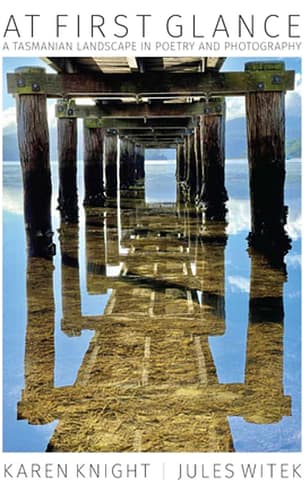
Launch speech—Karen Knight’s & Jules Witek’s ‘AT FIRST GLANCE’
Launch also covers Jules Witek’s photographic exhibition, both were launched by Liz McQuilkin, at Triabunna on 12th November 2022
WestWords—David Adès and Peter Boyle in conversation [24th Nov 2022]
More than an hour of poetry and conversation between poets David Adès and Peter Boyle, on Peter’s selected theme— exploring the unknown in life.
DAVID
Peter, with the theme that you’ve selected ‘Exploring the unknown in life’, you’re reading poems today from your last two books ‘Ideas of travel’, and ‘Notes towards the dream book of endings’. Both of those titles suggest to me the notion of exploration.
How do those two books reflect your theme?
PETER
I think both of those books reflect the idea of, or are based around the premise of, trying to write poetry that doesn’t start from what you know but is working its way towards what you don’t yet know. So it’s poetry that’s deliberately not paraphrasable—not exactly storytelling, not obviously related to some kind of theme that you could spell out in advance. So it has that exploratory quality, the sort of openness to the various things that life might unfold that we don’t yet know. So multiple dimensions of reality….
DAVID
You’d be familiar with this, there’s a very old conversation in poetry about whether poets—and probably in literature generally—should write about what they know. I remember as a seventeen-year-old wannabe writer I was told not to write anything until I had something to say. I wrongly didn’t think I had anything to say as a seventeen-year-old and that was possibly the worst advice I’ve ever been given. How much of writing for you is about exploring the unknown?
PETER
Well, I think for me writing has got to be about exploring the unknown in a sense that if it’s something that I could say to someone because I know it already, if it’s—you know—just my opinions about some this, that or the other topic, then to me it just doesn’t have the energy to push me into creative poetry….

Small Press Network—2022 Book of the Year Award: winner Eleanor Jackson
The Small Press Network (SPN) this evening announced the winner of the 2022 Small Press Network Book of the Year Award (BOTY): Gravidity and Parity by Eleanor Jackson, published by Vagabond Press!
Below, from Small Press Network’s Fiona Wallace’s interview with Eleanor earlier in the month:
Q. Your poems have a powerful sense of immersion in the present-day world. The COVID-19 pandemic, Black Lives Matter movement, Trump’s presidency and the incorporation of technology are brought naturally to the fore, rather than operating as impartial and immaterial backdrops. Can you talk about the importance of reflecting moments of time in your writing practice?
I definitely wanted these poems to have a very particular timestamp. For better or worse. At the time I worried the issues would date. Sadly, some of them haven’t.
I have long been interested in the idea of poetry as a documentary practice. I don’t think that knowledge or form is neutral, and I’ve been curious what we learn when trying to represent ‘reality’ as it happens. And this feels like a ‘momentous time’, for our community, for our cultures, for our society as a whole, and I was conscious of wanting to record that in real time. But even momentous times can feel simultaneously deeply prosaic and even boring. So I wanted to try and capture a time with a telescoping quality, sometimes looking at the minute and sometimes looking at the enormous.
Eleanor Jackson at the 2013 Tasmanian Poetry Festival, Launceston
Colette—from the short story ‘Grape Harvest’
She wanted some more bacon, and cut into the peasant bread, made of pure wheat, brown but succulent, and demanded from the gnarled giant an account of the war of 1870. It was brief.
“What’s to say? It wasn’t a very pretty sight … I remember everybody falling all around me and dying in their own blood. Me, nothin’ … not a bullet, not a bayonet. I was left standing, and them on the ground … who knows why?’
He fell into an indifferent silence, and the faces of the women around us darkened. Until then, no mother deprived of her sons, no sister accustomed to double work without her brother, had spoken of the war or those missing, or groaned under the weariness of three years….
Sidonie-Gabrielle Colette (28 January 1873 – 3 August 1954)
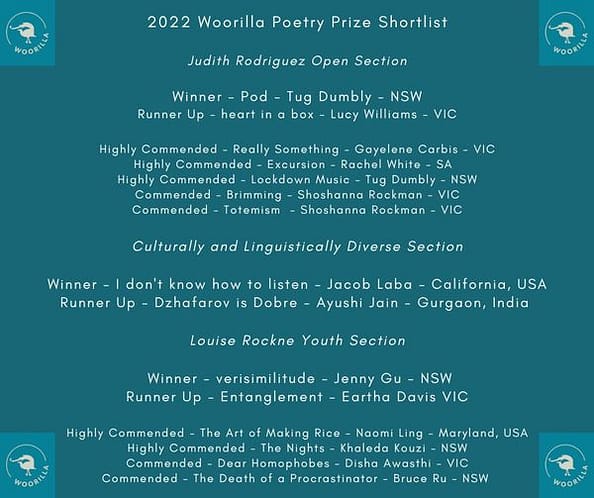
Woorilla Poetry Prize 2022
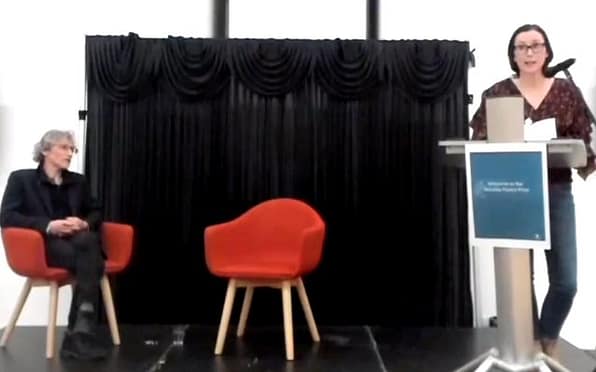
The Woorilla Poetry Prize was judged this year by Kevin Brophy and Alicia Sometimes, with the awards event taking place in Emerald, Victoria.
Kevin Brophy spoke briefly about the judging process. ‘I guess I want to remind you at the start that judging a poetry competition is a very human process. There is a human at the end of the poems, trying to receive the poems and trying to be everything that a judge is meant to be, but in the end having to be simply a lover of poetry, and react to the poems as a lover and admirer of poetry and what poets do … which is to renovate language.’
First Prize went to Tug Dumbly, with Lucy Williams runner-up. The three Highly Commended Awards went to Rachel White, Gayelene Carbis and Tug Dumbly, while the two Commended Poem awards both went to Shoshanna Rockman.
A video recording of the event is online.
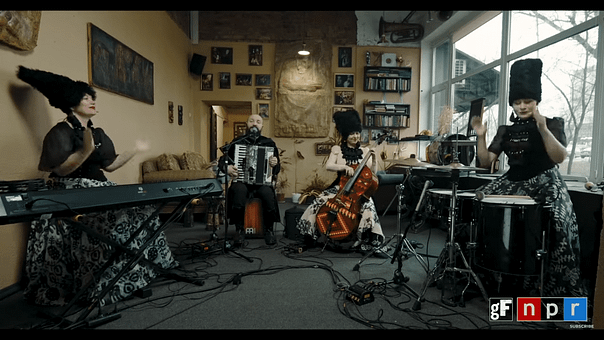
Ukrainian folk music quartet DakhaBrakha—NPR Music Tiny Desk (Home) Concert
2022 Tasmanian Literary Awards—shortlists announced
Lovely to see Lyn’s book made it to the shortlist, sorry Pete’s didn’t (he had two nominations that made the longlist)… sorry too for Adrienne who also had a couple of longlistings. (And for Jane, of course). Meanwhile, congrats to those who made it through.
There’s a link to the shortlists on this page, as well as a link to the longlists.
The Joan Didion estate sale
Sophie Haigney, writing for ‘The Paris Review’ (17th Nov 2022) about the artefacts being auctioned in the US at the Joan Didion estate sale….
Then there were the three lots of blank notebooks, tied with twine. They went for $9,000, $11,000, and $11,000 each. They were empty, some still wrapped in plastic, yet they were totally talismanic. I wondered: Would you write in these notebooks, having paid that price? Perhaps that’s the whole appeal—to write in a blank space that Didion might once have intended to use herself. Maybe the buyer had a hidden wish that somehow her intent might infiltrate their own work—that in owning these notebooks they might crack some secret code to making sentences like hers. There are sillier superstitions. But more likely, I think, you would have paid too much for these notebooks to ever touch them, and they would sit in a drawer or on a desk, unused and empty, just as they sat on hers.
Csik Zenekar—Hungarian folk music ensemble
Jane’s poetry residency in Slovakia in 2016 led to an introduction to Hungarian and Slovak music. This, from Csik Zenekar, (recorded 2009)….
Launch of ‘Reaching Light’, by Robert Adamson [Sydney, July 2022]
Robert reading and in conversation with his Flood Editions USA editor/publisher & poet Devin Johnston, with readings by Sarah Holland-Batt and Michele Seminara.
The very sad news is that Robert Adamson is gravely ill.
* * * * *
Normally, I’d not think twice about the mention here of a literary event—a book launch—yet I’m vaguely aware that doing so on this occasion could possibly be construed as no more than zeroing in on a topical note of interest.
However….
* * * * *
When Tim Thorne fell ill, I found myself hesitant to engage, ask how he was going … generally, just unwilling to intrude. In retrospect, it was a rubbishy form of interaction on my part—albeit under trying circumstances. I regret I didn’t make a greater effort…. Physically, Tim was slowing down, but mentally he was still off and running…. We shared a moment together, one session during the 2021 Tasmanian Poetry Festival. The state election had been called that very day, and scheduled for the 1st May. I made some reference to it, to which Tim quickly replied oh yes, and that’s going to put a very different interpretation on May Day, isn’t it? and he laughed.
I should also have said, oh by the way I appreciate and admire you so very much; for your generosity, for all you’ve achieved…. But I didn’t.
So goodbye rubbishy decisions.
I don’t know Bob Adamson’s work well, and my indirect association with him has only occurred since he provided back cover blurbs for one or two of the poetry collections I’ve published (Vanessa Page’s ‘Confessional Box’ comes to mind) some years ago. My belated appreciation of his poetry is due to the arrival in our home of a copy of the 2016 anthology ‘Contemporary Australian Poetry’ (Puncher & Wattman), where the work of poets is, according to surname, arranged in alphabetical order. Such a great anthology, so many very fine poems, but I always experienced difficulty getting past the opening five poems in the book—Adamson’s—’Via Negativa: The Divine Dark’, especially. Such fine poems all…. Bless you Bob for making vivid, and sharing, your perceptions.
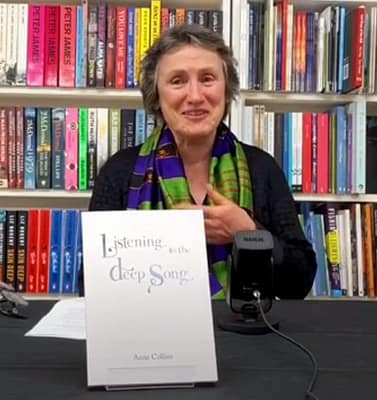
Anne Collins—book launch
Lovely to see that Anne Collins has launched her newest collection of poems and prose—’Listening to the Deep Song’ (Bright South)—in Hobart last week.
The book was launched at Hadley’s Hotel on 11th November by Petrina Meldrum:
I’d like to say how happy I am to be back in Hobart to share in the launch of Anne’s latest book, Listening to the Deep Song, and how nice it is to see so many familiar faces. Thank you all for coming along to support Anne and to celebrate with her.
When I first met Anne some six years ago, her manuscript, for all intents and purposes, was ready to be sent out to publishers. I remember clearly, when Anne brought it along to one of our early meetings, how impressed I was with the idea she had had, and with how she had gone about bringing it into existence.
As the intervening years flew by, the manuscript grew larger, and today, here we are, with this beautifully written book in our hands.
I think most of us are aware of Anne’s interest in Spain and the Spanish culture, but not necessarily of the depth of her involvement. In Listening to the Deep Song she shares, without restraint, her experiences.
Through multi-layered vignettes and some exquisite poetry, she takes us on a journey through Spain’s regions and major cities, through its seedy back streets, its world renown museums, and its quirky architecture. If you’re planning a trip to Spain, you can throw away your guide book and take Anne’s book with you instead. She’ll guarantee to get you lost at night in the back streets of Seville, or help you lose yourself in the whimsy of Miró’s universe in Barcelona.
Spain, of course, is not one country but a number of autonomous regions, each with their own language and cultural heritage, which they guard fiercely.
Anne recognises this by dividing her book into sections and allocating a flamenco rhythm or compás to each region. These rhythms reflect her sense of an underlying mood as she travelled through Spain.
On returning to Hobart, to her ‘Spanish life’, she has this to say:
‘Curiously in Hobart I have a Spanish life. I enjoy the exhilaration of flamenco dance classes… For short periods of time, I am immersed in flamenco energy. These experiences help me in finding my own flamenco self, my own flamenco confidence, still with much to learn.’
In the ‘Afterword: I am touching you’, a heart-warming piece, she tells us of her experience during Covid-19 isolation, a time when many put their lives on hold, but not Anne, she was Zooming her way to Madrid several times a week to attend flamenco classes online.
Following her journey, we become aware that there is another dimension to Anne and we are left, as a consequence, with a more intimate sense of who she is.
On attending a flamenco performance in Seville in a 16th century Sephardic courtyard at La Casa de la Memoria she records:
I feel an unexpected stirring of ecstasy and sorrow, a kind of loss deep within, of what I am not sure, but like the poet Félix Grande, I want to cry like a new born. What has this to do with me – an everyday 21st century stranger to my own roots and here for this brief moment? What yearning pulls me beyond their words of protest I barely understand, into ‘the gratitude, the anguish, the joy, the revelation’, the raw wailing core of this art we call flamenco?
We see a more playful Anne, in Barcelona, visiting one of Gaudí’s buildings, La Casa Batlló.
From her poem, In Gaudí Wonderland:
Inside the Casa Batlló the building seems
to sway and dance and smile
and I want to leap about
as the curves of my breasts and hips
align with the curves of the cave-like walls…
I imagine living here in this building
that honours a sense of joy.
Feel gracious and light, tender, seductive, playful,
free of straight lines and rigid postures
as if some essential fluidity
has re-awoken deep inside me.
Throughout the book there is a questioning going on, a desire to learn more – to have a deeper understanding, to belong. This is what Spain does to you if you let it: it draws you in and never lets you go. There is a sense of this happening to Anne as she gives herself over to Spain, while at the same time questioning why this is happening to her.
Her trips to Spain span a period of thirteen years, a long enough period for her to have noticed changes, both good and bad, all of which she shares with us. The diverse knowledge she has gained in this time is masterly woven into her vignettes, leaving us with signposts and pathways to follow if we wish to know more. The vignettes, at times a conversation with Spain, would give any traveller a masterclass in how to travel, in how to be more engaged with what lies beneath the surface.
Interspersed with the vignettes is Anne’s poetry. Some of the poems are born of her long interest in the life and work of Federico García Lorca.
Lorca’s first major work, Poema del Cante Jondo – Poem of the Deep Song – has clearly influenced Anne’s choice of title for the book, however, the poems she has chosen to respond to, form a conversation with a wider range of his work.
This poetic dialogue with Lorca’s work opens up a new way of reading into it, a way, through poetry, of showing the relevance of his work in a 21st century context.
In Anne’s poem, Learning to Spell, After the life of Federico García Lorca, which I’d like to read to you, she quotes phrases from two of Lorca’s poems, Landscape and Sleepwalking Ballad.
Learning to Spell
The boy learns to spell leaf
it turns to leaves on a yellow tree.
Leaf through the mistake of years–
a complicated task, a lot of rubbing out.
There’s knife and shelf, the rule’s the same
do your homework. By mistake the evening
a knife-edge wind cuts the leaves.
The alarm, the shelves full of books,
the guards are spell-bound.
The boy changes into a bird
watches through the mist on the panes
writes sentences with the word leaf,
a complicated task, a lot of rubbing out.
They leaf through the shelves.
After the wind there was only one leaf left.
On the page a trail of tears, the stanzas stretched out.
Her other poems reflect on her connection with and her understanding of Spain, and on her association with the art of flamenco. The flamenco poems make your heart beat to a different rhythm as you appreciate the degree to which this artform has become part of Anne’s life, and she part of the ‘flamenco family’.
I can truly recommend Listening to the Deep Song to you.
And now, I’ll hand over to Anne who is going to share some of her beautifully written pieces with us. Anne…
In conjunction with Hobart Bookshop, Anne’s also recorded a short video explaining more clearly her love of Lorca along with ‘everything Spanish’, here.
in his endorsement of Anne’s book, Peter Boyle writes—
“Part travel diary, part meditation on Spain and its cultures, part poetic dialogue with the poetry of Lorca, Anne Collins’ “Listening to the Deep Song” is a beautifully written testimony to her long enthusiasm for the many sides of Spanish culture. Bringing together her training in flamenco dance, her love of Lorca’s poetry and several of her journeys through Spain, Anne Collins offers her readers a personal response to a unique blend of cultures that continues to speak to the 21st century world. Varied and many-layered, marked by close observation and thoughtful questioning, this is a delightful book.”
Finally, the publisher’s description…
Like a traveller’s journal written in prose and poetry, Listening to the Deep Song records Anne Collins’ travels through various regions of Spain, which took place over many years. The book offers a meditation on Spain’s many-layered history and culture, reflecting on history, landscape, expressions of culture, and change. It reveals places of connection and friction within Spain and across the world; as far as Anne’s home in lutruwita-Tasmania.
The writing turns on a poetic dialogue and an embodied praxis; the latter being expressed through both Anne’s physical immersion in Spain, and her practice and knowledge of flamenco dance. The latter engages with, especially, the life and works of Federico Garcia Lorca, as well as with other poets and writers of, and about, Spain.
Listening to the Deep Song is deeply personal, yet it offers much that resonates deeply with contemporary concerns. Anne Collins’ writing is varied, thoughtful, observant, poignant and beautiful.
‘Listening to the Deep Song’ is available from Bright South. It sells for $30.
Didion: ‘the civil war was yesterday’
Haven’t decided on Didion. Some things she writes are breezily anecdotal—and no more—at other times she hits the spot. Here she’s in Greenville, Mississippi, reflecting on New Orleans and the South with locals. The year is 1970.
The time warp: The Civil War was yesterday, but 1960 is spoken of as if it were about 300 years ago.
(from ‘South and West’. The reference to 1960 may be alluding to the possibility of JFK’s election).
Poets on the Line—featuring Gina Mercer (18th Nov)
‘Poets on the Line’ is zoom event organised by Ross Donlon from Agitation Hill (Castlemaine, Victoria) this Friday 18th November, from 6 – 7 pm.
Zoom link will be posted in a few days. Featured poet for this first event is Gina Mercer.
Format is of a 20 minute reading, then Q & A involving the audience, concluding with Gina’s encore.
Hobart launch—Jan Colville’s ‘a small universe’
Jan is releasing a new chapbook of her poetry, a small universe! (published by Bright South).
Where: Hobart Bookshop
When: 24th of November, at 5.30pm
Please rsvp: rsvpbrightsouth@gmail.com or call (03) 6223 1803
Book launch—Gayelene Carbis’ ‘I Have Decided To Remain Vertical’; Melbourne 16 Oct 2022, launched by Marion May Campbell
Plenty of support for Gayelene Carbis, when Marion May Campbell launched her new poetry collection—’I Have Decided To Remain Vertical’—at Readings in St Kilda last month.
With Claire Gaskin MC-ing the event, local choir The Red Hot Singers — (‘This is not a choir, it’s a singing group … in other words, informal’, someone clarified; another pointed out ‘We’re all part of Soul Song’, a subset; we get out and about!’) — provided an African musical intro as a prelude to Marion May Campbell’s launch address. Much like Kevin Brophy in Melbourne (and Pete Hay in Hobart and Cameron Hindrum in Launceston), Campbell is a favoured ‘go to’ person when it comes to launching poetry in Melbourne, (she launched Susan Hawthorne’s ‘Dark Matters’ at Collected Works five years ago, back in the days when Kris and Retta welcomed all & sundry to their fabulous bookshop, ‘up the stairs and to the left: or take the lift!’)
Claire urged punters to ‘buy a book, to support Gayelene, to support poetry, to support Readings, to support the wonderful publishers who publish poetry’ before introducing Marion May Campbell, whose bio she proceeded to read. ‘If you haven’t read all those books [of Marion’s], you know, you really haven’t lived so you have to make sure you do that … a wonderful writer, a beautiful person who’s won many awards and supported many a writer … (Gayelene’s nodding!) Please warmly welcome Marion May Campbell.’
Marion spoke of the miracle of several key poems in this new collection presenting an integration ‘of a kind of terror and of comic Alice-like defiance. Surreality is presented with hyper-real acuity…. Poetry-making often snatched from the doors of disaster is both agent and catalyst for the I-persona — and I won’t call the ‘I persona’ Gayelene, because it’s so variable as well, and protean … takes on different shapes all the time. Her triumphant survival, no matter into what pits life and love have thrown her, is always done with great comic brio – and often hilarity, all the more liberating for the near-catastrophe that she skirts.’
‘I had a much longer version of this already-too-long speech, which quoted a lot of these poems—I would have liked to write about every poem in the collection….
. . . . .
‘In various inventive ways Gayelene’s work, so far—in her plays, stories, and now two poem collections—has explored both the comedy of feminine identifications, and the devastation wreaked by models of masculinity that men, and boys, strive to enact, or refuse at their peril.
. . . . .
“Again, the last line is an unmitigated triumph. ‘I hold my pen like a knife’.
. . . . .
“Here fabulism triumphs over sadness with magical metamorphosis, yet the humble domestic broom, remembering its origin, offers a retreat. And I’m reminded here of that Turkish proverb, When the axe came to the forest, the trees whispered—the handle’s one of us.’
‘Oh Gayelene, thank you for such fabulous, transfiguring work. Congratulations, from the heart.’
‘Marion … thank you for your beautiful, and passionate and erudite response to my work, and for launching my book into the world in words that are so uniquely you, thank you—from my heart, thank you.’
‘I think we should all go home now…. I mean do I need to say or read anything? Yes I do, Yes I do. I need to say thank you. These poems were written over many years, some a very long time ago. I spent years and hours working towards this book, and it’s just … me and the work … but it really takes a community to create and make a book. I’d like to firstly thank Puncher & Wattmann whom I’m thrilled to be published by, huge thank you to David Musgrave….
‘A huge thank you to Marion May Campbell, and Kathleen Mary Fallon, for extraordinary generosity over many years. Kathleen, thank you for suggesting the title, Marion really pushed for this one amongst the Kathleen Fallon list of possible titles … well not pushed, that’s not Marion’s style: she presented ‘elequent arguments’. Initially I thought, it’s too long, it sounds weird … and then I thought, ooh, I wrote that line. Now I think it’s a perfect title for the book….’
Gayelene proceeded to read a number of poems from her book, a reading of which Lyndon Walker has since written generously and reflectively, “A fine and powerful reading of your work. Very moving, and very funny – you have that balance there. You are one of the best readers/performers of your own work in this country.”
Bringing the event to a close, the Red Hot Singers once again took to the floor. ‘Gayelene … do you wanna? … come and sing with us.’
‘Oh, yeah sure. You twisted my arm….’
(to view the full launch event, visit here … to purchase the book, visit here).
Fourth Australian Haiku Anthology—Call for submissions
The Australian Haiku Society has announced a call for submissions for the Fourth Australian Haiku Anthology (4AHA) that will showcae the work of poets who are writing haiku in Australia today.
It is almost a decade since the previous Australian haiku anthology was released and the landscape has changed significantly since then. The society’s mission is to publish a collection that will be representative of the diversity in approach taken to writing haiku in this country at this time.
Submissions are welcomed by poets who are Australian by nationality or who currently reside here. There are no constraints with respect to form or the inclusion of seasonal references; both haiku and senryu are welcomed and may be published or unpublished.
The editorial team for the anthology will be Lyn Reeves, Beverley George and Rob Scott.
SUBMISSION GUIDELINES
Submit up to five of your best haiku and/or senryu by completing the submission form at the society’s website. The deadline for submissions is 1st December 2022.
Myron Lysenko: ‘If we lose this war, we’re going to lose our country, our language and our culture….’
Myron Lysenko, in conversation with Tina Giannoukos on 3CR Spoken Word this morning, Thursday 27th Oct 2022.
“A lot of the Ukrainian people believe that we will win the war, even though we’re fighting against extreme odds. If we lose this war, we’re going to lose our country, our language and our culture so it’s very important to us.
“As a Ukrainian, I was brought up to always think of Ukraine as my homeland. When I went to school people would say, you know, you’re not Ukrainian because you were born in Australia.
“And I went home and I said to my father, ‘What do I do Dad? They’re saying I’m not Ukrainian, they’re saying I’m Australian!’
He said, ‘Well you go back to your school and say, “If a horse is born in a pig pen, does that make a horse a pig?”‘
‘I’m Ukrainian, and always will be…. ‘
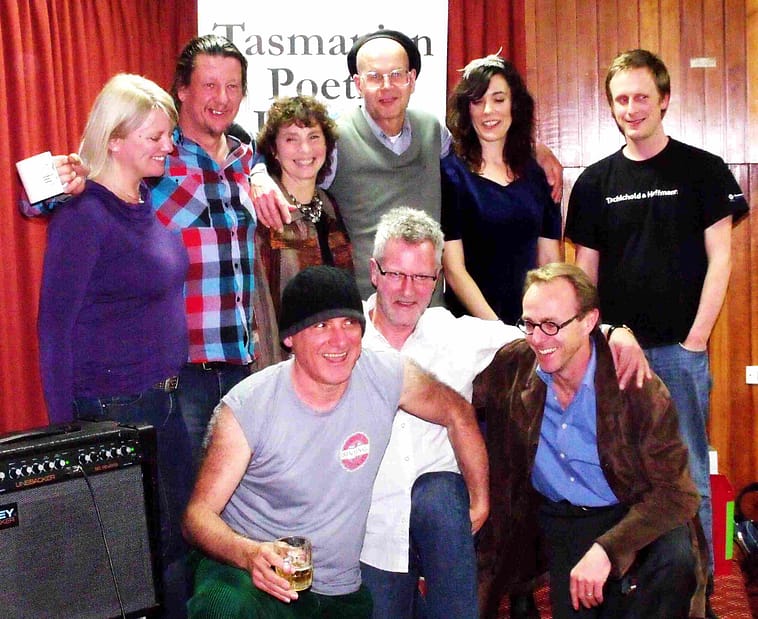
Myron Lysenko (back row, second from left)—Tasmanian Poetry Festival 2010
All their information was fifth-hand….
[Joan Didion: from ‘South and West’ (pg 34)]
“You-all ought to come visit with us,” a third woman said. They were all young women, the oldest among them perhaps thirty. “I’d play organ for you.”
“We’ll never get up there,” the first woman said. “I never been anyplace I wanted to go.”
(and, a couple of paragraphs lower down the page)
“The isolation of these people from the currents of American life in 1970 was startling and bewildering to behold. All their information was fifth-hand, and mythicized in the hand down. Does it matter where Taos is, after all, if Taos is not in Mississippi?”
Alice Allan—3CR’s ‘Spoken Word’
It was good hearing poet and podcaster Alice Allan in conversation with 3CR’s Waffle IronGirl on the ‘Spoken Word’ show, on the 20th October 2022.
Alice has published a couple of poetry titles—’The Empty Show’ (Rabbit Books), and the chapbook ‘Blanks’ (Slow Loris)—but considers herself primarily a podcaster. She produces the weekly podcast ‘Poetry Says’, an entertaining, erudite, often funny podcast with interesting writers—including Cassandra Atherton, Bonny Cassidy, Pam Brown, John Kinsella, Alison Whittaker, Ellen van Neervan, among others. Currently the podcast series has reached episode 197, it’ll be interesting to learn in due course, her plans for episode 200.
Alice notes the show has ‘evolved’.
‘Yeah. Well, I started it very much as a poetry beginner, six years ago, I think I’m even more of a beginner now than I was then’. She says she now fully understands the scope of what she took on back in 2016—back then, she had no idea. ‘I think it’s evolved because I can ask my guests better questions. I think I’ve grown a bit as an interviewer, and I can see the conversation more effectively now.’
What she loves most about putting the show together is that she gets to introduce people to poets beyond the bios that you’d find, for instance, in the back of Black Ink’s annual ‘Best Australian Poems’, (2003 to 2018). Previously she’d felt the world of poetry closed off to her, but these days ‘when I get to invite people onto the show, get to hear them um and ahh, laugh and make fun of themselves and read their poems in their own voice, that really excites me. I think about the version of myself where I started back in 2007. Understanding that these are people just like you and me.’
Asked by compere Waffle IronGirl about honesty and letting yourself ‘show’ … and about ‘perhaps even the dreaded word— (though) maybe dreaded only by me—authenticity,’ Alice responded appreciatively that she loved ‘that you underscore how difficult that word is—”authenticity”‘.
‘I’m playing a role to start with as the host,’ she explained, ‘but also with each interviewee. I come with a set of expectations, I often come with a lot of fear. I hope I’m getting better at digging a little bit deeper with people.’ (Here Allan remains customarily—but unnecessarily, in my opinion—modest; the relaxed and intimate podcast environment of ‘Poetry Says’ has triggered many delightfully ruminative exchanges—the following, for example, from a 2019 interview with poet Bonny Cassidy:
ALLAN: I remember talking to you around the time that Chatelaine was about to come out and you talked about feeling a certain level of separation from the work, even at that stage. I totally understand that now, with my own collection on the verge of coming out, it feels … so far away. And it’s a weird thing because you have this moment where it all publicly culminates, but actually in your world….
CASSIDY: It’s old news…
ALLAN: … it’s kind of over! So how do you feel about your three books?
CASSIDY: I think I’ve come to really own past work the past few years, such that it always feels very present to me. I’m very proud of it even though to me it is old and belongs to a certain phase of my writing, particularly with formative work, like when I look at Certain Fathoms now … there was a time when I’d look back on it and go … aaagh, I wish I could go back and revise it; or, hope no-one reads that now.
And I kind of got to a point where I thought, you really have to come to terms with that Bonny, you’ve got to stop looking at your first book and a) being so hard on it, and b) not really seeing it for what it is. I spent some time re-reading it and thinking ohh, okay, I see the DNA that goes from the first book through to the second and the third. And I honour that. Without that book, I wouldn’t have written the second one, without the second one I wouldn’t have written the third one, there’s this interdependency.… You can’t just cut it off and go, oh that was me then and let’s not talk about that now, that’s irrelevant. It’s not at all! It’s totally relevant. It’s an artefact, but … it’s something I made with thought and purpose, and it’s informed later work. It’s informed the ways that my three-and-a-half readers (laughs) might see my writing….
So I’m really fond of all the books, really fond of them. I don’t go back and re-read as a matter of course. I did think recently of doing that and maybe just setting aside a day—you know, maybe just spend this with my own words. I spend so much time consuming other people’s words day in, day out, maybe I should go back and just sit with my own, and be a reader of myself.
Roland Barthes has this statement about how the author can certainly go back to their own text, but they will only ever do so as a guest. And I really like that idea of going back and … you know … visiting your own work, and taking pleasure in it as a visitor—rather than going back with a cringe, or going back and seeing it as a kind of inscription of yourself. It’s not a tombstone!)
On the state of poetry and spoken word as it stands in Australia, Alice Allan says she’d ‘love for there to be more fun, love for us to play and laugh more’. She feels ‘very allergic personally’ to a serious strain she sees running through Australian poetry. ‘I don’t mind if it’s there. But I do mind if it’s all that’s there. I’m excited to see those moments where spoken word starts to inform poetry that purely exists on the page, by which I mean when we have a poet who is not thought of as—quote unquote—a spoken word poet, get up there and deliver their work in a way that cares about the audience. Don’t see that very often, though.’
Asked of what might be missing or deficient from the Australian podcasting scene, Alice is adamant: much is missing. ‘We need many, many more female voices. We need many, many more voices from people of colour.’ She recommends people check out the Barron Field experience, being made by Justin Clemens and his friends out of the Melbourne School of continental philosophy. ‘That show is nuts. Just three philosophers yelling at each other for way too long. And it’s fantastic. I want more shows like that, I want less production!’
And on the question of recommended reads, she singled out Eleanor Jackson’s ‘Gravidity and Parity‘ (Vagabond Press), a title that was shortlisted for the Small Press Network Book of the Year in 2022, and highly commended in both the 2022 Victorian Premier’s Literary Awards and the ASAL Mary Gilmore Award 2022. (‘As soon as I opened it and realized what she was doing, I was like, oh, hold the phone…. Yeah, it really blew me away!’); along with Harry Reid’s ‘Leave Me Alone‘ (‘I came to that book with exceptionally high expectations. And Harry has not let me down.’) She’s also had the chance to chat with Tracy Ryan a couple of months ago. ‘And I read pretty much everything of Tracy’s I could get my hands on in preparation, including “Rose Interior“, her tenth collection, out this year. She’s really a poet working at the height of her powers.’
Episodes of ‘Poetry Says’ are online at Poetry Says. 3CR’s interview with Alice Allan is online at Spoken Word.
Poetry London—the Poetry London Prizewinners 2022
Silvana Estrada, ‘La Corriente’ from the album ‘Marchita’ [Jan 2022]
Mexican musician Silvana Estrada—‘La Corriente’
[Thom Jurek, ALLMUSIC]—”…’Marchita’ is steeped in tradition but far from traditional. This album makes use of her entire musical background, including indie pop, classical, jazz, and Latin American folk traditions. It is rendered simply and directly, deeply influenced by the poetic tradition of women composers including Chavela Vargas, Violeta Parra, and Soledad Bravo.”
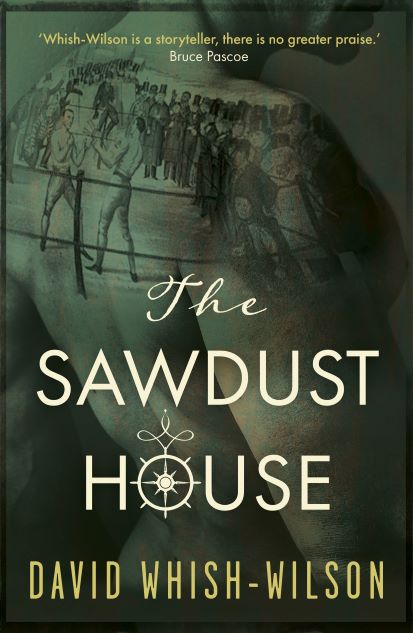
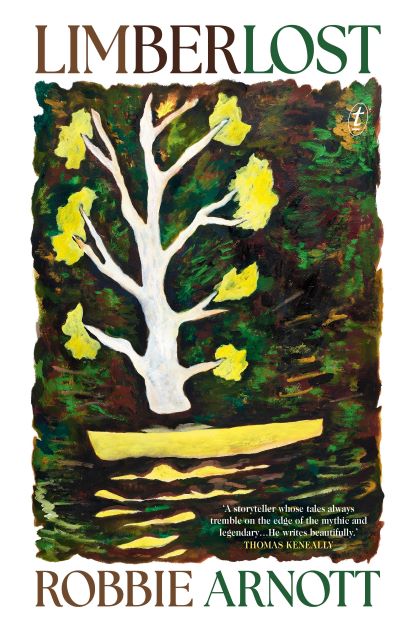
26th Oct: Robbie Arnott & David Whish-Wilson in conversation—Hobart
Robbie Arnott (author of ‘Limberlost’) and David Whish-Wilson (‘The Sawdust House’) in conversation about their new books.
Hobart Bookshop, 5:30 pm Wednesday 26th October
This is a double Author Event with David Whish-Wilson and Robbie Arnott talking to each other about their newly released books The Sawdust House and Limberlost.
The Sawdust House is a historical fiction set in San Francisco, 1856. Based on the true story of Australia’s first major sporting export, Irish-born James ‘Yankee’ Sullivan, a ‘notorious man’ formed in the crucible of the Australian convict system. Incarcerated by the Committee of Vigilance and watching his fellow prisoners being taken away to be hanged the convict tells a story of triumph and tragedy: of his daring escape from penal servitude in Australia; how he became America’s most celebrated boxer; and how he met the true love of his life.
In Tasmania in the heat of a long summer, Ned hunts rabbits in a river valley, hoping the pelts will earn him enough money to buy a small boat. His two brothers are away at war, their whereabouts unknown. His father and older sister struggle to hold things together on the family orchard, Limberlost. Desperate to ignore it all, Ned dreams of open water. Ned’s choices that summer come to shape the course of his life, the fate of his family and the future of the valley, with its seasons of death and rebirth.
David Whish-Wilson is the author of eight novels and three creative non-fiction books. He has been shortlisted for the Ned Kelly Award on multiple occasions and Sawdust House was recently long listed for the 2022 ARA Historical Fiction Prize.
Limberlost is Robbie Arnott’s third novel after his acclaimed debut, Flames (2018), and Miles Franklin shortlisted The Rain Heron (2020). Robbie Lives in Hobart.
About the event:
This is a ticketed event ($5.00) being held at The Hobart Bookshop on Wednesday the 26th October, where tickets include a complimentary glass of wine.
Francesca Haig’s new historical novel ‘Salt Blood’
October 10, 2022
Bloomsbury has pre-empted Salt Blood by poet Francesca Haig, a historical novel about the infamous 18th-century pirate Mary Read, in a six-figure deal.
Publishing director Emma Herdman signed UK and Commonwealth rights, excluding Canada and including audio, from Juliet Mushens at Mushens Entertainment in a two-book deal. Haig will be writing as Francesca de Tores. The book is slated for publication in spring 2024 and will be accompanied by a “major” marketing and publicity campaign.
Read more at ‘The Bookseller’
Rachel Edwards (left) in conversation with Francesca Haig—Fullers Bookshop, Hobart, 14th Dec 2016
Longlists announced, 2022 Tasmanian Literary Awards
The judges have selected longlists in the four book categories:
- Premier’s Prize for Fiction
- Premier’s Prize for Non-fiction
- Minister for the Art’s Prize for Books for Young Readers and Children
- Tim Thorne Prize for Poetry
For full details, visit Tasmanian Literary Awards 2022
The madman….
There’s a character in Anuradha Roy’s novel ‘Sleeping on Jupiter’. He’s mad, has no money, sleeps wherever he can find shelter. He cultivates a twig, plants it in the sand by the ocean, waters it with seawater, moves it to higher ground when the tide comes in and waves threaten his ‘plant’.
And then there’s another of her characters, the stallholder Johnny Topo.
The other day he had been gazing at the madman watering his dry twig and then making his day-long sorties into the water when he had abandoned his stall and printed off in daft pursuit. He wasn’t thinking, he hadn’t planned it, it was the end of a tiring stint, almost night, and there he was, racing the lunatic into the froth and back again, shouting nonsense, and then the two of them had laughed like hyenas and pissed into the sea side by side.
She’s a special talent, Anuradha….
A conversation with musician and photographer Jules Witek
‘At First Glance’ is a marriage of the writing of celebrated poet Karen Knight, and the photographic inventiveness of Jules Witek. The result is a captivating spectacle of words and images.
Jules discusses the couple’s forthcoming publication, along with plans for its launch.
Read more.
Canetti—’… more to be astonished by.’
The Paris Review mentions Elias Canetti, an extract that ends with the line
But the truth is that the more one has experienced, the more there is to be astonished by. Our capacity for wonder grows with experience, becomes more urgent.
‘Mississippi Moonlight’—Those Folk & The Inadequates
Came across another band I’m not familiar with, mentioned on Kim (Nielsen-Creeley’s) facebook page—enjoying their music. This is ‘Mississippi Moonlight’.
Raffle ticket?
Tony Rayner and Carol Easton at the 2022 Tasmanian Poetry Festival last weekend.
Only attended a couple of events, but they were terrific—lovely to see the festival come roaring back after covid….
Small Press Network: 2022 Book of the Year Award—Shortlist
This year’s shortlisted titles for Small Press Network’s Book of the Year Award have been announced. They are:
- No Document by Anwen Crawford (Giramondo)
- Friends and Dark Shapes by Kavita Bedford (Text)
- Hometown Haunts edited by Poppy Nwosu (Wakefield Press)
- Permafrost by SJ Norman (UQP)
- Gravidity and Parity by Eleanor Jackson (Vagabond)
- Theory of Colours by Bella Li (Vagabond)
- Sexy Tales of Paleontology by Patrick Lenton (Subbed In)
The BOTY 2022 winner will be presented in partnership with the Wheeler Centre as part of its Next Big Thing series, on 25 November 2022 at 6:30 pm. You can find the event details here.
I mention this in part cos it reminds me of entering Pete’s book in the award a couple of years ago, (and it won). I was asked to write something for use as part of the award presentation. I suggested yes I could (see below) but that I’d feel less comfortable reading it live. That’s okay, we can take care of that, I was told. (In the event, what I wrote was way too long and just a short segment was used)….
As to Pete….
One evening some years ago I was driving a taxi late at night, parked down in the vicinity of Hobart’s waterfront. Two women – tourists from New Zealand, I was to learn — climbed into the cab. They’d attended a literary event an hour or two earlier. They were cheerful and relaxed and happily exchanged literary perceptions of the evening in the comfort of the back seat of the vehicle. Generous and inclusive, they invited me to share their conversation, to which I responded by noting that for many Tasmanian writers —particularly those who wrote of the environment — a closer affinity was felt with the landscape of New Zealand than with the ‘… sunburnt country, A land of sweeping plains’ of Dorothea Mackellar’s Australia.
The pair asked if I could suggest the name of a praiseworthy Tasmanian writer, someone who’d perhaps slipped under their radar back home in New Zealand. I mentioned Pete, describing him as a poet and essayist and one of our country’s most respected environmentalists. Of the many reasons I might have offered in an appreciation of Pete’s work, I settled for just one — the fare was only running Salamanca to New Town, after all — and that was ‘generosity’. And I tried in my own words to recall for them a conversation years past when Pete had suggested ‘I don’t write because I think I’ve profound truths that other people would benefit from having exposure to. I don’t write to provide anyone with answers, I write to provide people with dilemmas. My essays – even my poetry lately – are written to set up tensions that are ultimately not resolved. I explore the tensions, but I don’t conclude.’
For their benefit, I’d have also mentioned — if the words had come to mind — Richard Flanagan’s support for Pete’s previous essay collection, Vandiemonian Essays, wherein Richard wrote, ‘All (these essays) are written with wit and without fear, with an erudition lightly worn, and with a pen dipped in a large love of this world. All can be read with both joy and curiosity… ’
It’s Richard’s allusion to ‘joy and curiosity’, coincidentally, that I’d recommend as an approach to Pete’s current essay collection, ‘Forgotten corners’ — that, along with an openness to being challenged, informed and entertained.
***
As the cab pulled to a stop, one of the women turned to me, remarking ‘I know it’s eleven-thirty in the evening, but I’m about to jump on the internet and learn a little more about Pete Hay — right now!’
The other leaned in towards me. ‘And I guarantee it, she will!’
‘See Me’ (referencing Martin Edmond’s blog ‘Isinglass’)
An extract from a post by Martin Edmond who continues to blog of exquisite abstractions:
…. Dylan goes on to sing: ‘Everybody that I talked to had seen us there / Said they didn’t know who I was talking about’ which is kind of apposite to my own attempts to re-visit the past, which tend to dissolve into phantoms and whispers, to two word sentences that no longer mean exactly what they say, that rely upon the intonations of beloved voices, now no longer with us, in order to be understood at all.
13 Oct—Graeme Hetherington book launch (Hobart)
The Divided Self: A Tasmanian Odyssey (Graeme Hetherington)
Hobart Bookshop, 5.30pm, Thursday 13th October
Ralph Spaulding will launch Graeme Hetherington’s new poetry book ‘The Divided Self: A Tasmanian Odyssey. This is Graeme’s ninth poetry collection and portrays the poet’s troubled journey to escape an “afflicted self” shadowed with loneliness and paranoia.
Tautly crafted short stanzas with references and images connoting blackness, punishment and curse, such as Mount Black’s shadows on Tasmania’s West Coast, the cat-o’-nine-tails, Coleridge’s albatross and the scourge of Christ’s crucifixion, convey the depth of the poet’s despair. Despite the poet’s desire to escape the “darkness of the past”, the reader senses that the power of his personal psychological drama will challenge his search for transcendence. The poet will certainly continue to seek poems that “soar beyond” the theatre of the self, but they will provide perhaps only temporary respite as he continues to experience personal uncertainties and pain.’ – Ralph Spaulding
About the event:
This is a ticketed event ($5.00) being held at The Hobart Bookshop on Thursday the 13th October, where tickets include a complimentary glass of wine.
Click Here to Book your tickets
08 Oct 2022—Thérèse Corfiatus, book launch (Ulverstone)
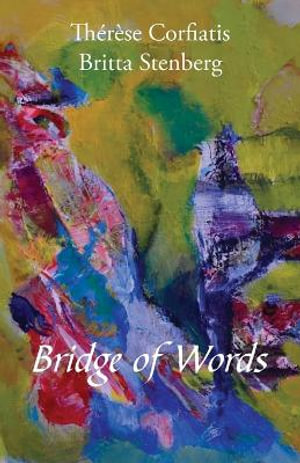
A new poetry collection, Bridge of Words—a collaboration between Thérèse Corfiatis of Ulverstone, and Britta Stenberg of Sweden—will be launched by Fay Forbes at the Red Cross Hall, 49 King Edward Street, Ulverstone, 2-4pm Saturday 8th October, 2022.
Thérèse is a featured guest of this month’s Tasmanian Poetry Festival (Launceston 30th Sept / 2nd Oct), while Britta—if I’ve interpreted google maps correctly—lives in the isolated town of Rentjarn, a community of some 71 souls in Sweden’s north.
I’m reminded of a 2006 writing collaboration between Karen Knight and Scottish poet Delys Rose, imagining the similarities of their experiences with those of Thérèse and Britta. Karen—from her home in Hobart, and Delys, comfortably ensconced in Scotland—were writing a poem a month. ‘Neither of us was particularly keen on formal stipulations and have found that the more open the remit, the better the results,’ wrote Delys at the time. ‘We began very simply with a poem about midsummer/midwinter because it was happening, at the moment we committed ourselves. It’s been a great way to keep up a long distance correspondence, not to mention generating new work.’
A key difference is that Karen and Delys had already met in Australia; and some time later, Karen travelled to visit Delys in Scotland. Britta and Thérèse have never met, though perhaps that will change. In one of the pair’s many online conversations (as reported by the ABC here), Britta suggests that it’s been exciting to get to know Tasmania and Therese. “Bye-bye from Sweden, come and see me some day.”

07 Oct 2022—book launch, Kevin Brophy (Melbourne)
Brunswick Bound, an independent bookstore in the heart of Sydney Road in Brunswick, Melbourne, celebrates the release of Kevin Brophy’s latest collection of short fiction: The Lion in Love.
The event is free to attend—RSVP to info@brunswickbound.com.au
…
06 Oct 2022—book launch, Robbie Arnott (Hobart)
Shambles Brewery, 222 Elizabeth Street, Hobart Tas 7000.
Thursday 6th October, starts at 6:00 pm, launched by Senator Peter Whish-Wilson.
Tickets $10 from Fullers Bookshop
In the heat of a long summer Ned hunts rabbits in a river valley, hoping the pelts will earn him enough money to buy a small boat.
His two brothers are away at war, their whereabouts unknown. His father and older sister struggle to hold things together on the family orchard, Limberlost.
Desperate to ignore it all—to avoid the future rushing towards him—Ned dreams of open water.
As his story unfolds over the following decades, we see how Ned’s choices that summer come to shape the course of his life, the fate of his family and the future of the valley, with its seasons of death and rebirth.
The third novel by the award-winning author of Flames and The Rain Heron, Limberlost is an extraordinary chronicle of life and land: of carnage and kindness, blood ties and love.
04 Oct 2022—Tamar Valley Writers Festival, Youth Program (Launceston)

… indiscriminately distributed
‘But Johnny Topo now had other customers and was asking if they wanted the sweet biscuits or the salty ones in exactly the tones he had put those questions to Latika and Gouri. Latika turned away, disappointed that his voice was so indiscriminately distributed. Her discontent returned and she wished again that her tea were coffee.’
Anuradha Roy, ‘Sleeping on Jupiter’ (2015)
Vale Hilary Mantel
British author Hilary Mantel, who won the Booker Prize twice for the first two books of her Wolf Hall trilogy, has died aged 70.
I confess to not being familiar with her work, but her obituary speaks of her capacity for the historical novel—including the Wolf Hall trilogy wherein she writes of the 16th Century during the time of King Henry VIII and Thomas Cromwell. (Hans Holbein the Younger painted the portraits of many characters of English history of this period including both King Henry VIII and Cromwell, hence my interest).
‘The Times’ remarks on her writing….
We hacks, even us literary ones, like to think of ourselves as a hard-bitten bunch, but the news that Hilary Mantel had died aged 70 knocked us back. What a woman, what a writer. Those of us who have read her Wolf Hall trilogy, all 2,000 pages, will feel it
particularly keenly.
The Wolf Hall trilogy
It feels unlikely that there are many readers out there who haven’t yet been swept up by the bloody brilliance of the Thomas Cromwell trilogy. Across three hefty novels, Mantel conjured up the splendid, tyrannical court of Henry VIII through the shrewd eyes of Thomas Cromwell, the blacksmith’s son from Putney who rose and rose to the King’s right hand. Until Mantel, history remembered Cromwell as a butcher but she made him real — brilliant, humane, ruthless. The trilogy comprises ‘Wolf Hall’ (2009), ‘Bring Up the Bodies’ (2012) and ‘The Mirror & the Light’ (2020).
It’s interesting though, to read—in the comments column accompanying ‘The Times’ article—the varied responses to news of her death. These range from
‘A tragic loss, she was a wonderful writer and not afraid of controversy’, to
‘she failed the basic test of the historical novelist, namely to portray convincingly the interior lives of people who lived a long time ago’, and
‘Patrick O’Brian is a far better master of history’, and
‘Her misrepresentation of St. Thomas More, who died for his beliefs at the hand of the murderous Henry VIII, is a prime example. I wonder how many readers of “Wolf Hall” came away believing More actually was the corrupt villain she created.’
Food for thought…. (Have ordered the first book of the trilogy through the library).
The ABC’s ‘My Garden Path’—Rob Blakers
‘My Garden Path—We head down the garden path with Rob Blakers, a photographer whose love of natural places has inspired the garden he cultivates for his local community.’
Blakers is renowned in Tasmania for his iconic wilderness photography. I recall witnessing him with his camera, many years ago, at a public meeting in Hobart which debated forestry and environmental issues, where various industry and conservation representatives argued their views. When at one stage a particular industry representative addressed the audience, Blakers appeared demonstrably upset at the words he was subjected to listen to.
I picked him up in my taxi once, years later. He’d been filming near Bonorong Wildlife Sanctuary, north of Hobart, and was heading back into the city some thirty kilometres away—a good fare, time enough to talk. I mentioned my time working in the forest industry, how I recalled noticing him with his camera that evening of the forestry / environment debate. He probably figured me for a fence sitter—and why not?—but continued comfortably chatting.
Blakers is a skilled photographer, particularly of the Tasmanian environment; this particular ‘Gardening Australia’ segment reveals that environmental photography isn’t a singular preoccupation but merely one strand of a many-storeyed way of life. ‘Activism is seeing what we’re not doing right, and saying stop—and in advocating, pushing towards, better directions,’ he says. ‘Growing one’s own food engages you with the natural world.’ The garden setup allows neighbours or friends or anyone who’s heard about it, to come along with a box—‘or I can supply a box!’—and pick their own herbs and veggies.’
‘From my side I’m just trying to maintain the diversity in the garden, maintain the level of pickable veggies, so that any time people come they’ll have a seasonal selection. People pay thirty bucks for a box. Essentially it’s just a break-even, there’s cost involved in a garden like this … there’s water, there’s seeds, there’s compost soil, there’s fencing, repairs … there’s always ongoing costs, so if we can break even on that—which we have done—it’s just a win-win all round.’
…………………………..
Angélique Kidjo—Tiny Desk Concert 12th Sept 2022
Twenty minutes of energy with Angélique Kidjo for NPR’s tiny Desk Concert.
Snuggle Up with Spineless: ‘Ecliptical’—featuring Hazel Smith
A Spineless Wonders Youtube presentention of—readings by Hazel Smith, a presentation by Roger Dean, a conversation between Hazel and Anne Brewster, and a talk by Joy Wallace. The event took place in June 2022 and was placed online on 25th August and is available for viewing here. It’s 1 hr 28 min in length.
ANNE BREWSTER
I’ve been reading Ecliptical and enjoying it a great deal, and I noticed at the beginning of the book you comment several times that poetry is a kind of archaic literary form, and you question somewhat whimsically about whether people actually read poetry or not. And if this is so, why do you write poetry, and what does it offer for you?
HAZEL SMITH
I think what attracts me a great deal about poetry is the enigmatic and chameleon qualities of language. The fact that a word can mean so many different things—it’s very exciting to explore and exploit that. I also love the interweaving of sound and sense that you get in poetry. But, there is a lot more to it than that, I think that there’s something much more fundamental—which is that I feel that poetry is incredibly flexible, mutable. There is so much that you can do with the form—you can stretch it in so many different ways. This is something that I love to do. I love to hybridize poetry with prose, with writing for performance, with writing for the screen. I love to bring poetry together with visual images, and with music.
It just gives me enormous scope to do what I want. And it really suits me because I like to have a very varied style of writing. I like to write in a very heterogeneous way, rather than a homogenous way. poetry really gives me a space to do that.
AB
And what about the title of the book, ‘Ecliptical’…. this evokes ideas of eclipse and ellipsis. And you seem quite interested in the idea—the act of—not seeing everything. For example, when you talk about personhood—which you do quite a lot—you’re very interested in these concepts of incompleteness and disruption.
HS
Yes, I think we never really do see the whole of everything, we never really have the full story about anything. People often house secrets, or they withhold information—they withhold information in families and sometimes it’s for generations. So we’re not in control of all the facts about something, we’re always wondering a little bit. And I like to present my material like that, I like to present my material in a very enigmatic way. I don’t want to fill in all the details. And I want to raise questions rather than answering them.
Ecliptical addresses contemporary psychological, ethical and philosophical issues including family secrets and tensions, private and public creativity, the enigma of time, surveillance, fake news, environmental damage and homelessness.
Ecliptical includes prose poetry and short prose; texts that are synaesthetic, sonic or linguistic explorations, surreal excursions and ‘bullet point’ adventures in which each line unveils a new observation. Other pieces employ non-literary forms or include documentary or remixed elements. Ecliptical also flirts with the posthuman in some collaborative computer-assisted poems.
Anuradha Roy interview, ‘The Rumpus’ (Aug 2022)
Roy’s fifth novel, ‘The Earthspinner’, was published in 2021. She spoke with Janet Rodriguez for an interview published in August 2022 in The Rumpus.
Three questions & responses from the interview—
(on writing poetry)
Rumpus: Your words are so elegant, I am sure you write poetry . . .
Roy: I don’t write poetry, actually! I have never been able to, but I have always read poetry.
(on identity and loss)
Rumpus: Regardless of how you categorize the book, The Earthspinner is a deeply gorgeous work of fiction. I found it to be filled, like your other books, with themes of identity and loss. Why do you think these show up in your writing?
Roy: A poem I used to know almost line for line was Elizabeth Bishop’s witty and wise “One Art” where she goes from the loss of inconsequential objects to the great, irreparable loss, of someone she loves. The fear of loss, the inevitability of loss—it’s a universal theme. As for identity, this has become so politically charged for most of us in the world these last few years that it’s difficult to escape addressing it.
(on relationships across religious divides)
Rumpus: Sara remembers the time of this violent upheaval as the same time she learns how to spin pottery. In her small village, a Hindu man named Elango, the local artisan potter, agrees to mentor her. Elango is in love with a Muslim woman, Zohra, which is another politically charged issue. There’s a Romeo and Juliet quality in Elango and Zohra, isn’t there? They almost don’t understand the danger of their union, do they?
Roy: Everyone who lives in India is aware of the extreme danger of loving across the religious divide, and yet people do it. That’s one thing that hasn’t changed since Shakespearean times. Elango knows the dangers in relation to Zohra but carries on anyway.
Which is simply to say, IMHO, Anuradha Roy is well worth a read. Below, from ‘Sleeping on Jupiter’:
He had idled near the temple for only a little while when Hari, another temple guide, tapped his arm saying, “Bhai, Badal. I need to leave – something urgent – and I’ve two people waiting for me. You take them to the temple, give them a quick round.”
Luck appeared to be on his side. It had to do with his early morning glimpse of shirtless Raghu, he was certain. Or perhaps it was those ten rupees and prayers at the old woman’s shrine. He remained carefully unsmiling and continued chewing his samosa. Between bites he said, “I’ve no time, got another group soon. And in the afternoon I need to get home.” He had no work till evening, but Hari did not need to know that. He looked towards the temple gates. he must not let Hari’s clients escape. He had to slow it down to extract as much as he could from Hari, but not too much.
Eureka Street—Vol 32 No 16 (2022)
Eureka Street, published by Jesuit Publications, was founded in 1991—a print magazine for fifteen years that went online from 2006. It was edited by Morag Fraser from 1991 to 2003, and is currently edited by David Halliday.
In an interview in 1995, Richard Flanagan voiced the opinion that “Eureka Street has been a huge success story because it uses short thoughtful articles by interesting people on good subjects, and has a bloody fine editor. And Australian Book Review actually debates literary issues in a way that’s readable and intelligible.”
Eureka Street has uploaded in excess of a hundred youtube interviews with individuals including Morag Fraser, Fr. Frank Brennan, Geraldine Doogue, Kristina Keneally, Stephanie Dowrick, Michael Kirby, Robert Adamson and Hugh Mackay. David Halliday’s December 2021 conversation with Morag Fraser delves into the reasons behind, and problems encountered in, setting up the journal in the first place.
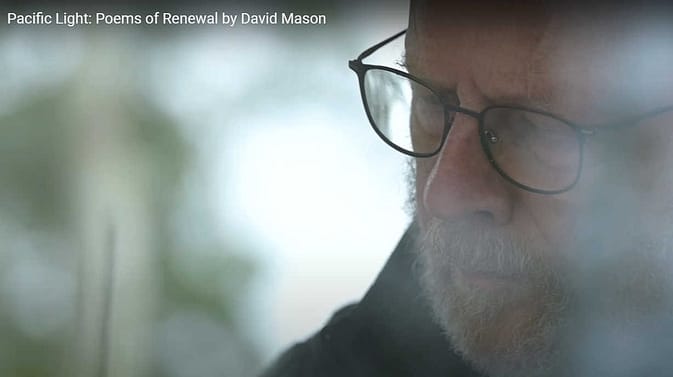
Anna Cadden’s film—’Pacific Light: Poems of Renewal by David Mason’
‘Pacific Light: Poems of Renewal by David Mason’, a film by Anna Cadden with underwater photography by Cally Conan-Davies, is a meditation on life, work, poetry and the soul. Poems are from David’s book Pacific Light (Red Hen Press, 2022), available through https://bookshop.org/books/pacific-li…
David Mason was born in Washington State, forty-odd degrees north latitude, and now lives on the Australian island of Tasmania, forty-odd degrees south latitude. That Pacific crossing is the work of a lifetime of devotion and change. The rich new poems of Pacific Light explore the implications of the light as well as peace and its opposing forces. What does it mean to be an immigrant and face the ultimate borders of our lives? How can we say the word home and mean it? These questions have obsessed Mason in his major narrative works, The Country I Remember and Ludlow, as well as his lyric and dramatic writing. Pacific Light is a culmination and a deepening of that work, a book of transformations, history and love, endurance and unfathomable beauty, by a poet “at the height of his powers.”
The film—23 minutes in length—is a very thoughtful, professionally-designed production, & I particularly enjoyed listening to David’s reminiscences of how he’s configured ways to live a life….
[DAVID MASON] ‘I don’t really have ideas so much as I have sensations. Keats said, “Oh for a life of sensations rather than of thoughts”, and I suppose to a very great degree that’s the way that I live as a poet. And what I try to do is define the words that are going to match those sensations and the rhythms I’m feeling, the sounds….’
[INTERVIEWER] ‘So—what is to you, the work of poetry? What is its purpose, in a way—if work gives us purpose, what is the job that poetry does in this world?’
[MASON]: ‘There are several different things. One is what it does for the poet’s life. I think it’s DH Lawrence who said, “I write so that I will not lose my life”. So one feels as if one is trying to live more fully, or relive more fully—you want more life. You want to live more—by observing more, writing more, seeing more, and all that….’
‘I don’t write just for myself. I write to speak to other people, and to speak across time to people I’ve never met about what it’s like to be alive in the world. I want to make memorable speech out of this, maybe even memorable song out of this. Which means, that to some extent, we write to face our mortality. Or we are always facing our mortality when we write. We’re always thinking about what it means to speak through that death and across that death, into another time, and to other people.’
David will be appearing as a guest of the Tasmanian Poetry Festival in Launceston at the end of the month.
Tasmanian poet Tim Slade, reading ‘Thylacine’
Tim Slade’s been writing poetry for a decade, his work has appeared in publications as diverse as The Weekend Australian, The Koori Mail, Australian Poetry Anthology, Growing Up Disabled In Australia and Cordite Poetry Review. Originally from Hobart, he settled in the tiny Tasmanian town of Pioneer a decade ago where he’s drawn inspiration for much of his poetry.
Tim’s poetry collection The Walnut Tree, was published in April 2021 by Daniela Brozek Cordier’s imprint Bright South Publishing, and launched by Pete Hay at Petrarch’s Bookshop, Launceston.
Tim Slade at the launch of The Walnut Tree
Coincidentally, both Slade and Hay—in their most recent collections—praised the work of a Scottish poet who lived out his life on a far flung island on the opposite side of the globe, Orcadian George Mackay Brown. Honouring Brown, Tim mailed a copy of his book to the local library in Stromness, Orkney Islands, where the book is now available to borrow. ‘On the harbour in Stromness, the view from this library is perhaps the most picturesque in the world,’ Tim writes.
Tim recently produced a Youtube video of ‘Thylacine’, one of the poems featured in his collection. As well, Warwick Hadfield read the poem on RN’s Breakfast programme in July this year. ‘Thylacine’ was previously published in Communion 15.
Otoliths # 66
When introducing issue sixty-six of online lit journal ‘Otoliths’ some weeks back, Mark Young noted that following the next issue, ‘there will be another four issues of Otoliths & then the journal will close with issue seventy, the southern winter 2023 issue.’ Which is a blow for writers & readers…. Founded in 2006, ‘Otoliths’ experiments wildly, offering opportunity for exciting writing & artwork, open—as the journal defines itself in ‘Duotrope’—’to all/most styles and topics, including experimental and literary.’
The current issue, no 66, is available online at otoliths.
Uluru Statement from the Heart: Sydney Peace Prize winner 2021—2022
On 3rd August 2022, the Australia Institute posted both a video, and a transcript, of a conversation between Pat Anderson, Professor Megan Davis and Archie Law about the Uluru Statement from the Heart and its three objectives: a Voice to Parliament, Treaty, and Truth.
Beginning of the conversation, host Ebony Bennett asked about the process that led to the Uluru Statement from the Heart.
In response, Pat Anderson noted that ‘we’ve been doing this since before 1840.’
‘Every generation of us has had a go at getting us to be acknowledged and accepted and
respected as the first peoples of this beautiful continent of ours. We’ve been here. The latest figure, our bridge over 100,000 years. It’s commonly said to be 65,000, but of course, that’s what the scientists say. But for us, we believe we have always been. We didn’t come from anywhere else. This is definitely, absolutely our place over millennia….’
For access to the conversation, visit the Australia Institute.
Liminal
Liminal —an anti-racist literary platform—is an online space for the exploration, interrogation and celebration of the Asian-Australian experience. Founded by Ling Jing McIntosh in late 2016 and perhaps best known for its focus on interviews with Australian arts practitioners, Liminal showcases creatives from a wide range of creative disciplines— literature, visual arts, music, dance, journalism, and more.
Red Room—Showcasing Tasmanian poetry and musicians. Mona, 27th August
Red Room Poetry Month features an afternoon of free entertainment at Mona in Hobart, Saturday 27th August at 1-2.15pm.
Come for the art, the architecture, the aesthetic, stay for the poetry. In partnership with MONA, come along to see/hear/feel some of Tasmania’s finest wordsmiths and spoken word artists including Esther Ottaway, Rebecca Young, Rohan King, Kathryn Lomer, Damon Young, Warren Mason and hosted by Bert Spinks plus live music by acclaimed troubadour Ben Salter and sets either side by legendary local jazz ensemble the Spike Mason Quartet.
Rebecca Young, performing at the 2020 Tasmanian Poetry Festival, Launceston. (March 2020)
Other work:
04 Sep 2003: Sarah Day’s launch of Kathryn Lomer’s ‘Extraction of Arrows’ (University of Queensland Press)
01 Dec 2003: Tim Thorne’s review of Kathryn Lomer’s ‘Extraction of Arrows’ (University of Queensland Press)
27 Feb 2014: Philomena Van Risjwick’s launch of Kathryn Lomer’s ‘Night Writing’ (University of Queensland Press)
27 May 2021: Jane Williams’ launch of Esther Ottaway’s ‘Intimate, low-voiced, delicate things’ (Puncher & Wattmann)
Kathryn Lomer, with Ray Liversidge and Nathan Curnow. (Queensland Poetry Festival, 2012)
Vale David Ireland
Saddened to learn of David Ireland’s death last month.
He was awarded the Miles Franklin Award on three occasions, for his novels ‘The Unknown Industrial Prisoner’ (1971), ‘The Glass Canoe’ (1976), and ‘For a Woman of the Future’ (1979).
Professor Van Ikin penned a farewell to Ireland at ‘The Conversation’, including his recall of an early meeting with Ireland:
As a young Sydney Uni postgrad in 1976, I met Ireland in his tiny Sydney writing pad and inadvertently opened a door to an empty low-lit room. The floor was carpeted with card-sized slips of paper, some of which fluttered up and relocated upon my entry.
“Sorry, not that door,” said Ireland, and proceeded to explain that his novels evolved from scenes and images, each jotted onto a card. (The Unknown Industrial Prisoner is composed of 330 of these.) He would arrange and rearrange them on the floor, mosaic-style, in a process that was allowed to take however long was needed.
Damon Young — Red Room Poetry
DAMON YOUNG — RED ROOM POETRY MONTH
Red Room Poetry features Hobart-based poet Damon Young this weekend as part of Poetry Month. And as I read his lines
‘… publisher / with a passion for bold voices / like his.’
… I wondered whether (interpreting the words ‘like his’) I might read myself into them, and decided — regrettably — I could. And found myself returning to fallout from the Peter FitzSimons / Jacinta Price interview (behind a paywall) in the ‘Sydney Morning Herald’ of a week or two ago. Is Price a conservative? Definitely. Do I feel on side with FitzSimons with his view that Aboriginal Australians have been wronged? Definitely. Have I sympathy for Price’s statement that she’s entitled to her views as a Black conservative woman? How can I not? As a result, I’m not at all sure where that leads me, or leaves me…. I’ve never particularly understood the attraction of being ‘politically conservative’, though I remember an experience back in 1982 handing out ‘How to vote’ cards for Labor’s John Cain in the Victorian state election, and offering one to a young, sharply dressed woman in the street. I distinctly recall the look of sheer displeasure that crossed her face—as if anything left of liberal was simply too painfully repulsive to contemplate.
Martin Flanagan reflects on current and future currency of the term ‘conservative’ in his book ‘The Art of Pollination’, relating an exchange with Malcolm Fraser. Flanagan writes,
‘I visited Fraser’s city office shortly after I wrote my essay against torture. It was on his desk when I entered his office. “Read your essay,” he said, in his clipped, patrician way. “It’s good, but I think you’re too late.” And on that subject, as on all subjects of public import that I discussed with him, his knowledge was encyclopaedic. To my mind, he was a conservative humanist. One of the political battles facing us in the immediate future is wresting the word conservative back off people who are actually reactionaries wishing for twentieth century certainties that no longer exist.’
Italian pianist and composer Ludovico Einaudi: Tiny Desk Concert
Lucovico Einaudi performing for NPR Music’s Tiny Desk Concert on a visit to the United States—15th July 2022.
Mary Blackwood — book launch, Hobart: 22nd June
Alex Skovron on 3CR this morning
Alex in conversation with Di Cousens, recalling an early poetry submission….
“One of my very first submissions was from Sydney. It was to ‘Poetry Australia’, and at that time Les Murray was editing. I sent a bundle of poems representing those early ten years of my poetry writing but towards the later phase of that, poems I thought were good enough to try to submit. And Les Murray eventually sent back the bundle of poems with a wonderful comment, he said ‘I can’t quite like these enough, though there are felicities here’. That was in one way a rejection but in another it was encouragement. And I didn’t take it as a rejection, because I knew I had a fair way to go and I needed to refine not only what I was writing but my whole approach to poetry if I wanted to be serious about it.”
[3CR, the Spoken Word Show, 19th May 2022]
Book extract, Tad Friend’s ‘In The Early Times’
from ‘Literary Hub’, May 11th 2022
When Day poisoned his tea with five heaping spoonfuls of sugar, Addison warned him that his teeth would fall out and that he’d get diabetes—one of her periodic public service announcements denouncing meat, cigarettes, and hypocrisy. He just scowled at her. She scoops out half his sugar when he’s not looking, but he recoups it later in cookies. He doesn’t fret about getting diabetes because he has leukemia, and he doesn’t fret about having leukemia because he is determined to be a stoic, and he doesn’t fret about failing to be a stoic because he doesn’t always remember that that’s what he’s supposed to be.
Fullers Poets — Mary Blackwood & Liz McQuilkin: 12th May (Hobart)
Fullers Poets is a new event series celebrating contemporary poetry. The first event in this series will feature poets Liz McQuilkin (Unwrapping Clouds) and Mary Blackwood (Small Cosmos) in conversation, with readings from their work.
Praise for Liz McQuilkin:
‘Liz McQuilkin has Mary Oliver’s ability to show us ordinary, yet extraordinary, moments in the natural and human worlds. I love her sharing of reflective moments, and her pellucid, deeply moving observations on births, deaths, and the journeying between.’ – Esther Ottaway
Praise for Mary Blackwood:
‘Mary Blackwood writes with power and precision. She takes a razor to the times in which we live, slicing away the dross and the cant. She gifts us poetry that is deft, sure, laden with insight. If a poet’s task is one of linguistic distillation, a paring down to lay bare the diamantine essence of things, then here is a poet of the very first order. Read these poems – see what language can do.’ – Pete Hay
To Observe that Kind of Devotion: A conversation (Camille Dungy and Major Jackson — ‘Orion’)
(Published recently in US literary journal ‘Orion Magazine’: read the full interview)
Camille: One of the things that is most exciting to me about all the best writing going on right now, all politically engaged writing (and I think environmental writing has always been politically engaged) is how it requires a roving eye. A roving eye can work well at a distance far enough to accommodate a number of different nonrelated possibilities as data points, as touchstones, to show a kind of commonality. How a writer can connect firestorms and blizzards and tornadoes, and also questions about police, and whatever might happen in whichever elections are coming up, and how all of these themes are interconnected. And poetry is a place that through metaphor, through image, through just pure fantastical language, and the beauty of alliteration, you can gather these themes, these spinning planets that seem to be millions of miles apart, and make them into a connected galaxy. Poetry can bring all these seemingly disparate things into one space, and that’s one way it can be politically useful, can help change minds, can help us see ourselves differently, and expand how we understand the world.
Art can help both slowly and quickly. Major fast change can happen in response to writing. We have examples of that. But there are also those slow centuries-long glacial-pace changes, too. But glaciers shape landscapes, right? A glacial pace can be as important as a lightning-fast pace. I think that is the responsibility of poets, of editors—to be able to put the poems into place so they can spark change at any pace.
Camille T. Dungy has authored an essay collection and four poetry collections, most recently Trophic Cascade. She has edited three anthologies, including Black Nature. Dungy is a distinguished professor at Colorado State University, and Orion’s poetry editor.
Major Jackson is the author of five books of poetry, most recently, The Absurd Man. His edited volumes include: Best American Poetry 2019, Renga for Obama, and Library of America’s Countee Cullen: Collected Poems. A recipient of fellowships from the Guggenheim Foundation and National Endowment for the Arts, he has been awarded a Pushcart Prize, a Whiting Award, and has been honored by the Pew Fellowship in the Arts and the Witter Bynner Foundation in conjunction with the Library of Congress. He is the Gertrude Conaway Vanderbilt Professor of English at Vanderbilt University, and the poetry editor of Harvard Review. He is also an Orion board member.
‘Otoliths’: issue 65, southern autumn issue
Issue sixty-five of Otoliths, the southern autumn 2022 issue, is now up.
This issue, which marks the beginning of the seventeenth year of the journal’s existence, contains a mix of — sometimes mixed — photographs, paintings, short stories, poetry, interviews, magazine columns, & manifestos from an international contributor list including Karl Kempton, Linda King, Mark Pirie, Dario Zumkeller, AG Davis, Mark Cunningham, Sanjeev Sethi, Ken Friedman, Demosthenes Agrafiotis, James Cochran, Jim Leftwich, hiromi suzuki, Michael J. Leach, Elancharan Gunasekaran, Louise Landes Levi, KJ Hannah Greenberg, Chuck Joy, Marco Giovenale, Jimmy Crouse, Andrew Cyril Macdonald, Nicholas Alexander Hayes, Mario José Cervantes, Timothy Pilgrim, Alan Catlin, Paul Ilechko, Jim Meirose, Adam Fieled, Gregory Stephenson, John Sweet, Sterling Warner, Jack Galmitz, Lynn Strongin, Texas Fontanella, Richard J. Fleming, Sarah Bilodeau, M.J. Iuppa, John M. Bennett, Carla Bertola & John M. Bennett, Harvey Huddleston, bofa xesjum, fred flynn, John McCluskey, Ben Egerton, John Gallas, Nathan Whiting, Laurent Grison, Volodymyr Bilyk, Xe M. Sánchez, Ellen Wardman, Barbara Parchim, Bruce Robinson, Jeff Bagato, jim mccrary, Gale Acuff, Grzegorz Wróblewski, harry k stammer, Howie Good, Jen Schneider, Alberto Vitacchio, richard lopez & Márton Koppány, Heather Sager, Keith Polette, Michael Basinski, Luis Cuauhtémoc Berriozábal, Daniel f Bradley, Dave Read, Robert Beveridge, Tom Beckett, Mary Kasimor, Connor van Bussel, R. S. Stewart, Tony Beyer, Daniel de Culla, John Levy, Joanne Bechtel, Kenneth Rexroth, Nathan Anderson, Jeff Harrison, Bill Wolak, Clara B. Jones, Nicole Raziya Fong, Charles A. Perrone, Russ Bickerstaff, Paul Dickey, Sabine Miller, Keith Nunes, Diana Magallón, Bob Lucky, Cecelia Chapman & Jeff Crouch, bart plantenga, Joshua Martin, Jillian Oliver, Réka Nyitrai, Marilyn Stablein, Jerome Berglund, Christopher Barnes, Peter Cherches, Jürgen O. Olbrich & Hubert Kretschmer, Kay Kestner, Cameron Morse, Eric Hoffman, Gavin Lucky, Kiriti Sengupta, Patrick Sweeney, Robin Wyatt Dunn, Jane Simpson, Elmedin Kadric, Kit Kennedy, Steven Tran, dan raphael, Andrew Taylor, Charlotte Jung, Michael Borth, Carol Stetser, Penelope Weiss, Marcia Arrieta, John M. Bennett & Jim Leftwich, Márton Koppány, Rich Murphy, Cecelia Chapman, J. D. Nelson, Kit Willett, Angelo ‘NGE’ Colella, H. A. Sappho, Martin Stannard, Michael Brandonisio, Paul Pfleuger, Jr., Katrinka Moore, David Jalajel, Keith Higginbotham, Susan Gangel, Judith Skillman, Bob Heman, & Guy R. Beining.
Vale: Chris Bailey
Stranded — The Saints, 1976
Launch: David Webby’s children’s book (March)
David Webby’s ‘The Misadventures of Harry and Larry: The Chosen Ones’
Launch — Hobart Bookshop (youtube: 3mins 09 secs)
Two bush Mice, Harry and Larry, from the Bunya Mountains become trapped in a 4WD owned by two humans, known as Charlie and Izzy Humbledink, and are thrust into an exciting adventure all the way up the east coast of Australia. On the way, Wilmar, Queen Mother of all Humpback Whales in the vast ocean, reveals to them the Prophecy that they are the Chosen Ones that will save the world.
What does this mean?
How can two simple bush Mice change the way humans think and act?
Find out as Harry and Larry travel with their human friends to explore the lush landscape of the tropical north of Australia; they also survive some often-scary encounters with local inhabitants, and they call on the skills gained in Mouse Scouts to get them out of trouble. This is a pair of Mice who find that there is more to life than they knew, and destiny was not an easy way to discover their worth…come on an adventure and share the fun and learning with Harry and Larry!
AUTHOR BIO
David was born in New Zealand, but during a working holiday in Australia in 1984, he decided Australia was the place for him, and has lived here ever since. In early 2017, he and his wife moved to Tasmania, and settled in the beautiful Huon Valley with their two labradoodles. David is a podiatrist by trade, and enjoys bushwalking, photography, gardening, and bee keeping. His inspiration to write comes from his love for trees and wildlife, and his memories of childhood exploration. He includes a richness of history and culture in his writing that has come from extensive travels, both within Australia and overseas.
ABOUT THE ILLUSTRATOR: M. K. PERRING
After traveling all over the world before moving and living in Australia I’ve always had a passion for the creative arts, going straight into film and television for secondary education. After improving my skills for a few years independently, I came across University to advance my skills in filmmaking and Animation. I started working on a personal project on YouTube accumulating over 2.5 million views collectively with a fan base dedicated to my storytelling and character design. Having finished a Bachelor of Animation, I am constantly exposed to creative environments and learning more programs and methods while working in teams to be ready for industry.
Notes from a launch: Esther Ottaway’s ‘Intimate, low-voiced, delicate things’
My take on Jane Williams’ launch of Esther Ottaway’s poetry collection ‘Intimate, low-voiced, delicate things’ in Launceston last year — please visit here.
‘I’ve been a fan of Esther Ottaway’s poetry since her first, small, powerful book Blood Universe some fourteen years ago.’ she said. ‘The long wait has been well worth it and … I suspect Intimate, low-voiced, delicate things could not have been conceived, written, crafted and let go of any sooner because the result is so intellectually and emotionally gratifying. This is a book about the deepest connections we make – with lovers, family, friends but ultimately self.’ (Jane Williams)
Ralph
Poetry evening, Launceston — Tuesday 12th April 2022
After a break, poetry is back in Launceston on Tuesday 12th April, in the back bar area of the Sports Garden Hotel, corner of George and Cimitiere Streets. It will be a re-launch of POETRY PEDLARS.
Arrive between 7 p.m. and 7.30 for a 7.30 reading start, but come earlier if you want to read in order to put your name down on the list.
No Guest Reader this month (just in case the event attracts only a small audience due to Covid), but “because of this we will have two reading brackets, so bring an extra poem or two to read…”
The competition for this month is to write a poem around the theme “It’s Pay day” – however you interpret it.
Winner gets a bottle of wine and a book, as well as a certificate to say you’ve won.
Children’s book ‘Tyenna’ (Julie Hunt, Terry Whitebeach) — launched by Daniela Brozek
Launch of the new children’s book Tyenna. The Hobart Bookshop presents Julie Hunt and Terry Whitebeach with an introduction from Daniela Brozek discussing the book and what they have learned about the Tasmanian environment.
(from Allen & Unwin)
An engaging and suspenseful novel about one girl’s experience of the terrifying Tasmanian bushfires.
They huddle low, nostrils burning from the smoke. A wave of despair flows over Tye. Nothing will survive this firestorm. The bush and everything she loves will be lost.
It’s the summer holidays, and Tye is staying at her grandparents’ lodge at Chancy’s Point in Tasmania’s beautiful Central Highlands. But her plans for fun with best friend Lily and working on her pencil pine conservation project are thwarted as fire threatens the community and the bush she loves – and when Tye discovers Bailey, a runaway boy hiding out, she is torn between secretly helping him and her loyalty to her grandparents.
As the fire comes closer and evacuation warnings abound, Tye is caught up in the battle of her life. Will she and Bailey survive? What will happen to her beloved pencil pines and the wildlife at risk? Can she and her close-knit community make a difference in a world threatened by climate change?
Author bio:
Julie Hunt loves storytelling and traditional folktales. Her stories combine other-worldly elements with down-to-earth humour. She loves travel and is fascinated by landscapes and the tales they inspire. This interest has taken her from the rugged west coast of Ireland to the ice caves of Romania where she collected ideas for her graphic novel, KidGlovz, illustrated by Dale Newman. KidGlovz won the 2016 Queensland Literary Award and her latest novel, Shine Mountain, was shortlisted for the 2019 NSW Premier’s Award. She has received many awards and commendations for earlier books, including winning Readings’ inaugural Children’s Book Prize for Song for a Scarlet Runner in 2014 and the Children’s Book Council of Australia Picture Book of the Year Award for The Coat, illustrated by Ron Brooks, in 2013.
Dr Terry Whitebeach is a Tasmanian writer, historian and community artist who has performed, presented conference papers and taught creative writing in community, workplace and educational settings. Her publications include poetry, radio plays, novels for young adults and biographies or life histories. Trouble Tomorrow was her fourth collaborative project with Sarafino Enadio.
Series editor and series creator Lyn White has extensive experience as a primary school teacher-librarian and EAL teacher and in 2010 completed postgraduate studies in Editing and Communications at the University of Melbourne. Lyn is passionate about children’s literature and has great expertise in engaging students with quality texts. Her work with refugee children motivated her to create the acclaimed Through My Eyes series of books set in contemporary war zones. Lyn created and edited the Through My Eyes – Natural Disaster Zones series to pay tribute to the courage and resilience of children who are often the most vulnerable in post-disaster situations. Lyn continues to teach EAL and is an education consultant and conference presenter.
A poet’s view of the war….
(Talia Lavin, ‘The Intelligencer’, 15th March 2022: ‘The War Never Left. A conversation with Ilya Kaminsky about memory, viral poetry, and the tragedy of Ukraine.)
Which poets in Russian and Ukrainian, contemporary and past, should we be reading to understand this moment?
We don’t read the poets to understand the moment. We read poets to understand ourselves. What do we know about ourselves in this moment other than the plain old fact that we are afraid? That we try to numb our fear with dailiness of shopping, flipping the phone, etc.
But if I must put it in terms of this moment: The purpose of the state is to numb the senses. The purpose of a lyric poet is to wake them up.
(From ‘Intelligencer’)
Vale Blaise van Hecke
Saddened to hear this….
A well-respected figure in the publishing industry and an avid ally of small press publishing in particular, Blaise van Hecke died suddenly on 13 March 2022. (ArtsHub)
2022 Adelaide Festival Awards for Literature
a few exciting things happening at Calanthe!
(from Vanessa Page, at ‘Worded Page’, discussing recent publications from Queensland publisher Calanthe Press including her own Botanical Skin )
Back in January Calanthe Press launched its new website and if you haven’t had a chance to explore it yet, I encourage you to take the time.
Read the post in full at Worded Page
Review, Jane Williams’ ‘Points of Recognition’
Alison Clifton reviews Points of Recognition, one of two of Jane’s collections to appear in 2021 (the other: Between Breaths, Silver Bow Publishing, Canada).
‘Jane Williams’ Points of Recognition is inherently human poetry. Her concerns are wide-ranging: from empathy to idiosyncrasy, the mundane to the marvellous, compassion to passion, diffidence and restraint to ecstasy and excess. Always she is wondering, inquiring. What does it mean to be human? And what does it mean to be inhumane, even inhuman, in our treatment of others?’
War Poetry in Ukraine: Serhiy Zhadan and Lyuba Yakimchuk
An essay by Maria G. Rewakowicz, published in ‘Los Angeles Review of Books’, 22 Feb 2022
Ever since Russia annexed Crimea in 2014 and soon after stirred the conflict in the southeast region of Donbas, the theme of war has figured prominently in Ukrainian prose and poetry. The ongoing war has inspired two poetic anthologies in English translation, Letters from Ukraine: Poetry Anthology (2016) and Words for War: New Poems from Ukraine (2017), as well as, more recently, two volumes in the Contemporary Ukrainian Poetry Series published by Lost Horse Press: Serhiy Zhadan’s A New Orthography (2020) and Lyuba Yakimchuk’s Apricots of Donbas (2021). Both Zhadan and Yakimchuk come from the conflict-ridden Donbas and, even though they no longer live there, have emerged as the region’s trusted spokespersons. Yakimchuk, born in Pervomaisk of the Luhansk Oblast, now occupied by the self-proclaimed Luhansk People’s Republic, resides in Kyiv, and Zhadan, born in Starobilsk, also of the Luhansk Oblast, now under Ukrainian control, lives in Kharkiv.
Read more at ‘Los Angeles Review of Books‘
Launch — Les Wicks’ poetry collection ‘Time Taken — New & Selected’
Time Taken — New & Selected’, (Puncher & Wattman) is Les Wicks’ fifteenth poetry collection.
2022 will mark the 50th anniversary of Wicks’ first poem publication. His imprint Meuse Press will turn 45. He has been presenting workshops around Australia across 35 years.
Time Taken is a New & Selected collection revisiting his best poems across this time span, the culmination of a lifetime’s work.
Time Taken will be launched by Martin Langford at the Friend in Hand Hotel, 58 Cowper St, Glebe, Sydney, upstairs bar, on Sunday 13th March at 2.30pm
Launceston — ‘A Passion for Poetry’
Monday February 28 at 4pm
City Park Radio, 96.5 FM or 103.7FM or live streaming on the Internet.
1st episode of ‘A Passion for Poetry’, presented by Nancy Corbett.
The first program features Dylan Thomas and Leonard Cohen reading their own poems (thanks You Tube) and an interview with Colin Berry, president of the Tasmanian Poetry Festival Committee and multiple winner of the coveted Launceston Poetry Cup.
Please tune in.
Geoff Goodfellow at Adelaide Festival, 7th March 2022
Geoff Goodfellow returns to Writers’ Week with a reading of his new verse novella, ‘Blight Street, (Walleah Press), featuring Geoff and performers Roslyn Oades and Nic Darrigo.
(From the festival’s notes):
“Set in the northern suburbs of Adelaide, ‘Blight Street’ is written in the language and idiom of the culture it portrays. Harrowing but tender, ‘Blight Street’ draws on the vital themes that characterise Geoff’s writing: the working class struggle, the tragedy of addiction and the celebration of love.”
The reading (a free event, no need to book) is timed for 10.45 am, Monday 7th March, Plane Tree Stage, Pioneer Women’s Memorial Garden. It will followed by a short interview with Geoff, chaired by Rick Sarre.
Forwarded message from Seasonal Poets (Hobart)
Subject: Seasonal Poets – February Reading Cancelled
Date: 15 February 2022 at 9:10:08 am AEDT
Dear Friends of Seasonal Poets,
Next Monday, 21st of February, should have been our first reading for 2022 at Hadley’s Hotel. Given the current restrictions for masks and social distancing, we have reluctantly decided to cancel the reading. We are looking forward to our May Autumn reading and hope you are as well.
We would like to leave you with the poem ‘Window’ by Tim Thorne who died in September.
Window
What is the mind that would invent the lock?
What are the pathways of the brain
that must be followed with no ball of string
to arrive at a device
which excludes? Why would you start?
If this slab of the earth
was where you had always been,
there would be no entry point,
no threshold of distrust, only the base
ab origine home and whole.
Cook and Banks cased the place, reported back.
(This mob didn’t do disorganised crime.)
‘It is a place of curios if it is, at all,
a place.’ The Enlightenment understood
locus in its richest meaning.
Meanwhile need, greed and curiosity
(those drivers of all crime)
were building against a coastline
that bound like straps. Something
(by Hegel!) had to give. Someone
had to go. The blue chasm had to
be bridged, the stormy lanes traversed,
the metaphors of danger maelstrom-mixed.
Easier than wriggling through a window
as it turned out, the landing was made.
ABR, States of Poetry 2016 – TAS – Tim Thorne
Thank you all for supporting poetry and Seasonal Poets.
Regards,
Gina Mercer, Anne Collins and Irene McGuire, co-curators
Tasmanian Poetry Festival, September 2022
Noting from the festival’s facebook page … the 2022 festival is now planned for September in several venues over two weekends, with some events on the weekend of the 17th and 18th and the main Festival on the following weekend, from Friday the 23rd to the 25th of September.
The festival also hopes to have some other poetry events in the lead up to the Festival, similar to last year.
Poets (including some musicians) will include people from different parts of Tasmania as well as some from the Mainland and further afield (COVD permitting).
At this point, guest poets include: Therese Corfiatis, Anne Kellas, Dave Mason, Thomas Bailey, Ren Alessandra, Daniel J. Townsend and Fleassy Malay. There will also be open mic opportunities.
The Festival was originally planned for March, but has been moved to September following the influx of COVID infections post border opening.
‘Otoliths’ issue sixty-four, southern summer 2022
A southern summer issue of otoliths’ (issue sixty-four), is online featuring the work of 120—130 writers and artists including Tony Beyer, Les Wicks, Pete Spence, John M. Bennett, Eileen R. Tabios, Sheila E. Murphy, Cameron Morse, Alyssa Gillespie and many more.
Nothing by editor Mark Young in the issue, but you can savour some recent work in the latest issue of
A time of goodbyes
(From Anne Layton-Bennett’s blog)
But the analogy holds given that during the closing weeks of 2021 Tasmania – and particularly Launceston – lost three of its finest people in Tim, Annie and Peter. They were all leaders in their field, and were truly lovely, caring and generous individuals. I feel privileged to have known all of them, albeit not necessarily well, or for lots of years.
So in memory of all these impressive people: renowned poet, writer and environmentalist Tim; dancer and cultural icon Annie; and Peter: writer, horticulturist, gardener extraordinaire, and champion of the environment, this tribute is for you as well as Stuart and Ruth.
Read the post in full at Anne Layton-Bennett.
(Also read Anne’s reflections on her continuing love affair with Tasmania, written at the height of the pulp mill controversy in Tasmania and published in Famous Reporter in 2012).
We all have roots, and after twenty-two years mine are now firmly established in Tasmania. After all, I’ve spent – almost – more of my life here than anywhere else. And despite that initial reluctance to move, my roots – like mature tree roots – are now deep and well dug-in.
As is my love affair with Tasmania. Which is why, like so many others, I’m hopeful those firm handshakes across the forestry roundtable will ultimately succeed in uniting Tasmanians by permanently closing the emotional chasm.
But my affinity is also with the trees, and I’m no longer a wavering, transplanted sapling. Because I live in the Tamar Valley, with the daily uncertainty of Gunns proposed pulp mill a constant and malignant threat, rather like those ancient forest trees I’ve grown steadily stronger, more steadfast and resolute. Determined both to ensure this tentative, fragile peace will last, and that a pulp mill will never threaten the vibrant beauty of this valley.
Read the essay in full at Planted in Tasmania
Geoff Goodfellow’s verse novella for younger readers, ‘Blight Street’
The launch of Geoff Goodfellow’s new book, published December 2021 (Walleah Press) and due to be launched in Hobart late February 2022, has been deferred due to covid considerations. More details when available.
Joe Strummer, ‘Forbidden City’
Ron Moss — ‘Cloud Hands’ (Nov 2021)
Ron C. Moss is a Tasmanian poet and artist whose haiku and short form poetry, has appeared in leading journals and anthologies across the world. His award-winning poems have been featured many times and translated into several languages. ‘Cloud Hands’ (Walleah Press) is the fourth major collection of Ron’s previously published haiku, and it brings together work from more than twenty years of writing.
Laurie Brinklow — ‘My island’s the house I sleep in at night’ (Oct 2021)
Being an islander means that you aren’t like everyone else.” Bounded by water, you can live your life with certainty knowing where your edges are. Drawn from interviews with artists from Newfoundland and Tasmania, these poems capture what it means to be an islander. To know every rock and tickle, “the sea your road/the hole in the sky/your light to travel by.” In My island’s the house I sleep in at night, Brinklow — jointly published by Walleah Press, and Island Studies Press, Prince Edward Island, Canada — weaves stories and images with her own poetic imaginings. These are poems steeped in community memory, about belonging to a place like nowhere else, a kitchen party full of islanders telling stories about the patch of rock they call home.
thinking aloud
It’s the Queen’s Birthday Holiday. Kevin Brophy has won an AM, a version of an Order of Australia Medal.
thinking aloud
The Tasmanian Poetry Festival committee is holding its AGM tonight. Half tempted to go along and put my hand up, but not sure how well I’d perform within a committee.
Harry Laing — ‘unsettled’ (April 2021)
‘unsettled; (Walleah Press)
‘unsettled’ is a collection of broad thematic and formal range. Laing renders our history, our current ecological crisis and some of our contemporary mores into a rich, tumbling music, as memorable as it is accessible. The poems that revisit the author’s past are especially poignant: closing some doors as the windows open to poetry’s crisp, delicious air.
(Aidan Coleman)