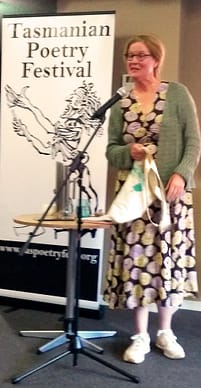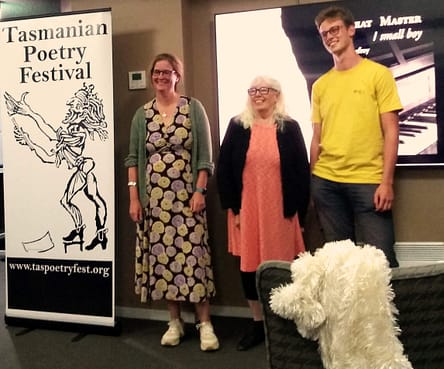
The 2025 Tasmanian Poetry Festival kicked off Friday evening, October 10, 2025, at Sporties Bar in Launceston. Young Dawkins reflected on serving as one of three judges for the 2025 Tim Thorne Poetry Prize.
American-born poet Young Dawkins was a central figure in the New Hampshire beat revival movement, where he helped found the Jazzmouth Poetry Festival, before moving to Scotland and becoming a regular on the Scottish Performance Poetry scene. He was the 2011 Scottish Slam Poetry Champion, and the 2012 runner up. In May 2011, Young went to Paris to represent Scotland in the Poetry Slam World Cup, and in August 2011 he performed a solo show at the Edinburgh Fringe.
From 2011 – 2013, Young organised and hosted the BBC Edinburgh Fringe Poetry Slam.
Since moving to Tasmania in 2013, Young has performed at events and festivals including the Silver Words spoken word night, the UndergroundArtBar, Cygnet Folk Festival, Pangaea, Junction Arts Festival, Moonah Arts Centre, Stories After Dark at Hobart Library, and ECHO. He has also performed with highly acclaimed jazz musicians Andrew Legg and Nick Haywood at venues including Lark Cellar Door, the Tasmanian Museum and Art Gallery and the Tasmanian College of the Arts.
Young Dawkins – a resident these days of southern Tasmania – spoke of his pleasure at being in Launceston for the opening of the 41st Tasmanian Poetry Festival. ‘I believe Launceston is the beating heart of Tasmanian poetry, I really do,’ he observed. ‘You people love poetry. You show it. You support it. You care about it. You produce it. And as a poet, I love you. So thank you very much for having me here.’
‘The Tim Thorne Prize in Poetry has very quickly made its mark in Australia. I know people from the mainland who talk to me about it and they say, where did that come from, a $25,000 prize? That’s quite remarkable. There have only been 20 Tasmanian poets who have even been named to the Long List. Only two people have won it.’
Young suggested the prize, and its prestige, owes a great debt to Tasmanian poet Tim Slade. Slade had taken the case for increased recognition for the prize to the Tasmanian state government, persistently arguing for greater prizemoney (the state body’s initial suggestion had been $10,000).
‘So Tim Slade, if you see him’ Dawkins continued, ‘tell him thank you, because he’s the reason that one of Tasmania’s greatest poets is commemorated and lives on in this way.’
Dawkins’ allusion to ‘one of Tasmania’s greatest poets’ was right on the money. Following Thorne’s death, Tasmanian MP Michelle O’Byrne read the comments of friend and fellow festival director, poet and playwright Cameron Hindrum, into Hansard:
One of Australia’s best contemporary poets, Tim Thorne, passed away this morning after a long and typically defiant battle with illness. His moral courage, his unique capacity to turn a perfect poetic phrase, especially to make unexpected rhymes materialise seemingly out of nowhere, his strength, his intelligence, his humour, all were a source of inspiration to generations of writers who had the benefit of his mentorship or guidance. I will be forever grateful for having known him and I hope that that is no small thing. There will, of course, always be the infinite legacy of his work. Whenever and wherever it is read, he will be there, smiling. Vale, Tim, it is not enough to say thank you, but thank you.
‘Let me tell you about the 2025 awards,’ Young Dawkins continued. ‘I was honoured to be asked to be one of three judges – three completely different judges – coming at this with very different points of view about what constitutes good poetry.’
‘We met for the first time in October of last year and were handed 25 books. Here you go, figure it out. Twenty-five books of poetry.’
‘We looked at each other and said, we’re never going to agree about this. So we said, we need some guide rules. And we set out three broad criteria on which we would judge these works.’
The criteria the trio chose was, firstly, the quality of the writing. ‘And I say immodestly that I think all three of us have done enough with poetry to understand what good writing looks like and sounds like,’ Dawkins added.
‘The second was interesting, to judge it on the impact and what our emotional response was as an individual. We agreed that when you read poetry, it should move you. It should make you angry. It should make you sad. It should make you other things – but it should do something. It should have an emotional response, an impact.’
‘And the third thing was how interested were we in the theme of the book? How did the book keep us connected all the way through? We spent four months at this. We met dozens of times by email, we met in person, we called each other on the phone. We talked a lot. We spent a lot of time on this and took this very seriously. We were so far apart on our views.’
The trio began by ranking each book on points. ‘And we weren’t anywhere near each other. Not even remotely near each other. And we did this again and again and again and again.’
After a period of reading — ‘we read and read’ – they kept returning to one book. In conversation they used words and phrases to describe their responses: ‘Simple.’ ‘Tight.’ ‘Nothing wasted.’ ‘The artistry is impressive.’ ‘Her images wash of colour and movement.’: Pam Schindler’s ‘say, a river’.
Dawkins introduced Pam Schindler to read. Pam mentioned how honoured and thrilled she was to win the award. ‘When the shortlist was announced, the judges published brief comments on each of the books on the shortlist,’ Pam said. ‘And I thought, well, that’s enough prize for me, just hearing those words about my book when they were included in the shortlist. But it’s a great honour. And I’m also very thrilled to take part in kicking off this wonderful festival for its 41st time round, which is a huge achievement, very special.’
Young Dawkins also introduced the winner of the Highly Commended Section of the Award, Kim Nielsen-Creeley, explaining how as judges they’d ‘continued to push books to the middle of the table, individually, one at a time, over the months, and there was another book we kept bringing back. And it was an interesting thing, because we knew this was a first collection by an author – an emerging voice –and that there was a power here, and something distinctly, deeply Tasmanian about this voice. So for the first time in the history of the Tim Thorne Prize – right, there’s only been two – but this is the first time, and we went to the Tasmanian government with the courage of Tim Slade, and said, we want to create a new designation. We want to create a designation highly commended.’
‘Well, that’s never been done before,’ they said. ‘Well, we’re going to do it this year, because this book deserves it,’ we replied.
‘This is what we as judges wrote:
This collection features intelligent and richly informed observations on how place impacts people. The poems are both reflective and vulnerable, and the reader gains deep insight into the author’s lifelong response to her environment.
And it gives me really great personal pleasure’ Dawkins concluded, ‘that I was the first one to pull this book out from the centre of the table.’