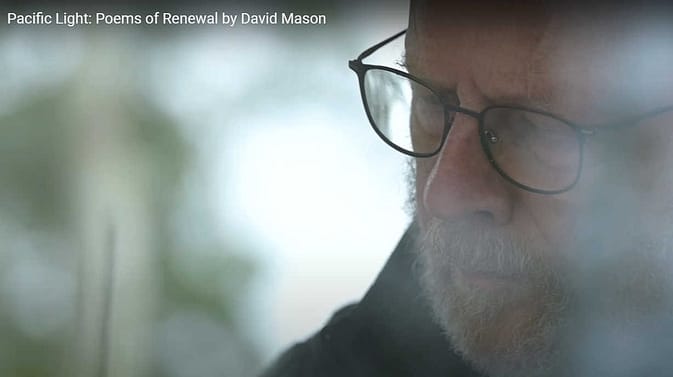
Thoughtful words, both by and about US poet David Mason, now resident in Tasmania.
Siham Karami reviews Mason’s Pacific Light (Forty South Publishing, Sept 2022)….
In this collection, we sense it in the very first poem, “On the Shelf,” whose title rhymes with and is the same metric length as that of the final poem, “Note to Self” — another indication of the care with which Mason organizes his effects. There we are invited to observe the smallest thing, a spider’s shed skin, which the speaker “thought twice before touching,” because the spider’s “soul” is still “able to frighten.” He wonders if his own “shed skins / in houses where my name has been removed” will elicit an emotional response, if “some words of mine” will thus “go on living,” without asserting it. The question remains humbly open.
There’s reference too, to previous conversation with Mason in the form of a link to Leath Tonino’s 2015 interview with the poet, published in The Sun.
Tonino: As you’ve described it, the Greek view seems particularly fitting for a poet. I like the idea of poets as people writing from the brink, with the clarity and intensity of the about-to-die. It makes me think of the Zen Buddhist tradition in which a master often writes a final poem on his deathbed.
Mason: That happens in the Western tradition as well. Many poets write their own epitaphs. Take Robert Frost’s: “I had a lover’s quarrel with the world.” That’s just a beautiful idea. We’re always a little at odds with the world, always wrestling with it, fighting it, beating our head against it. But we also love it very much. Elsewhere Frost says, “Earth’s the right place for love: / I don’t know where it’s likely to go better.” You’ve got a body, and the body can love as well as suffer. Sometimes love is suffering, right?
I think poets as a group often do have an essentially Greek view of existence. I don’t mean they are all influenced by the Greeks. There are obviously Christian poets and Buddhist poets and many others with different theological standpoints. But the awareness of death seems common to all. It’s almost the nature of poetry.
Tonino: But obviously poetry doesn’t have to be only about loss, grief, and death.
Mason: Right. There’s a spectrum. Sometimes it’s about transforming loss. We are all transformed by grief. We change in the way a tree struck by lightning changes. Artists try to capture that in a poem or a minuet or a painting or a sculpture.
A student was asking me just today: Why is it so hard to write about happiness? I replied that it’s hard to write well about anything — it’s just damn hard to get the words down right — but it’s especially hard to convey the joyful aspects of life without becoming sentimental. Sadness, too, can be maudlin, but it’s particularly true of happiness.
And yet there are happy works of art out there, works that are brimming with gaiety, to use W.B. Yeats’s word. Even the tragedies often crackle with a kind of life energy. You feel revitalized by partaking in them. Somebody once speculated that the writer Flannery O’Connor must be a cynical person, because her short stories are so dark. Her answer, which I’m paraphrasing, was that no completely cynical or nihilistic person can write fiction. In a sense, the very act of creation is fundamentally an acknowledgment of life.
I read a lot of contemporary poetry and often find myself feeling that there’s no vitality to it. It’s as if the author were dead inside, or just writing for professors. There’s no human pulse there. The poem doesn’t beat like a heart. All the best literature has that pulse. It makes you feel alive to read it.