Five Islands Poetry Prize ~ for a First Book of Poetry

Terms & Conditions

  • This is an annual prize for a first already-published book-length collection of poetry by an Australian poet or a poet living and writing in Australia.
  • The author of the prize-winning book will receive $2750 and the publisher will receive $1100.
  • A book can be entered by the author or publisher.
  • The book must contain at least thirty pages of poetry, have an ISBN, and be available through retail sales outlets.
  • Self-published books are eligible as long as they meet the above criteria.
  • For the 2024-2025 Prize, books published between 1 July 2024 and 30 June 2025 are eligible.
  • Note: the prize aims to support professional publishers, in particular small-press, independent publishers.
  • Submissions are open until 15 July 2025.
  • There will be three judges, whose decision will be final.
  • The Prize will be announced in late November, and presented shortly afterwards.
  • Four copies of the submitted book are to be posted to PO Box 68 Brunswick Victoria 3056.
  • Books submitted will not be returned.
  • An email must be sent to Kevin Brophy at: kevinjb@unimelb.edu.au attesting that this is the poet’s first published book of poetry, and providing the book’s publishing date, and contact details for the poet and the publisher.

Step 1

Post four copies of the submitted poetry book to the address below. Please note, posted books should be received on or before 15 July 2025.

Five Islands Poetry Prize
PO Box 68
Brunswick Victoria 3056

Step 2

Email Kevin Brophy, attesting that this is the poet’s first published book of poetry, and provide contact details for the poet and the publisher. Please subject your email as “Five Islands Prize Entry”.


Five Islands Press Poetry Prize 2025

Stuart Barnes – new poem and interview in Welsh journal ‘Modron Magazine’

(from an interview with Glyn F. Edwards, published in the Welsh journal Modron Magazine (Writing on Nature & the Ecological Crisis), April 14th 2024.

Q4. Sexuality and ecology are central themes in your poetic voice – do you consider them disparate or allied?

I’ve always felt very comfortable writing about ecology and the sexuality of the more-than-human world (some of the poems I wrote during childhood were about the love between rhododendrons and eucalyptuses, tiger quolls and Tasmanian devils, and the Derwent estuary’s freshwater and saltwater), but, until a few years ago, very uncomfortable writing about my (and other human beings’) sexuality.

Growing up among the kaleidoscopic foothills of kunanyi / Mount Wellington was astounding, but growing up gay/queer in lutruwita / Tasmania (the last Australian state to decriminalise sex between consenting adult men—the maximum penalty was 21 years in jail, the harshest in the Western world) was terrifying. The homophobia I experienced from five to 18 that manifested itself in psychological and physical violence contorted my perception of my sexuality—writing about it was torturous, then impossible. As a teenager I found solace in walking solo along the fern-edged trails near my home and with friends at beautiful Cradle Mountain–Lake St Clair National Park, Walls of Jerusalem National Park and Mount Field National Park (which, with other national parks and reserves, comprise the Tasmanian Wilderness World Heritage Area).

(Read more)

Martin Flanagan and Cameron Hindrum in conversation

Thursday 21st March 2023 — 18:00 to 20:00

UTAS Inveresk Library celebrates Tasmanian Reads Week with ‘The Place that Made Us: Martin Flanagan in conversation with Cameron Hindrum’.
Martin Flanagan explores what it is about Tasmania – its places. its stories, its people and its ghosts – that seep into the bones and the imagination of a creative soul such as Cameron Hindrum, who has called the island home all his life.
What are the defining cultural moments and narratives that both define Tasmania and are reflected in the art that is produced here?
How is this reflected in the seminal reading, writing and creativity that has occupied Martin and Cameron in their various literary endeavours?
All welcome.
Ticket provides general admission to the talk.
Book sales will be available at the event.

Research journals and gatekeeping

Caitlin Cassidy, The Guardian, 10th March 2024

“We’ve set up a crazy system where publishers own and control knowledge and we’ve let them do that,” Foley says. “Researchers give content for free, sign over copyright, and publishers make a lot of money.

“You can get rubbish, nonsense and misinformation online for free but you have to pay for the good stuff. We need to make sure we’re getting the right information out there.”

Journal publishers have one of the highest profit margins of any industry, taking in an estimated $20bn US a year.

More …

Anne Elder Award —Australian Poetry announces Call-Out

  1. Open call for entries – Monday, 15 January 2024
  2. Close of entries – Tuesday, 12 March 2024, 5pm (AEST). Books must be postmarked no later than Tuesday, 12 March 2024.
  3. Winner announcement – May 2024


Information and enquiries
Jacinta Le Plastrier
Email: ceo@australianpoetry.org
Note: Responses to enquiries will not be sent until after 15 January. Please note the new AP address is now: AP, Anne Elder Award, GPO Box 1753, Naarm/Melbourne, VIC 3000. The GPO box number is essential.


The award is named after Anne Elder (1918-1976), a dancer with the Borovansky Ballet in the 1940s who later in life became a notable poet. Her poetry attracted praise from many critics for its vigour, depth of reference and distinctive artistry.  Sponsored by the Australian Communities Foundation, this prestigious, national, annual award is for a sole-authored first book of poetry of 20-minimum pages in length, published in Australia.


Established in 1977, the prize has offered important recognition to poets at a critical point in their writing lives, and its alumni represent some of Australia’s best-known and highly respected poets. The winner is awarded $1,000, and there is also the opportunity for the judging panel, which for the 2023 Award will be announced in late January, to award other books a commendation or special mention.


Books published between 1 January 2023 and 31 December 2023 are eligible for entry into the 2023 Anne Elder Award.


Submission Guidelines & Eligibility

  1. Open to Australian residents only
  2. Entries must be in English. Bilingual volumes are acceptable as long as one of the languages in which the poems are written/translated is English
  3. Book should be a sole-authored first collection of poetry published in 2023
  4. Book must be 20+ pages in length and have been legally deposited with the National Library of Australia
  5. A book can only be considered a first volume if the author has not had previous volumes of poetry of 20+ pages published either in Australia or elsewhere
  6. Chapbooks are also eligible if they meet the above guidelines—please note, if a poet has entered a chapbook previously, they cannot re-submit a longer collection
  7. Entrants who have previously published in another genre are eligible as long as the entry submitted for this award is the first volume of poetry published by the author
  8. Co-authored entries are not eligible for the award
  9. First prize $1,000. Winners and commended entrants will receive a copy of Selected Poems of Anne Elder (Lauranton Press)
  10. The judges reserve the right not to award a prize
  11. The judges’ decision is final and no correspondence will be entered into.


How to Enter

  1. Send 3 copies of the book to: Anne Elder Award Nominations, c/o Australian Poetry, GPO Box 1753, Naarm/ Melbourne Vic 3000.
  2. Entry fee $35 (including GST) is payable at the time of entry. Payment is via an invoice generated by AP. Please contact Jacinta at ceo@australianpoetry.orgso she can organise an invoice, to be paid via EFT. Please also let her know when you have mailed your copies so she can be in contact if they do not arrive.

The magazine Overland has been targeted for its solidarity with the Palestinian cause.

A discussion group that includes Australian writers, teachers and academics is campaigning to get an editor and academic sacked and funding withdrawn, in response to a literary journal’s publication of pro-Palestinian and anti-Israel articles.

Messages from a WhatsApp group, which were posted to X/Twitter by Evelyn Araluen, appear to show an “urgent call to action” against Jonathan Dunk, who co-edits Overland with Araluen.

The requests in the group appear to include asking for screenshots to use as evidence to support taking legal action against Dunk and the journal. Other comments posted by Araluen call for complaints to be made to Deakin University, where Araluen and Dunk are employed as academics, and also to Creative Victoria, which funds Overland.

(Rosemary Sorensen, ‘Independent Australia’, 4th Feb 2023—more)

Koraly Dimitriadis — book launch, Launceston 29th February 2024

The TPF 2024 kicks off its first pre-festival event with a book launch by Koraly Dimitriadis – a Melbourne poet, performance artist, film maker and short story writer.

Join us upstairs at 6 pm on the 29th February at the Plough Inn (lift available) 170 Brisbane St., Launceston to hear this wonderful and multi-talented woman.

Koraly is on her book tour and will also be performing at Silver Words in Hobart on 28th February.

Ticket link:- https://www.trybooking.com/COZAU

Arts Tasmania is a major sponsor of the Tasmanian Poetry Festival in 2024.


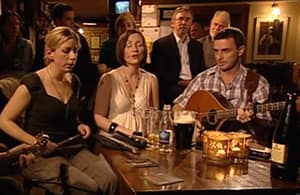
Julie Fowlis & Muireann Nic Amhlaoibh (2009)

Julie Fowlis

The Hollywood Inn, Co. Wicklow: “Scottish Hebrides singer Julie Fowlis & Kerry singer Muireann Nic Amhlaoibh singing ‘Dá bhFaighfinn Mo Rogha de Thriúr Acu’ (0:00), Dhannsamaid Le Ailean (1:24) & Cairistion’ Nigh’n Eoghainn (2:16) with accompaniment from Éamon Doorley (Bouzouki) and Martin Ross (Guitar). This clip was recorded for the Geantraí music series on TG4 in 2009.

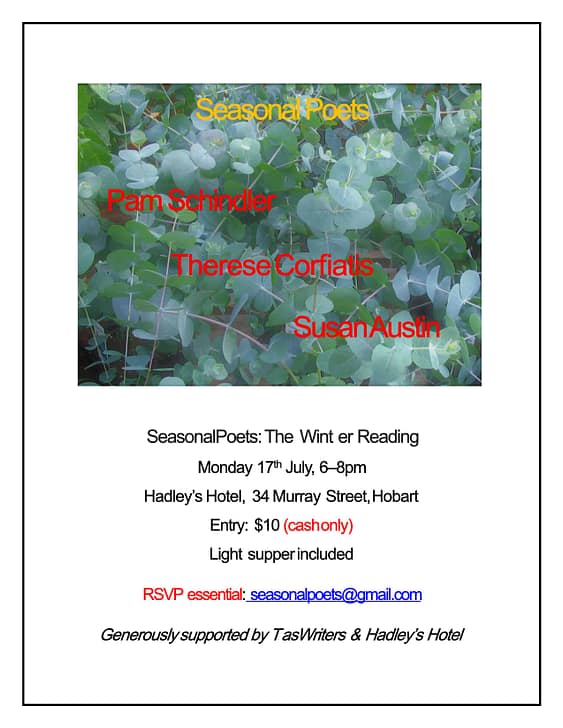
Seasonal Poets Summer Reading — 26th February, Hobart

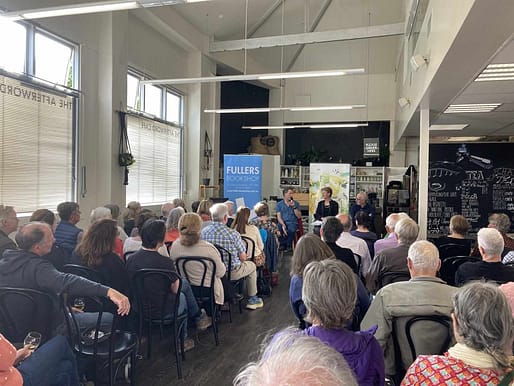
2024 is bringing changes to Seasonal Poets. Seasonal Poets will be partnering with Fullers Bookshop for each of its Seasons. The format will continue as it has always been, with three poets each reading for 20 minutes.

The biggest change is the venue. After seven years at Hadley’s Hotel, Seasonal Poets will now be meeting at Fullers Bookshop. And, tickets will be available through the Fullers ticketing link or at the door. This means not having to remember to have cash. The tickets will remain at $10.00. And the sessions will begin at 5:30 and run to 7:00. Wine will be available for purchase in the café.

More from the Co-curators of Seasonal Poets (Gina Mercer, Anne Collins and Irene McGuire):

‘We would like to thank Taswriters for all their help in making Seasonal Poets a reality. We could not have survived for seven years without their support. Unfortunately, they are no longer in a position to continue to subsidise our readings at Hadley’s.

‘We would also like to thank Hadley’s Hotel for their support over these same years.

And, we would like to thank Fullers Bookshop for giving us a new home to continue to present Tasmanian poets to an appreciative audience.

‘Thank you for supporting Seasonal Poets.

‘More details will follow closer to the February readings.’


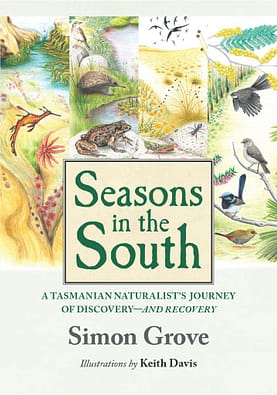
Simon Grove’s ‘Seasons in the South’ (launched Hobart, 23rd Nov 2023)

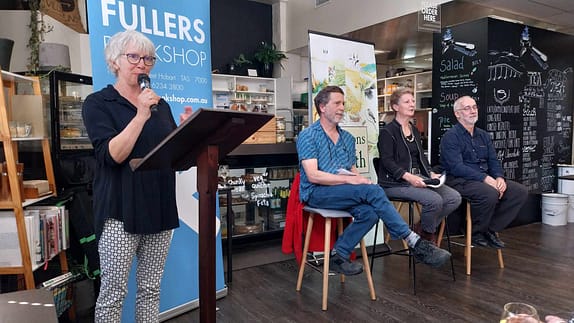
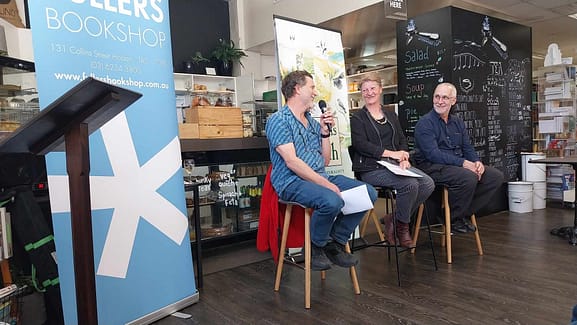
Author Simon Grove, illustrator Keith Davis and Dr Sally Bryant AM joined in conversation to mark the launch of Simon’s new book ‘Seasons in the South’, at Fullers Bookshop in Hobart on 23rd November 2023.


Simon Grove is Senior Curator of Invertebrate Zoology at the Tasmanian Museum and Art Gallery in Hobart. He hails from England. Following doctoral research in the Daintree rainforests of tropical North Queensland, he moved to Tasmania with his young family in 2001, to work as a Conservation Biologist. A lifelong naturalist, he is author of The Seashells of Tasmania: A Comprehensive Guide, and has also published widely on Tasmanian natural history and ecology. Simon regularly chats about Tasmanian invertebrates on local radio, and in 2019 was awarded the Australian Natural History Medallion—the ‘Nobel Prize for Australian naturalists’.


For book details, visit Seasons in the South. As well, visit Simon Grove.

Booranga Writer’s Centre, publisher of literary journal ‘fourW’, loses Create NSW funding for 2024

The Booranga Writers’ Centre has been unsuccessful in it’s bid for annual funding from Create NSW under Chris Minn’s Labor government.

This came as a real shock to the Booranga Committee as Wagga Wagga Writers Writers, to give Booranga its full legal title, has been operating for 30 years.

Booranga serves its members and the local community through hosting Writers-in-Residence at their facility located on the Charles Sturt University Campus in Wagga Wagga, and through the publication of its annual anthology fourW. It also supports local and visiting writers with venues, book launches and reading events.

Business Manager Dr Greg Pritchard said ‘this is a real blow to the writers of the region and may mean the Centre has to close. At the very least we will have to severely curtail our activities’
‘It’s very disappointing’ he said, 'as Booranga had a great year with many events, a book sale, open day, writing film night, 10 open mic events and associated workshops and I have just been distributing copies of fourW thirty-four the centre’s anthology of new poetry and prose from all around the Riverina, Australia and internationally.’
‘We participated in the public meetings in 2023 about the new cultural policy, and the call from creatives in the Region was for more funding for regional areas, not to defund one of the Riverina’s key cultural organisations.’

Booranga President David Gilbey said he was very disappointed, ‘I've often said that so long as there was ongoing funding (from the NSW
Government) Booranga could continue - this was the genius of the original funding from Arts NSW back in the 1990s. Its cessation is certainly a mortal blow to Booranga as we know it.’ 

Bruny Island Bird Festival — March 15th-17th 2024

The Bruny Island Bird Festival:  Bringing together Science, Conservation, Community and Creativity to create three days of enjoyment and education about the birdlife of this wonderful island.

Packed with new features as well as old favourites, there will be Expert Speakers, Birdwatching Tours & Walks, a Market Day, Art Exhibition and evening events to celebrate birds.

Everyone is most welcome, birders and non-birders alike. 

For more information, visit Bruny island Bird Festival 2024

Bruny Island Bird Festival 2024

… the Aran jumper crowd

… the Aran jumper crowd
 
(Pat Carty, ‘The Sunday Times, 3rd December 2023)
https://www.thetimes.co.uk/article/shane-macgowan-the-man-who-made-irish-music-cool-gj0fvk505
(apologies, it’s probably behind a firewall)
 

Rum Sodomy & the Lash made it into the UK Top 20 in 1985 and it was likely the first time most of us heard of them. MacGowan’s songwriting had taken a quantum leap and the band were also able to run at an old standard like Dirty Old Town and make it their own. It’s no exaggeration to say the album made Irish music acceptable to many ears and rescued it from the Aran jumper crowd.

2 paragraphs from Doris Lessing’s ‘Under My Skin’

2 paragraphs from Doris Lessing’s ‘Under My Skin’ (vol one, autobiography to 1949)

Something else happened, which I have had to think about ever since. At a Mission in Old Umtali there was an afternoon’s fete, and black people as well as white wandered about under the trees drinking tea and eating cake. I had never been with black people as an equal, in a social situation. I was delighted. I was curious. I was threatened, and did not know how to behave. I went up to two old black men standing each with a teacup in his hand and began chatting, social stuff, of the kind my mother was so good at. I chattered and they listened, looking gravely down at me. Then one said gently, ‘You see, I am very old and you are very young.’

Nothing very much, you’d think. I had been given the mildest of snubs, with a smile that forgave. But that was not it. There was something about the occasion, the old men, the words, that ‘got to me’. I knew they had. But what? What happened? Yet not for years did anyone say anything as powerful, making me think, forcing me to use words, incident, old men, as if hidden there was some kind of original excellence, which I must refer to. But nothing had been said, judged in terms of simple sense. And yet everything had. Long after, when something of the same kind happened, and then again, and again – I understood it doesn’t matter what words are used, if a person waits, unconsciously, not even knowing it herself – himself — wanting to hear something, be struck by something, needing it, then words as apparently empty as ‘It’s a fine day’ can have the same effect. But time was needed for that little incident to lodge itself in my mind as a paradigm, and ….


Pub to Park – a Bothwell storytelling event, Tasmania, Fri 1st December

A Bothwell storytelling event featuring Kim Nielsen-Creeley, Marilyn Arnold, Tim Hurburgh and Mallika Naguran.

Friday 1 December at the BoHo (Bothwell Hotel) from 3-6 pm.

Listen to stories and poems on highland life and love, over wine, cheese and crackers.

Kim Nielsen-Creeley is a Launceston-based writer and poet. She has released a chap book titled Roughly, and is ready to submit a full length poetry book. Kim is active in the local poetry scene as presenter and emcee. She has been interviewed and read on local and ABC radio. She has assisted to create poetry events in the local poetry scene, and also blogs on-line.

Marilyn Arnold, also from Launceston, has two books of poetry: Capture, written with Carol Easton, and Lies, Lovers and Other Constructions. An award-winning poet, Marilyn is the inaugural president of the Tasmanian Branch of the Society of Women Writers and a committee member of the Tasmanian Poetry Festival. She runs regular poetry open mic and workshop sessions. Marilyn has written about nature in the central highlands, having lived in Hamilton in her previous life!

Tim Hurburgh is an architect, writer and poet who grew up on the Derwent River north of Hobart. The Ouse resident has released his first book of poetry, Disruptions: Tasmania in Poetry. Tim’s second book, Tall Poplars: Tales of Tasmania’s fabled Derwent Valley is a collection of short stories. When not penning poems or weaving tales, Tim sends ping-pong balls whizzing past hot ears in the disused district school uphill.

Mallika Naguran is a short story and children’s stories writer who will soon be published as a novelist. Her debut story collection, She Never Looks Quite Back, has been shortlisted for a book award. She is the founder of Pub to Park Storytelling, which features published authors, poets and new voices live across Tasmania. The city-turned-country girl is now always woken up too early by eager roosters in Ouse.

Cheese platter $10 per head. Wine/whiskey/tea/coffee extra.

RSVP to Mallika Naguran by email: malnag@hotmail.com or text 0459 352 532

Venue: Bothwell Hotel of the Highlands, 15 Alexander Street, Bothwell, Tasmania.

Small Press Network—2022 Book of the Year Award: winner Eleanor Jackson

The Small Press Network (SPN) this evening announced the winner of the 2022 Small Press Network Book of the Year Award (BOTY): Gravidity and Parity by Eleanor Jackson, published by Vagabond Press! 

Below, from Small Press Network’s Fiona Wallace’s interview with Eleanor earlier in the month:

Q. Your poems have a powerful sense of immersion in the present-day world. The COVID-19 pandemic, Black Lives Matter movement, Trump’s presidency and the incorporation of technology are brought naturally to the fore, rather than operating as impartial and immaterial backdrops. Can you talk about the importance of reflecting moments of time in your writing practice?   

I definitely wanted these poems to have a very particular timestamp. For better or worse. At the time I worried the issues would date. Sadly, some of them haven’t. 

I have long been interested in the idea of poetry as a documentary practice. I don’t think that knowledge or form is neutral, and I’ve been curious what we learn when trying to represent ‘reality’ as it happens. And this feels like a ‘momentous time’, for our community, for our cultures, for our society as a whole, and I was conscious of wanting to record that in real time. But even momentous times can feel simultaneously deeply prosaic and even boring. So I wanted to try and capture a time with a telescoping quality, sometimes looking at the minute and sometimes looking at the enormous.

Read the interview in full.


36

Eleanor Jackson at the 2013 Tasmanian Poetry Festival, Launceston

52

The Joan Didion estate sale

Sophie Haigney, writing for ‘The Paris Review’ (17th Nov 2022) about the artefacts being auctioned in the US at the Joan Didion estate sale….

Then there were the three lots of blank notebooks, tied with twine. They went for $9,000, $11,000, and $11,000 each. They were empty, some still wrapped in plastic, yet they were totally talismanic. I wondered: Would you write in these notebooks, having paid that price? Perhaps that’s the whole appeal—to write in a blank space that Didion might once have intended to use herself. Maybe the buyer had a hidden wish that somehow her intent might infiltrate their own work—that in owning these notebooks they might crack some secret code to making sentences like hers. There are sillier superstitions. But more likely, I think, you would have paid too much for these notebooks to ever touch them, and they would sit in a drawer or on a desk, unused and empty, just as they sat on hers.

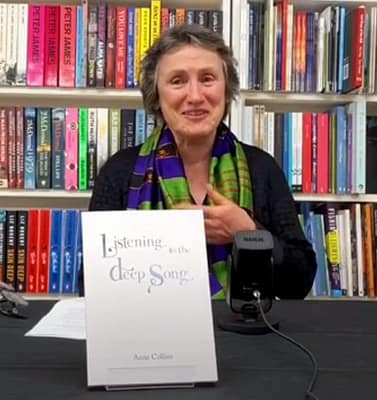
Anne Collins—book launch

Lovely to see that Anne Collins has launched her newest collection of poems and prose—’Listening to the Deep Song’ (Bright South)—in Hobart last week.

cover Listening to the Deep Song Anne Collins


The book was launched at Hadley’s Hotel on 11th November by Petrina Meldrum:

I’d like to say how happy I am to be back in Hobart to share in the launch of Anne’s latest book, Listening to the Deep Song, and how nice it is to see so many familiar faces. Thank you all for coming along to support Anne and to celebrate with her.

When I first met Anne some six years ago, her manuscript, for all intents and purposes, was ready to be sent out to publishers. I remember clearly, when Anne brought it along to one of our early meetings, how impressed I was with the idea she had had, and with how she had gone about bringing it into existence.

As the intervening years flew by, the manuscript grew larger, and today, here we are, with this beautifully written book in our hands.

I think most of us are aware of Anne’s interest in Spain and the Spanish culture, but not necessarily of the depth of her involvement. In Listening to the Deep Song she shares, without restraint, her experiences.

Through multi-layered vignettes and some exquisite poetry, she takes us on a journey through Spain’s regions and major cities, through its seedy back streets, its world renown museums, and its quirky architecture. If you’re planning a trip to Spain, you can throw away your guide book and take Anne’s book with you instead. She’ll guarantee to get you lost at night in the back streets of Seville, or help you lose yourself in the whimsy of Miró’s universe in Barcelona.

Spain, of course, is not one country but a number of autonomous regions, each with their own language and cultural heritage, which they guard fiercely.

Anne recognises this by dividing her book into sections and allocating a flamenco rhythm or compás to each region. These rhythms reflect her sense of an underlying mood as she travelled through Spain.

On returning to Hobart, to her ‘Spanish life’, she has this to say:

Curiously in Hobart I have a Spanish life. I enjoy the exhilaration of flamenco dance classes… For short periods of time, I am immersed in flamenco energy. These experiences help me in finding my own flamenco self, my own flamenco confidence, still with much to learn.’

In the ‘Afterword: I am touching you’, a heart-warming piece, she tells us of her experience during Covid-19 isolation, a time when many put their lives on hold, but not Anne, she was Zooming her way to Madrid several times a week to attend flamenco classes online.

Following her journey, we become aware that there is another dimension to Anne and we are left, as a consequence, with a more intimate sense of who she is.

On attending a flamenco performance in Seville in a 16th century Sephardic courtyard at La Casa de la Memoria she records:

I feel an unexpected stirring of ecstasy and sorrow, a kind of loss deep within, of what I am not sure, but like the poet Félix Grande, I want to cry like a new born. What has this to do with me – an everyday 21st century stranger to my own roots and here for this brief moment? What yearning pulls me beyond their words of protest I barely understand, into ‘the gratitude, the anguish, the joy, the revelation’, the raw wailing core of this art we call flamenco?

We see a more playful Anne, in Barcelona, visiting one of Gaudí’s buildings, La Casa Batlló.

From her poem, In Gaudí Wonderland:

Inside the Casa Batlló the building seems

to sway and dance and smile

and I want to leap about

as the curves of my breasts and hips

align with the curves of the cave-like walls…

I imagine living here in this building

that honours a sense of joy.

Feel gracious and light, tender, seductive, playful,

free of straight lines and rigid postures

as if some essential fluidity

has re-awoken deep inside me.

Throughout the book there is a questioning going on, a desire to learn more – to have a deeper understanding, to belong. This is what Spain does to you if you let it: it draws you in and never lets you go. There is a sense of this happening to Anne as she gives herself over to Spain, while at the same time questioning why this is happening to her.

Her trips to Spain span a period of thirteen years, a long enough period for her to have noticed changes, both good and bad, all of which she shares with us. The diverse knowledge she has gained in this time is masterly woven into her vignettes, leaving us with signposts and pathways to follow if we wish to know more. The vignettes, at times a conversation with Spain, would give any traveller a masterclass in how to travel, in how to be more engaged with what lies beneath the surface.

Interspersed with the vignettes is Anne’s poetry. Some of the poems are born of her long interest in the life and work of Federico García Lorca.

Lorca’s first major work, Poema del Cante Jondo Poem of the Deep Song – has clearly influenced Anne’s choice of title for the book, however, the poems she has chosen to respond to, form a conversation with a wider range of his work.

This poetic dialogue with Lorca’s work opens up a new way of reading into it, a way, through poetry, of showing the relevance of his work in a 21st century context.

In Anne’s poem, Learning to Spell, After the life of Federico García Lorca, which I’d like to read to you, she quotes phrases from two of Lorca’s poems, Landscape and Sleepwalking Ballad.

Learning to Spell

The boy learns to spell leaf

it turns to leaves on a yellow tree.

Leaf through the mistake of years–

a complicated task, a lot of rubbing out.

There’s knife and shelf, the rule’s the same

do your homework. By mistake the evening

a knife-edge wind cuts the leaves.

The alarm, the shelves full of books,

the guards are spell-bound.

The boy changes into a bird

watches through the mist on the panes

writes sentences with the word leaf,

a complicated task, a lot of rubbing out.

They leaf through the shelves.

After the wind there was only one leaf left.

On the page a trail of tears, the stanzas stretched out.

Her other poems reflect on her connection with and her understanding of Spain, and on her association with the art of flamenco. The flamenco poems make your heart beat to a different rhythm as you appreciate the degree to which this artform has become part of Anne’s life, and she part of the ‘flamenco family’.

I can truly recommend Listening to the Deep Song to you.

And now, I’ll hand over to Anne who is going to share some of her beautifully written pieces with us. Anne…


In conjunction with Hobart Bookshop, Anne’s also recorded a short video explaining more clearly her love of Lorca along with ‘everything Spanish’,  here.


in his endorsement of Anne’s book, Peter Boyle writes—

“Part travel diary, part meditation on Spain and its cultures, part poetic dialogue with the poetry of Lorca, Anne Collins’ “Listening to the Deep Song” is a beautifully written testimony to her long enthusiasm for the many sides of Spanish culture. Bringing together her training in flamenco dance, her love of Lorca’s poetry and several of her journeys through Spain, Anne Collins offers her readers a personal response to a unique blend of cultures that continues to speak to the 21st century world. Varied and many-layered, marked by close observation and thoughtful questioning, this is a delightful book.”


Finally, the publisher’s description…

Like a traveller’s journal written in prose and poetry, Listening to the Deep Song records Anne Collins’ travels through various regions of Spain, which took place over many years. The book offers a meditation on Spain’s many-layered history and culture, reflecting on history, landscape, expressions of culture, and change. It reveals places of connection and friction within Spain and across the world; as far as Anne’s home in lutruwita-Tasmania.

The writing turns on a poetic dialogue and an embodied praxis; the latter being expressed through both Anne’s physical immersion in Spain, and her practice and knowledge of flamenco dance. The latter engages with, especially, the life and works of Federico Garcia Lorca, as well as with other poets and writers of, and about, Spain.

Listening to the Deep Song is deeply personal, yet it offers much that resonates deeply with contemporary concerns. Anne Collins’ writing is varied, thoughtful, observant, poignant and beautiful.


‘Listening to the Deep Song’ is available from Bright South. It sells for $30.
Fourth Australian Haiku Anthology—Call for submissions

The Australian Haiku Society has announced a call for submissions for the Fourth Australian Haiku Anthology (4AHA) that will showcae the work of poets who are writing haiku in Australia today.

It is almost a decade since the previous Australian haiku anthology was released and the landscape has changed significantly since then. The society’s mission is to publish a collection that will be representative of the diversity in approach taken to writing haiku in this country at this time.

Submissions are welcomed by poets who are Australian by nationality or who currently reside here. There are no constraints with respect to form or the inclusion of seasonal references; both haiku and senryu are welcomed and may be published or unpublished.

The editorial team for the anthology will be Lyn Reeves, Beverley George and Rob Scott.

SUBMISSION GUIDELINES

Submit up to five of your best haiku and/or senryu by completing the submission form at the society’s website. The deadline for submissions is 1st December 2022.

Myron Lysenko: ‘If we lose this war, we’re going to lose our country, our language and our culture….’

Myron Lysenko, in conversation with Tina Giannoukos on 3CR Spoken Word this morning, Thursday 27th Oct 2022.

“A lot of the Ukrainian people believe that we will win the war, even though we’re fighting against extreme odds. If we lose this war, we’re going to lose our country, our language and our culture so it’s very important to us.

“As a Ukrainian, I was brought up to always think of Ukraine as my homeland. When I went to school people would say, you know, you’re not Ukrainian because you were born in Australia.

“And I went home and I said to my father, ‘What do I do Dad? They’re saying I’m not Ukrainian, they’re saying I’m Australian!’

He said, ‘Well you go back to your school and say, “If a horse is born in a pig pen, does that make a horse a pig?”‘ 

‘I’m Ukrainian, and always will be…. ‘

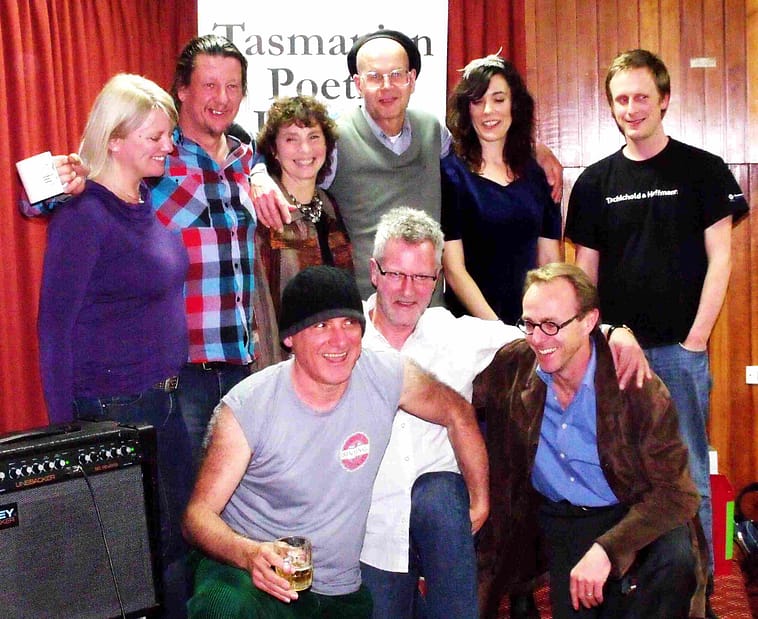
Myron Lysenko (back row, second from left)—Tasmanian Poetry Festival 2010


War Poetry in Ukraine: Serhiy Zhadan and Lyuba Yakimchuk

An essay by Maria G. Rewakowicz, published in ‘Los Angeles Review of Books’, 22 Feb 2022

Ever since Russia annexed Crimea in 2014 and soon after stirred the conflict in the southeast region of Donbas, the theme of war has figured prominently in Ukrainian prose and poetry. The ongoing war has inspired two poetic anthologies in English translation, Letters from Ukraine: Poetry Anthology (2016) and Words for War: New Poems from Ukraine (2017), as well as, more recently, two volumes in the Contemporary Ukrainian Poetry Series published by Lost Horse Press: Serhiy Zhadan’s A New Orthography (2020) and Lyuba Yakimchuk’s Apricots of Donbas (2021). Both Zhadan and Yakimchuk come from the conflict-ridden Donbas and, even though they no longer live there, have emerged as the region’s trusted spokespersons. Yakimchuk, born in Pervomaisk of the Luhansk Oblast, now occupied by the self-proclaimed Luhansk People’s Republic, resides in Kyiv, and Zhadan, born in Starobilsk, also of the Luhansk Oblast, now under Ukrainian control, lives in Kharkiv.

Read more at ‘Los Angeles Review of Books

Island 104

Thursday 27th April, 2006 – 5.30pm, Hobart Bookshop, Hobart.

Island 104 was launched in Hobart this evening by Norman Reaburn, Chair of Island’s Management Committee.

Norman spoke of the procedures followed for finding a new editor, how in the past the committee had met behind shut doors and scratched its collective head till coming up with a name. This time, they’d decided to do things differently, instigating a national search for an editor by networking through friends and colleagues across the whole of the continent. And the response, said Reaburn, amazed and astounded, there was a significant number of people interested in the job.

Secretly, in its heart of hearts, the committee had hoped to be able to find an editor who lived in Tasmania. Gina Mercer’s application had been one of the early ones, and in Reaburn’s mind was the vague notion that even at this early stage of proceedings they’d found their applicant. Gina possessed a strong academic background, had published a novel, a poetry collection, had acted as a judge for literary competitions and won critical and academic attention for her work. ‘We took great pride and pleasure in offering her the editorship of Island, and took great delight when she accepted.’

David Owen, retiring editor, spoke of Island as ‘an unpredictable magazine’, but with so much communal support and goodwill ‘it is impossible to see how it could fail’. He named and thanked the work of previous editors who’d brought good things to Island and made it a truly national magazine. ‘I’ve had a few handover sessions with Gina, the magazine is in very, very good hands, I’m absolutely thrilled to be handing over to her.’

‘As for anecdotes,’ David continued … ‘well there were the occasional difficulties, such as with the second issue I edited. A reference I made in the editorial was – I realised – basically a big mistake on my part. This was at eight o’clock at night, just after we’d taken the magazine to the printers. I rang them first thing next morning, “I hope you haven’t started printing yet?” ‘

‘Yeah, just about finished….’

‘So I told them my problem, and they said don’t worry, we’ll just cut the page out, do a cut and paste job & no one will notice, you might at most see a little join.’

Owen said he lived with – and learned from – the experience.

‘And then there’s Island’s letterhead masthead,’ he continued, ‘which on one side says “excellence’ and on the other “variety”. I’ve had quite a few letters just addressed to The Editor, Island Excellence Variety. Or addressed to Rodney Croome; this will happen to you too Gina, so when they come your way, simply reply mentioning Rodney left about nine years ago….’

Owen went on to relate a wee mishap in a portaloo, remarking that ‘if there’s any writer who I felt worthy of pissing on my leg it was him: that’s the way I’ll remember Island!’

Gina Mercer spoke of her vision for Island as a ‘national conversation’, rooted and composted in Tasmania with writing diverse and rich. ‘Tasmania has been a fantastic and welcoming place to come to, as has been the experience of coming to grips with editing the magazine. I’ve always been a reader, but now I’m reading Island six or seven times before publication – and it’s David’s turn to be able to relax and enjoy the magazine for what it is without the responsibility of editing it into print.’

Gina wished David well and invited a half-dozen contributors to read from Island 104. ‘The next Island launch will be on Friday 23rd June’, she continued, ‘as part of The Tasmanian Writers Centre’s Ice Cold Words Festival dealing with writing about the Antarctic.’ Gina encouraged continued support for the magazine. ‘All my family and friends know what they’re getting for Christmas … Island in their stockings. And if you ever feel the need to contact and converse with me, feel free – particularly if it’s at the time I’m stuffing Island magazine into envelopes to contributors and subscribers, I’d love your help.’

E-Panel: October Literary Journal Editors

Interesting – from an Australian point of view – to come across this blog, Emerging Writers Network, by Dan Wickett in the US, given that one of the panellists is Christina Thompson, a former editor of Meanjin, and editor these days of Harvard Review.

I was a journal editor in Australia before I became editor of Harvard Review, so it would be fair to say that this is the part of the publishing world that I know best. It’s a small pond, to be sure, but I’m fond of it.

The E-panel features very general questions about magazine editing, ie … “Is it safe to say you do this [edit] out of love?” … [THOMPSON: I took the vow of poverty a long time ago. Actually, I’m in for the freedom: the freedom to make decisions about things I think I understand and care about; the freedom to create something that I like without too much interference or commercial pressure. Plus I feel like I can do some good for younger writers by showcasing their work alongside that of some of the literary world’s heavy-hitters] … etc.