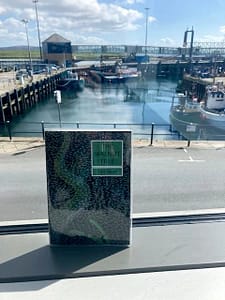
Ed Southorn’s new collection ‘SEA LAKE MOUNTAIN’

Ed Southorn has published a new collection, available from Walleah Press for $20 (includes postage within Australia).

Ed Southorn’s second poetry collection examines memory, landscape, history and myth, weighing the impacts of property development, population pressure and climate change in the Bega Valley on the far south coast of New South Wales. The second half of the collection explores storied spaces and places in Europe, America and the Australian outback.

Artist David Campbell provided the cover for the book, while poets Liam Ferney and Kristen Lang contributed blurbs:

Sea Lake Mountain is steeped in the littoral, the pull and push of tides in the Bega Valley. ‘The wave is every living thing/gone before the Moon/can intervene.’ Even the Monaro plains are an ‘ocean [of] nothing but land’. Southorn’s keen eye and sharp descriptive flair let the poems wash in the numinous without neglecting to acknowledge the ‘library of toppled shelves’ the settler gaze must sort through. For ‘I am water and my blood salt’.

LIAM FERNEY

These poems diversify our understandings, breaking the linearity of our human stories in favour of an ecology of thought as fluid as the world entwining it. The poems follow yearning, conflict, sadness, love, but always through immersion. Ed Southorn finds his moment, the poems tell us, ‘in a confluence of synchronicities’. Meeting these moments, we leave with a larger world inside us.

KRISTEN LANG

cover 'SEA LAKE MOUNTAIN' by Ed Southorn
                                   Ed Southorn’s poetry collection ‘SEA LAKE MOUNTAIN’

Available for $20, posted within Australia, from Walleah Press

Vanessa Proctor, Helen Swain ~ Whispering Gums

Good, if belatedly, to come across a generous and thoughtful reading on the praiseworthy Canberra-based literary blogsite, Whispering Gums of a couple of poetry collections published over the past twelve months, Helen Swain’s Calibrating Home and Vanessa Proctor’s On Wonder.

The two books were both published in 2024, and it’s a little amusing because Tasmanian poet Helen Swain’s collection, Calibrating home, was published by the New South Wales-based 5 Islands Press, while Sydney poet Vanessa Proctor’s collection, On wonder, was published by the Tasmanian-based Walleah Press.

Helen Swain lives and works in Lutruwita/Tasmania. She has been a teacher, performer (performing in Tasmania, mainland Australia, Berlin and Paris) and community arts worker. Along with Mary Blackwood, Eleanor March, Gina Mercer and Lyn Reeves, Helen was part of a dedicated team behind the publication of Quicksilver Water, a 2022 anthology of women poets who’d been meeting and making art in the heart of Hobart for nine years representing an age group of eight to ninety-three years.

The Hobart City Council generously provided a grant to fund publication of the anthology as well as enabling Oasis to pay contributors, and to further gift some remaining copies to the wider Hobart community … causing one minor hickup, Hobart Bookshop had a purchase enquiry at the time, and got in touch in Gina. ‘Hmmm … not sure, it’s not meant to be for sale, but not to worry, we’ve a handful left’, and I think a copy eventually made its way into the hands of the would-be buyer. Not sure if money actually changed hands….

Gina Mercer launched Helen’s Calibrating Home in Hobart last November, noting ‘this is a very good book’ (you can read the launch speech online at Rochford Street Review) that will

’tilt your world – as you might tilt your glass of clear tea as you sit in the late afternoon sun – admiring the play of light and viscosity and shadow – as you sip both tea and poems… because having your world tilted by Helen’s hands is good. Her hands are steadying and precise and full of thought. Helen’s hands are knowing in all the best ways. They are enlivening, compassionate hands that hold that necessary, slippery “glow-worm” (‘Hospital Waiting Room’) on which we all depend – hope.’

Of Helen Swain’s ‘Calibrating Home’, Whispering Gums notes ‘The poems in this collection slip between past, present and future, often within the same poem, as you can see in “Traced”. There is a sense of struggle, but also of tenacity and endurance. War is evident, in specific poems like “Meeting up (for Michael O’Neill, killed in Ukraine May 2022” and in gentle poems like “Teacups” (“Grandmother’s teacups/survived the war”) where the domestic collides with violence. The shock of violence or war, and the cold displacement of people, is never far away in these poems. But, neither is the domestic, the peace, the connections, the gentleness (in “Suzi and the Spider”), and the humour (in “Mary”)’.

Of Vanessa Proctor’s On wonder, Whispering Gums notes that the book ‘was given to me by on old schoolfriend. It comes from a poet steeped in the haiku tradition, but it meets Swain at various points. One delightful synchronicity occurs between Swain’s “Suzi and the spider” which tells of Suzi gently releasing back into the wild a spider that has come into her house, and Proctor’s “A dragonfly” in which the narrator carefully unravels a spider’s silk from a dragonfly to set it free. Both speak of gentleness and respect for nature, and of connections between living things.

Vanessa’s book has been well reviewed elsewhere since publication in December 2024, including a thoughtful piece by Michael Sharkey in ‘The Australian’ earlier this year as well as another half dozen or so … you can find a couple on Greg Piko’s https://gregorypiko.com/2025/05/04/vanessa-proctor-on-wonder/ blog site, and  Samantha Sirimanne Hyde at Grattan Street Press in September.

Helen Swain’s ‘Calibrating Home’ is available for $26 at Five Islands Press, while Vanessa Proctor’s ‘On Wonder’ is available at Walleah Press for $22.


2025 Five Islands Poetry Prize | Shortlist

Five Islands Press has announced the Judges’ shortlist for the 2024–25 Prize.

Bathypelagia —Debbie Lim, Cordite Publishing Inc.
Portraits of Drowning — Madeleine Dale, University of Queensland Press
The Infant Vine Isabella — G. Mead, UWA Publishing
Past & Parallel Lives — Kaya Ortiz, UWA Publishing

The winning and order of commended books will be announced at a Zoom event on
Wednesday 3 December, from 5.00–6.00 pm (AEST Melbourne time). Join at:
https://unimelb.zoom.us/j/2338614152?pwd=aVhRZElvYjh1T2ZId2h1QW9ZbThSU
T09&omn=83583511486 Password: 106945

Everyone is welcome to attend to hear the judges’ report and readings from the finalists.

Please note submissions are open until 15 July next year for the 2025–26 Prize. Entry is
free. For details on how to submit, go to https://www.canberra.edu.au/five-islands-prize/


Robert Dessaix to launch ‘The Dear Four’: Hobart


TheDearFour-launch-invitation

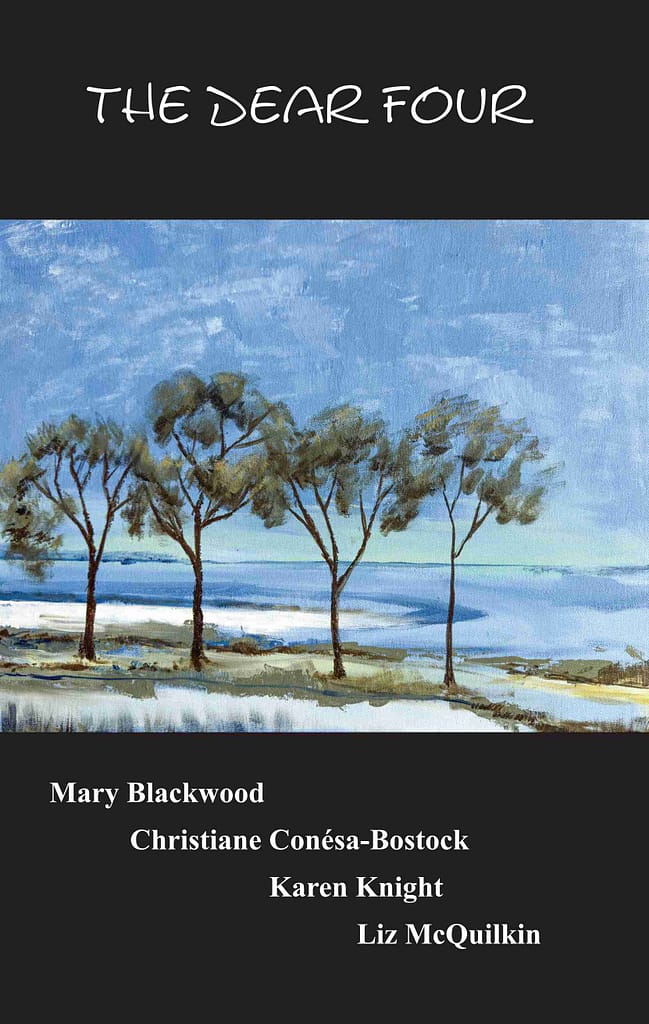
An invitation to attend the launch by Robert Dessaix of the poetry collection ‘The Dear Four’, featuring new poems by Mary Blackwood, Christiane Conésa-Bostock, Karen Knight and Liz McQuilkin

Sunday 14th December 2.30pm

Royal Yacht Club of Tasmania, Marieville Esplanade, Sandy Bay, Hobart

Drinks available from the bar

RSVP: lizmcquilk@gmail.com by 30th November

Vanessa Proctor’s collection ‘On Wonder’ | review

Samantha Sirimanne Hyde has penned a laudatory review of Vanessa Proctor’s Dec 2024 poetry collection On Wonder, at Grattan Street Press (29th September, 2025).

The Japanese perception of sadness, particularly a tender, contemplative sadness, is often defined by the term ‘mono no aware’. This is often rendered as the pathos or frailty of all things: an understanding of the impermanence of all matter and the wistful reaction that comes from its acceptance. Proctor’s poetry is often touched with this leitmotif of finding beauty in what’s blemished, fragile or ephemeral. For instance, cherry blossoms, which epitomise beauty, transience and renewal in Japanese culture, are depicted in the poem, “The Scattering of Blossom”, shifting between life and death, beauty, sorrow and acceptance. The poem moves from Australia, where the cherry trees bloom along Sakura Avenue “at the old POW camp in Cowra”, a resting place for over two hundred Japanese soldiers “beneath a foreign soil”, to Rikugien Gardens in Japan, where the poet reflects on the pale pink blossoms and the impending birth of her child, and finally to a snapshot of luminous flowering wild cherry trees in the foothills of the Himalayas.

Proctor encourages the reader to look more deeply at the world and at ourselves with kindness and compassion, celebrating our interconnectedness with one another and with nature. On Wonder is a book of understated elegance with comforting alchemy, a collection to be savoured time and time again.


Sri Lankan born Samantha Sirimanne Hyde lives in the unceded land of the Wallumedegal people in NSW. She holds an MA in Creative Writing from Macquarie University. Her collection of 20 short stories is called The Villawood Express & other stories and over 300 of her haiku and tanka have appeared in poetry journals. Her debut novel, The Lyrebird’s Cry, is a tale of self-discovery of a gay man trapped into an arranged marriage.

Louise Akers | 12 to 20 questions (from rob mclennan’s blog)

(from ‘rob mclennan’s blog’, 17 April 2025)

5 – Are public readings part of or counter to your creative process? Are you the sort of writer who enjoys doing readings?

I love doing readings–because they are fun and social and ephemeral experiences, but also it is a hell of a way to edit a poem. When I know I am reading something out loud in front of strangers, I will be totally ruthless in a way that only vanity can inspire. Also sometimes while I’m reading it, and really hearing and feeling its living reception I will change little things to allow for clarity or rhythm or some other immediate and interpersonal effect.

7 – What do you see the current role of the writer being in larger culture? Do they even have one? What do you think the role of the writer should be?

Oh, it’s hard not to just quote Walter Benjamin on this one. I think critique is important; I think it is important to register the fact that throwing language at a problem (“problem” standing in here very broadly and clumsily for any of the myriad social-political-environmental-economic cataclysms we are enmeshed in currently), policing the language around a problem, or even diagnosing a problem discursively are all deeply incomplete projects, while also realizing that that is not an excuse or a reason not to do those things. Very clunky sentence, but hopefully you get the drift.

(More at rob mclennan’s blog)

Louise Akers is a poet living in Brooklyn, NY. She is a PhD student in English at NYU and is the co-organizer of the small press and working group, the Organism for Poetic Research. Akers is the author of two books of poetry, Alien Year (Oversound, 2020) and Elizabeth/The story of Drone (Propeller Books, 2022).

Dulcetly (Kristy Bowen): Adventures in self-publishing

(from a post on Kristy Bowen’s blog Dulcetly | notes on a bookish life – 03 March 2025))

I was moving some books around on my shelf and realized I have now published just as many books via self-publishing as I did traditional publishing….

After 2020, I felt a shift in my relationship toward po-biz and publishing, as well as a general backlog and build-up of unpublished work. In those intervening years, I’ve had fairly long routines of writing poems daily (or at least fragments)  By the time 2021 had rolled around,  was sitting on three full-length manuscripts that I genuinely had no idea what to do with. I submitted at least two of them during reading periods for my current press, but nothing was picked up those go-rounds. I am not really a contest person, especially if they have high entrance fees and the idea of finding an forging another relationship with an indie seemed an up-hill climb.  And no one publisher could possibly take on as many books as I had stuffed away in my hard drive.

(More at Dulcetly)

Five Islands Poetry Prize ~ for a First Book of Poetry

Terms & Conditions

  • This is an annual prize for a first already-published book-length collection of poetry by an Australian poet or a poet living and writing in Australia.
  • The author of the prize-winning book will receive $2750 and the publisher will receive $1100.
  • A book can be entered by the author or publisher.
  • The book must contain at least thirty pages of poetry, have an ISBN, and be available through retail sales outlets.
  • Self-published books are eligible as long as they meet the above criteria.
  • For the 2024-2025 Prize, books published between 1 July 2024 and 30 June 2025 are eligible.
  • Note: the prize aims to support professional publishers, in particular small-press, independent publishers.
  • Submissions are open until 15 July 2025.
  • There will be three judges, whose decision will be final.
  • The Prize will be announced in late November, and presented shortly afterwards.
  • Four copies of the submitted book are to be posted to PO Box 68 Brunswick Victoria 3056.
  • Books submitted will not be returned.
  • An email must be sent to Kevin Brophy at: kevinjb@unimelb.edu.au attesting that this is the poet’s first published book of poetry, and providing the book’s publishing date, and contact details for the poet and the publisher.

Step 1

Post four copies of the submitted poetry book to the address below. Please note, posted books should be received on or before 15 July 2025.

Five Islands Poetry Prize
PO Box 68
Brunswick Victoria 3056

Step 2

Email Kevin Brophy, attesting that this is the poet’s first published book of poetry, and provide contact details for the poet and the publisher. Please subject your email as “Five Islands Prize Entry”.


Five Islands Press Poetry Prize 2025

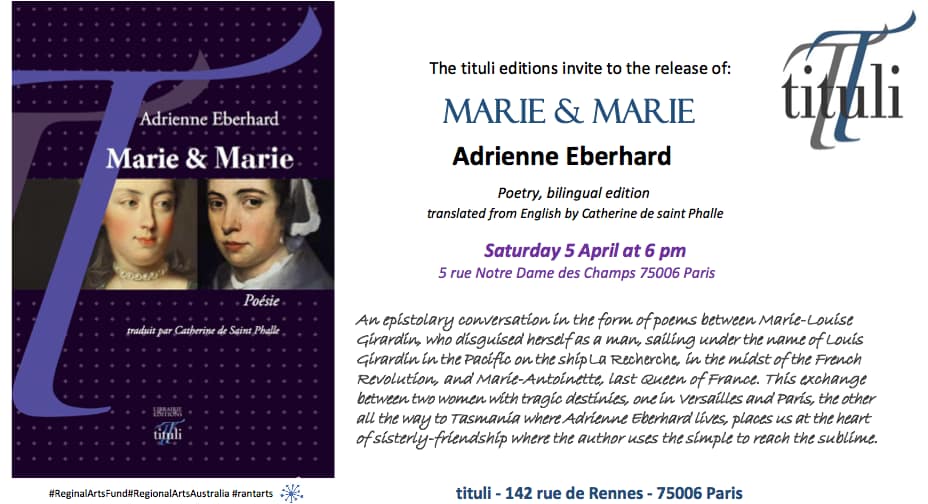
Adrienne Eberhard | ‘Marie & Marie’, Paris launch

Lovely to learn of the launch in Paris last week of Adrienne Eberhard’s new collection of poems, ‘Marie & Marie’, on Saturday 5th April.

Thirteen years in the making, Adrienne’s bi-lingual collection ‘Marie & Marie’ imagines the correspondence between Marie-Antoinette and Marie-Louise Girardin. Adrienne, who’s been in France overseeing the book’s publication the past month, returns to Tasmania soon where she’ll (no doubt) be planning and looking forward to a local launch. Congrats!


Alison J Barton – on 3CR’s Spoken Word, interviewed by Indrani Perera

Enjoyed a thoughtful interview with Wurundjeri poet Alison J Barton recently, aired on 3CR’s Spoken Word program (08 August 2024)…. Indrani Perera spoke to Alison about her collection, ‘Not Telling’, Alison’s debut full-length poetry collection published by Puncher and Wattman.

Perera began by asking about the book’s ‘intriguing’ title…

The title came to me because the unifying theme of the collection is language and speech and in fact silence and not speaking. It’s also a bit of a play on a line in one of the poems in the collection. That’s the unifying theme, but the book is also broken into three sections and they’re quite distinct, the sections. I have one about colonisation and Aboriginal Australian history, one that’s really about family relationships and just indeed human relationships, and another section that has poems that are written around psychoanalytic theory. But yes, the unifying theme is language, speech and silence. You see that coming up in most of the poems, I think.

I know people don’t talk about favourite children, but do you have a favourite section in the book?

Ah, that’s a good question. I haven’t thought about that, actually. Yeah, maybe I do, but I don’t want to say. But no, look, there are poems in each section that I’m quite fond of. I think the sections are so distinct that it’s pretty hard to pick a favourite.

Fair enough.

’Buried Light’ is the first of the poems Alison read throughout the half-hour program, introducing the topic of colonisation in Australia – something that, growing up in the 80’s, ‘ just wasn’t a thing. The history that I learnt was so revisionist it was ridiculous’, says Barton. Perera wondered what it was like as a First Nations poet to have a residency at Oxford University. (In the past, Aboriginal human remains were often obtained by researchers – some associated with Cambridge – and frequently without consent. Aboriginal groups have long demanded the repatriation of remains – and some have been returned – but the process has invariably been slow, and often obstructive)

Yeah, look, it was a great experience but, of course, I was very aware of that contradiction in being there and also I’ve reflected on it a lot since the fellowship.

and there’s a great deal left unsaid here in an interview packed within a half hour program, though Puncher & Wattman’s website offers more of the book’s detail and its depiction of the

ongoing legacy of colonial dispossession and the strength of its survivors through representations of the wretched damage caused by the invasion of Australia, as well as musings on sacred land and celebration of continued culture. It testifies to the systemic oppression of Aboriginal people, connecting present-day black trauma with its origins. Jolted by the life realities of who we were, and are, alongside exacting accounts of genocide, the reader is immersed in a rich and harrowing world.’

…………………………………….

It was about five years ago that Barton took up poetry.

I sort of thought that I couldn’t write poetry so it was something that I didn’t explore until it suddenly came to me about five years ago and I just haven’t been able to stop ever since.

‘Do you know what it was that prompted that shift from prose into poetry?’

What actually happened is a poem just came to me and it’s very rare for that to happen now but it just spontaneously came to me and I wrote it down and I realised it was a poem and I literally have not stopped writing poetry since then.

So it basically snuck up on you and ambushed you?

Exactly. Yeah, that’s a good way of putting it. And there’s something sort of mystical I think about the creative process.

Alison I’m wondering what inspires you to write?

That’s such a big question. Basically everything.

I am in a daily writing practice, so I’m putting something on paper every day and, yeah, anything and everything, I would say.

So everything’s sort of grist for the mill?

I think so, yes. And while I write every day, it’s usually stream of consciousness writing that I then read over later and turn into poetry.

So when you write, is it in paragraph form or are you using dot points?

No, neither, I very much am writing in an endless stream. I have a journal, I use paper and pen and I use grammar sparingly, but there are no paragraph breaks. It’s a very continuous line of thought.

And how long do you do that for each day?

Ideally I would do it for an hour, at least an hour each day, but of course I don’t always get to do an hour. For me, even if I write for a few minutes, I’m happy that I’ve written something each day. Sometimes it’s much longer.

Do you find that doing it daily helps you to then form poems?

Yes. Well, it gives me a lot of material to go over later and turn into poetry, I think if I didn’t do that, I would produce much less poetry. There have only been a couple of times in my career where I’ve sat down with the intention of writing a poem and not using any material, any sort of written material that I’ve produced prior and a poem has just come to me spontaneously.

Usually it’s through great effort.

So is it like your shortcut or your secret hack to writing poetry, doing that daily practice?

Yes, I think that’s right, yeah.

I really envy you writing every day.

Thank you … for some people they need to write, they must write, but they have to force themselves and for me for some reason it’s actually a pleasure.

That’s fabulous.

That’s a great place to be in as a writer. I feel very lucky.

…………………………………….

Writing can be isolating, but a good writing group offers encouragement, honest feedback, and shared understanding. Being part of a writing group means you’ve people to push you to improve, keep you on track. Alison was questioned about whether she belonged to a writer’s group, ‘or do you have somebody that you share your work with and get feedback as you’re going?’

Yeah, I am in a writer’s group with three other poets, it’s only something that we’ve started recently, probably in the last year, I would say, and it’s incredibly useful for refining poems, sometimes I’ll take a poem to that group and I’ll think this poem needs a lot of work. This is in its very early stages. And then the group will surprise me and say, Alison, this poem’s ready.

I think what’s great about that group as well is that we’re all writers, we’re all poets, so we are honest with each other. If something needs work, you know, we want to get better and we want to help each other.

So yeah,  there’s real trust in that group and I value that perspective. I feel like trust is be very important if you’re sharing work, especially poetry, which feels very personal.

I’m curious about your writing and if there are particular topics that you’re writing about.

In general, you mean?

Yeah.

No, I don’t, I really don’t restrict myself and I don’t want to force a poem about something. I have done that at times, but it’s kind of rare.

I think one of my early poetry mentors said to me something along the lines of, you have to let the poem be what it wants to be. And I think it’s very true. I think when I write a poem, it surprises me sometimes, you know, in subject matter sometimes or where it goes.

………………………………………………………………………………………………………………………………………………..

(To listen to the full recording, visit 3CR’s Spoken Word program).

Alison J Barton’s work has appeared in Australian and international journals and anthologies such as Meanjin, Cordite, Westerly, Mascara Literary Review, Australian Poetry Journal, Black Box Manifold and many more. In 2023 she was the inaugural winner of the University of Cambridge First Nations Writing Residence Fellowship. She has been the recipient of several fellowships with Varuna House and the winner of a number of international writing residencies. Alison’s poetry appeared in the Best of Australian Poems 2022 and 2023 and has been recognised in numerous prizes. She’s appeared in podcasts for the Guilty Feminist and Poetry Says.

Alison J Barton’s collection ‘Not Telling’ is available from Puncher & Wattmann retailing for $27.


2024 Anne Elder Award judges panel announced

Australian Poetry has announced the three judges for the Anne Elder Award 2024 panel. They are Jeanine LeaneTheodore Ell, and Ella Skibeck-Porter. Theodore was the 2022 Anne Elder Award co-winner with Harry Reid (a judge last year) and Ella was Highly Commended in the 2023 Award.

2024 Anne Elder Award panel:

Jeanine Leane is a Wiradjuri writer, poet and teacher from the Murrumbidgee River near Gundagai. Her poetry has won numerous awards and prizes, including the David Harold Tribe Prize 2023. Jeanine is widely published in the areas of Aboriginal literature,  literary critique, and writing identity and difference. She is currently a First Nations Writer in Residence at the University of Melbourne where she previously taught Creative Writing and Aboriginal Literature. Jeanine’s current poetry collection, Gawimarra: Gathering  (University of Queensland Press), is short-listed for the VPLA 2024 Poetry Prize.


Theodore Ell is a writer and honorary lecturer in literature at the Australian National University. His poetry collection Beginning in Sight shared the 2022 Anne Elder Award. From 2018 to 2021 he lived in Lebanon, accompanying his wife on a diplomatic posting. Ell’s essay ‘Façades of Lebanon’, about witnessing the 2019 Lebanese revolution and surviving the 2020 Beirut port explosion, won the 2021 Calibre Essay Prize, and his memoir Lebanon Days was published in 2024. Ell’s poetry, essays, translations and non-fiction have been published in Australia, Italy, the United Kingdom and Lebanon.


Ella Skilbeck-Porter is a poet living in Naarm/Melbourne. Her debut collection These are Different Waters (Vagabond 2023) was shortlisted for the Helen Anne Bell Poetry Bequest and the Mary Gilmore Award and was Highly Commended in the Anne Elder Award. Her work has been widely published in journals and anthologies including Best of Australian Poems 2024, Living Systems: Poetry from Asia Pacific, HEAT, Otoliths, Rabbit and Cordite Poetry Review.

Helen Swain’s poetry collection ‘Calibrating Home’ | launch speech by Gina Mercer (Nov 2024)

Gina Mercer, Hobart | 24th November 2024:

So, here is a book. It’s Helen’s book. It’s a very good book. Filled with – and ‘about the goodness of people’. You, all of you – you are a ‘goodness of people’. Gift yourself this very good book. Gift one to any of your people who love goodness. Who need this brilliant balance of balm and grim. Oh, for goodness’ sake – buy a heap. It’ll make Helen happy. It’ll make Bronwyn, the indefatigable and ever-helpful bookseller, happy. And Helen’s perspicacious publisher, 5 Islands Press. And Suzi – why, even the wee spider will be happy.

So here goes, here, I launch this very good book. Helen’s book. Here – it flies into your delighted arms and hearts. Because we know deeply about the goodness of people. That goodness, and this very good book of Helen’s poetry, are our best protection against the weather or whatever is coming.

Read Gina’s full launch speech at Rochford Street Review.

‘Class’: new (free) downloadable anthology of poems (Meuse Press, Aust)

Maybe of interest? New (free) downloadable pdf anthology of poems entitled ‘Class’ (Meuse Press, NSW Australia, edited by Les Wicks) featuring 74 contributors (45 Australiana along with international contributors published in 14 languages) — at https://meusepress.tripod.com/Meuse.htm (scroll down the right hand side of the page and click on Class.pdf) with contributors including Margaret Bradstock, Kit Kelen, Jennifer Compton, Philip Hammial, Richard James Allen, Jennifer Maiden, Beth Spencer, Louise Wakeling, Margaret Ruckert, Martin Longford, Lesley Synge, Ross Donlon, Kathryn Hummel and many more….

Elanna Herbert ~ ACT Literary Awards 2024

Lovely to see Elanna Herbert’s 2023 poetry collection ‘sifting fire writing coast’ has been shortlisted in the ACT Literary Awards, along with Sandra Renew’s ‘Apostles of Anarchy’, K. A. Nelson’s ‘Meaty Bones’, Tim Metcalf’s ‘The Moon the Bone’, and Paul Hetherington’s ‘Sleeplessness’. Good luck to all.


Anne Elder Award —Australian Poetry announces Call-Out

  1. Open call for entries – Monday, 15 January 2024
  2. Close of entries – Tuesday, 12 March 2024, 5pm (AEST). Books must be postmarked no later than Tuesday, 12 March 2024.
  3. Winner announcement – May 2024


Information and enquiries
Jacinta Le Plastrier
Email: ceo@australianpoetry.org
Note: Responses to enquiries will not be sent until after 15 January. Please note the new AP address is now: AP, Anne Elder Award, GPO Box 1753, Naarm/Melbourne, VIC 3000. The GPO box number is essential.


The award is named after Anne Elder (1918-1976), a dancer with the Borovansky Ballet in the 1940s who later in life became a notable poet. Her poetry attracted praise from many critics for its vigour, depth of reference and distinctive artistry.  Sponsored by the Australian Communities Foundation, this prestigious, national, annual award is for a sole-authored first book of poetry of 20-minimum pages in length, published in Australia.


Established in 1977, the prize has offered important recognition to poets at a critical point in their writing lives, and its alumni represent some of Australia’s best-known and highly respected poets. The winner is awarded $1,000, and there is also the opportunity for the judging panel, which for the 2023 Award will be announced in late January, to award other books a commendation or special mention.


Books published between 1 January 2023 and 31 December 2023 are eligible for entry into the 2023 Anne Elder Award.


Submission Guidelines & Eligibility

  1. Open to Australian residents only
  2. Entries must be in English. Bilingual volumes are acceptable as long as one of the languages in which the poems are written/translated is English
  3. Book should be a sole-authored first collection of poetry published in 2023
  4. Book must be 20+ pages in length and have been legally deposited with the National Library of Australia
  5. A book can only be considered a first volume if the author has not had previous volumes of poetry of 20+ pages published either in Australia or elsewhere
  6. Chapbooks are also eligible if they meet the above guidelines—please note, if a poet has entered a chapbook previously, they cannot re-submit a longer collection
  7. Entrants who have previously published in another genre are eligible as long as the entry submitted for this award is the first volume of poetry published by the author
  8. Co-authored entries are not eligible for the award
  9. First prize $1,000. Winners and commended entrants will receive a copy of Selected Poems of Anne Elder (Lauranton Press)
  10. The judges reserve the right not to award a prize
  11. The judges’ decision is final and no correspondence will be entered into.


How to Enter

  1. Send 3 copies of the book to: Anne Elder Award Nominations, c/o Australian Poetry, GPO Box 1753, Naarm/ Melbourne Vic 3000.
  2. Entry fee $35 (including GST) is payable at the time of entry. Payment is via an invoice generated by AP. Please contact Jacinta at ceo@australianpoetry.orgso she can organise an invoice, to be paid via EFT. Please also let her know when you have mailed your copies so she can be in contact if they do not arrive.

Koraly Dimitriadis — book launch, Launceston 29th February 2024

The TPF 2024 kicks off its first pre-festival event with a book launch by Koraly Dimitriadis – a Melbourne poet, performance artist, film maker and short story writer.

Join us upstairs at 6 pm on the 29th February at the Plough Inn (lift available) 170 Brisbane St., Launceston to hear this wonderful and multi-talented woman.

Koraly is on her book tour and will also be performing at Silver Words in Hobart on 28th February.

Ticket link:- https://www.trybooking.com/COZAU

Arts Tasmania is a major sponsor of the Tasmanian Poetry Festival in 2024.


Update from Liquid Amber Press – 2024 publications, and beyond

(from Liquid Amber’s newsletter | 19th January 2024)

Publications for 2024 – and beyond

What an amazing round of submissions we had for the Liquid Amber Publication Call! Thank you to everyone who submitted – for your willingness to share your wonderful work with us. We would certainly love to have been able to publish more titles – but are thrilled to announce our list for 2024.

  • Jenny Pollak Clarion
  • Dominique Hecq Volte Face
  • Nathan Curnow Canaan
  • Stephanie Powell Small Acts
  • Rose Lucas Remarkable as Breathing

And in 2025, we look forward to publishing:

  • Anne Elvey Intents
  • Angela Costi The Heart of the Advocate
  • E Anne Gleeson The Deepest Thing

Andy Jackson, interview with Advocacy for Inclusion (28th Nov 2023)

Thoughtful responses from poet Andy Jackson, interviewed by Rob from Advocacy for Inclusion (28th Nov 2023), online at Buzzsprout.

Rob, discussing Andy’s poetry collection Human Looking

The poem that really struck me that I sat with for quite a bit was separation, and for me it spoke of the violence of surgical intervention and a very deep and intimate sense of loss that followed from that. In the poem, you speak of those philosophers with scalpels, and I love that line, the kind of philosophy of cutting, those philosophers with scalpels who make a life normal by breaking it in two. So, and I guess this is really flying from what you’ve said so far, is the current health system enthralled to this pursuit of this idea of normal at all costs? And how much does the system operate with the presumption that health is really defined by that particular way of looking and functioning in the world? I guess it really is a little bit of a further answer.

Andy Jackson

Yeah, look, that poem came out of a very particular interest that I had at the time in looking at conjoined twins and this really intriguing sense that for the two, you know, you’re sharing skin, which is, I guess, a very extreme version of our interconnectedness anyway. And that’s where that line comes from, you know, making life normal by breaking it in two, because the assumption in that context is, well, you can’t have a normal life. It’s not normal, to be conjoined. You actually, often it’s thought of as you have to sacrifice one in order to have a singular child. And of course, you know, in general and in that particular situation, there’s no way of being purist about this. I, for my own sake, I’ve had surgical interventions that have quote – unquote normalised me slightly, and they were necessary, you know, they were useful. But it’s interesting, I find it very interesting to explore what the motivations are and where that border is between something that is necessary and something that seems necessary. So in many other cases, we think about intervening in a child’s life. I mean, we see this in people who are intersex, for example. They’re forced to, you know, oh, we’ve got to make this child either, or recognize them being male or female. We’ve got to, in other situations, you know, we even see it with kids who are bullied. We think, all right, we’ll move the child who’s being bullied, rather than addressing the behavior. So, yeah, I think it’s understandable on some level to go for the individualist, easier option of, let’s fix this person so that they blend in, or let’s move them to another space so that the bullying or the staring doesn’t happen. The harder option is to really start unpacking and addressing and yeah, tackling the prejudice that happens. It’s not easy, but it’s the only thing that is actually going to make a society more coherent and more fair and more just and compassionate. That’s the challenge and we all suffer from this idea of the normal. It’s something that I think plenty of us, you know, it affects more deeply but I think all of us have this feeling that we don’t quite match up. So it’s not just a question of disabled people, it’s really a question for all of us. How do we have a different model? How do we have a model that’s more about the broader human health and human flourishing and human connection, and belonging on the land and being able to be here with each other.

Australian poetry news — Five Islands Press

Oystercatcher Enterprises Ltd, a not-for-profit company recently founded by Mark Tredinnick and Steve Meyrick, is proud to announce its intention to revive Five Islands Press as a publisher of new poetry and writing about poetry and other lyric works.

Founded in 1986 by Ron Pretty, and named for the five islands off Port Kembla, where Ron lived and wrote, Five Islands has published many of Australia’s finest poets. When Ron stepped back from active involvement with the press in 2007, the fine publishing tradition that he established was continued for over a decade by his successors, with the Press publishing a further 44 books by emerging and established poets before announcing, in 2018, that it would cease publishing new work. Since 2020, the imprint has been managed by Dr Gareth Jenkins, Managing Editor of Apothecary Archive.

Dr Jenkins welcomed the change. “It has been a pleasure connecting with Five Islands readers and writers over the last three years. I always felt like I was just an archivist of the press and its long history so I’m very pleased it will get a new lease of life through Mark and Steve’s initiative.”

Mark Tredinnick, Managing Editor of Five Islands, outlined Oystercatcher’s plans. “It’s our intention to publish at the press an exciting range of new titles, the best lyric work of our best writers, poetry that is timeless and timely, intelligent and intelligible, beautiful and urgent, poetry that is both accomplished and accessible to audiences well beyond the poetry specialists who are most of the readers of new poetry at present.”

“We’re grateful to Gareth for agreeing to transfer the imprint to our new company, and for his vital role in preserving the imprint during a period when its history and tradition of the press could well have been lost.”, Dr Tredinnick said, “I’m really pleased that Gareth has agreed to collaborate with Oystercatcher in rebuilding FIP as we grow it and, with luck, change the shape of Australian poetry, in particular broadening its readership.”

“Our aims are close to those that the founder of Five Islands Press, the late Ron Pretty, spent his life promoting,” explained Mark. “In his own poetry, in his writings on the craft, in his teaching and mentoring and, importantly through Five Islands Press, Ron wanted to make poetry that took people deeper into their daily lives and minds. And he wanted that poetry to reach readers who might not otherwise read it. So, in responding to what we see as the urgent need for more poetry publishing in Australia—especially of lyric poetry, poetry of wisdom and accomplishment and craft—it seemed sensible to carry on what Ron began, to revive a revered press he founded and, with others like Kevin Brophy, built into the most respected poetry press of its day.”

“I owe a debt to Steve Meyrick, too, a fine emerging poet, for seeing in the renewal of Five Islands a way to do some good, of the kind we’re both committed to—for poetry, for the manifold Australian poetries, and the places and lives they witness—while also honouring a press that has already done so much pioneering work in these areas. Steve lives on Wodi Wodi land, within sight of the five islands, and I’m not far inland on Gundungurrah country, so it gives us great joy to rebirth this press where it began. Poetry’s realm, it has been said, is the parish or the watershed, and it is the world. That idea guides our hopes for the press, and the oystercatchers of the shores of the five islands will hold us accountable.”

Steve, who was formerly CEO of a successful economics consultancy, will take on the role of Commercial Director of Five Islands Press. “Much work lies ahead of us, developing the structures and processes that will enable Five Islands Press to become again—and remain—a force in poetry publishing for many years”, Steve said. “We expect it’ll be twelve months before our publishing activity fully hits its stride. But we’re excited to announce that the first publication of the Five Islands Press in its new incarnation is Mark Tredinnick’s Nine Carols, a small book of carols written by Mark, which Alan Holley has set for four voices. The Australian Chamber Choir, which first commissioned Holley to write them some carols, premiered one of the carols (“The Carol of the Two Crows”) in 2022 and will sing that and “Koel Carol” in its 2023 Christmas series; Fiore Ensemble sings three more of them this November in Melbourne, and the book, including a new Advent Overture (a ghazal) written for the occasion, appears in November to catch the Christmas trade to accompany the performances by ACC and Fiore. The book is stunningly designed and illustrated by Gerhard Bachfischer, and printed and stitch-bound by Carbon8 in Marrickville. It perfectly showcases these beautiful contemporary carols, instances of the plainspoken lyricism Five Islands hopes to publish more of in its reincarnation. Other publishing initiatives will be announced early in 2024.”

Review, David Mason poetry collection ‘Pacific Light’ (Los Angeles Review of Books, 20 Nov 2022)

Thoughtful words, both by and about US poet David Mason, now resident in Tasmania.

Siham Karami reviews Mason’s Pacific Light (Forty South Publishing, Sept 2022)….

In this collection, we sense it in the very first poem, “On the Shelf,” whose title rhymes with and is the same metric length as that of the final poem, “Note to Self” — another indication of the care with which Mason organizes his effects. There we are invited to observe the smallest thing, a spider’s shed skin, which the speaker “thought twice before touching,” because the spider’s “soul” is still “able to frighten.” He wonders if his own “shed skins / in houses where my name has been removed” will elicit an emotional response, if “some words of mine” will thus “go on living,” without asserting it. The question remains humbly open.

There’s reference too, to previous conversation with Mason in the form of a link to Leath Tonino’s 2015 interview with the poet, published in The Sun.

Tonino: As you’ve described it, the Greek view seems particularly fitting for a poet. I like the idea of poets as people writing from the brink, with the clarity and intensity of the about-to-die. It makes me think of the Zen Buddhist tradition in which a master often writes a final poem on his deathbed.

Mason: That happens in the Western tradition as well. Many poets write their own epitaphs. Take Robert Frost’s: “I had a lover’s quarrel with the world.” That’s just a beautiful idea. We’re always a little at odds with the world, always wrestling with it, fighting it, beating our head against it. But we also love it very much. Elsewhere Frost says, “Earth’s the right place for love: / I don’t know where it’s likely to go better.” You’ve got a body, and the body can love as well as suffer. Sometimes love is suffering, right?

I think poets as a group often do have an essentially Greek view of existence. I don’t mean they are all influenced by the Greeks. There are obviously Christian poets and Buddhist poets and many others with different theological standpoints. But the awareness of death seems common to all. It’s almost the nature of poetry.

Tonino: But obviously poetry doesn’t have to be only about loss, grief, and death.

Mason: Right. There’s a spectrum. Sometimes it’s about transforming loss. We are all transformed by grief. We change in the way a tree struck by lightning changes. Artists try to capture that in a poem or a minuet or a painting or a sculpture.

A student was asking me just today: Why is it so hard to write about happiness? I replied that it’s hard to write well about anything — it’s just damn hard to get the words down right — but it’s especially hard to convey the joyful aspects of life without becoming sentimental. Sadness, too, can be maudlin, but it’s particularly true of happiness.

And yet there are happy works of art out there, works that are brimming with gaiety, to use W.B. Yeats’s word. Even the tragedies often crackle with a kind of life energy. You feel revitalized by partaking in them. Somebody once speculated that the writer Flannery O’Connor must be a cynical person, because her short stories are so dark. Her answer, which I’m paraphrasing, was that no completely cynical or nihilistic person can write fiction. In a sense, the very act of creation is fundamentally an acknowledgment of life.

I read a lot of contemporary poetry and often find myself feeling that there’s no vitality to it. It’s as if the author were dead inside, or just writing for professors. There’s no human pulse there. The poem doesn’t beat like a heart. All the best literature has that pulse. It makes you feel alive to read it.

Launch of ‘Reaching Light’, by Robert Adamson [Sydney, July 2022]

Robert reading and in conversation with his Flood Editions USA editor/publisher & poet Devin Johnston, with readings by Sarah Holland-Batt and Michele Seminara.


The very sad news is that Robert Adamson is gravely ill. 

*          *          *          *          *

Normally, I’d not think twice about the mention here of a literary event—a book launch—yet I’m vaguely aware that doing so on this occasion could possibly be construed as no more than zeroing in on a topical note of interest.

However….

*          *          *           *            *

When Tim Thorne fell ill, I found myself hesitant to engage, ask how he was going … generally, just unwilling to intrude. In retrospect, it was a rubbishy form of interaction on my part—albeit under trying circumstances. I regret I didn’t make a greater effort…. Physically, Tim was slowing down, but mentally he was still off and running…. We shared a moment together, one session during the 2021 Tasmanian Poetry Festival. The state election had been called that very day, and scheduled for the 1st May. I made some reference to it, to which Tim quickly replied oh yes, and that’s going to put a very different interpretation on May Day, isn’t it? and he laughed.

I should also have said, oh by the way I appreciate and admire you so very much; for your generosity, for all you’ve achieved…. But I didn’t.

So goodbye rubbishy decisions.

I don’t know Bob Adamson’s work well, and my indirect association with him has only occurred since he provided back cover blurbs for one or two of the poetry collections I’ve published (Vanessa Page’s ‘Confessional Box’ comes to mind) some years ago. My belated appreciation of his poetry is due to the arrival in our home of a copy of the 2016 anthology ‘Contemporary Australian Poetry’ (Puncher & Wattman), where the work of poets is, according to surname, arranged in alphabetical order. Such a great anthology, so many very fine poems, but I always experienced difficulty getting past the opening five poems in the book—Adamson’s—’Via Negativa: The Divine Dark’, especially. Such fine poems all…. Bless you Bob for making vivid, and sharing, your perceptions.

Book launch—Gayelene Carbis’ ‘I Have Decided To Remain Vertical’; Melbourne 16 Oct 2022, launched by Marion May Campbell

Plenty of support for Gayelene Carbis, when Marion May Campbell launched her new poetry collection—’I Have Decided To Remain Vertical’—at Readings in St Kilda last month.

With Claire Gaskin MC-ing the event, local choir The Red Hot Singers — (‘This is not a choir, it’s a singing group … in other words, informal’, someone clarified; another pointed out ‘We’re all part of Soul Song’, a subset; we get out and about!’) — provided an African musical intro as a prelude to Marion May Campbell’s launch address. Much like Kevin Brophy in Melbourne (and Pete Hay in Hobart and Cameron Hindrum in Launceston), Campbell is a favoured ‘go to’ person when it comes to launching poetry in Melbourne, (she launched Susan Hawthorne’s ‘Dark Matters’ at Collected Works five years ago, back in the days when Kris and Retta welcomed all & sundry to their fabulous bookshop, ‘up the stairs and to the left: or take the lift!’)

Claire urged punters to ‘buy a book, to support Gayelene, to support poetry, to support Readings, to support the wonderful publishers who publish poetry’ before introducing Marion May Campbell, whose bio she proceeded to read. ‘If you haven’t read all those books [of Marion’s], you know, you really haven’t lived so you have to make sure you do that … a wonderful writer, a beautiful person who’s won many awards and supported many a writer … (Gayelene’s nodding!) Please warmly welcome Marion May Campbell.’

Marion spoke of the miracle of several key poems in this new collection presenting an integration ‘of a kind of terror and of comic Alice-like defiance. Surreality is presented with hyper-real acuity…. Poetry-making often snatched from the doors of disaster is both agent and catalyst for the I-persona — and I won’t call the ‘I persona’ Gayelene, because it’s so variable as well, and protean … takes on different shapes all the time. Her triumphant survival, no matter into what pits life and love have thrown her, is always done with great comic brio – and often hilarity, all the more liberating for the near-catastrophe that she skirts.’

‘I had a much longer version of this already-too-long speech, which quoted a lot of these poems—I would have liked to write about every poem in the collection….

.   .   .   .   .

‘In various inventive ways Gayelene’s work, so far—in her plays, stories, and now two poem collections—has explored both the comedy of feminine identifications, and the devastation wreaked by models of masculinity that men, and boys, strive to enact, or refuse at their peril.

.   .   .   .   .

“Again, the last line is an unmitigated triumph. ‘I hold my pen like a knife’.

.   .   .   .   .

“Here fabulism triumphs over sadness with magical metamorphosis, yet the humble domestic broom, remembering its origin, offers a retreat. And I’m reminded here of that Turkish proverb, When the axe came to the forest, the trees whispered—the handle’s one of us.’

‘Oh Gayelene, thank you for such fabulous, transfiguring work. Congratulations, from the heart.’


‘Marion … thank you for your beautiful, and passionate and erudite response to my work, and for launching my book into the world in words that are so uniquely you, thank you—from my heart, thank you.’

‘I think we should all go home now…. I mean do I need to say or read anything? Yes I do, Yes I do. I need to say thank you. These poems were written over many years, some a very long time ago. I spent years and hours working towards this book, and it’s just … me and the work … but it really takes a community to create and make a book. I’d like to firstly thank Puncher & Wattmann whom I’m thrilled to be published by, huge thank you to David Musgrave….

‘A huge thank you to Marion May Campbell, and Kathleen Mary Fallon, for extraordinary generosity over many years. Kathleen, thank you for suggesting the title, Marion really pushed for this one amongst the Kathleen Fallon list of possible titles … well not pushed, that’s not Marion’s style: she presented ‘elequent arguments’. Initially I thought, it’s too long, it sounds weird … and then I thought, ooh, I wrote that line. Now I think it’s a perfect title for the book….’

Gayelene proceeded to read a number of poems from her book, a reading of which Lyndon Walker has since written generously and reflectively,  “A fine and powerful reading of your work. Very moving, and very funny – you have that balance there. You are one of the best readers/performers of your own work in this country.”

Bringing the event to a close, the Red Hot Singers once again took to the floor. ‘Gayelene … do you wanna? … come and sing with us.’

‘Oh, yeah sure. You twisted my arm….’

(to view the full launch event, visit here … to purchase the book, visit here).

Tasmanian poet Tim Slade, reading ‘Thylacine’

Tim Slade’s been writing poetry for a decade, his work has appeared in publications as diverse as The Weekend Australian, The Koori Mail, Australian Poetry Anthology, Growing Up Disabled In Australia and Cordite Poetry Review. Originally from Hobart, he settled in the tiny Tasmanian town of Pioneer a decade ago where he’s drawn inspiration for much of his poetry. 

Tim’s poetry collection The Walnut Tree, was published in April 2021 by Daniela Brozek Cordier’s imprint Bright South Publishing, and launched by Pete Hay at Petrarch’s Bookshop, Launceston.

Tim Slade at the launch of The Walnut Tree

Coincidentally, both Slade and Hay—in their most recent collections—praised the work of a Scottish poet who lived out his life on a far flung island on the opposite side of the globe, Orcadian George Mackay Brown.  Honouring Brown, Tim mailed a copy of his book to the local library in Stromness, Orkney Islands, where the book is now available to borrow.   ‘On the harbour in Stromness, the view from this library is perhaps the most picturesque in the world,’ Tim writes.

Tim recently produced a Youtube video of ‘Thylacine’, one of the poems featured in his collection. As well, Warwick Hadfield read the poem on RN’s Breakfast programme in July this year. ‘Thylacine’ was previously published in Communion 15.


Fullers Poets — Mary Blackwood & Liz McQuilkin: 12th May (Hobart)

Fullers Poets is a new event series celebrating contemporary poetry. The first event in this series will feature poets Liz McQuilkin (Unwrapping Clouds) and Mary Blackwood (Small Cosmos) in conversation, with readings from their work.

Praise for Liz McQuilkin:
‘Liz McQuilkin has Mary Oliver’s ability to show us ordinary, yet extraordinary, moments in the natural and human worlds. I love her sharing of reflective moments, and her pellucid, deeply moving observations on births, deaths, and the journeying between.’ – 
Esther Ottaway

Praise for Mary Blackwood:
‘Mary Blackwood writes with power and precision. She takes a razor to the times in which we live, slicing away the dross and the cant. She gifts us poetry that is deft, sure, laden with insight. If a poet’s task is one of linguistic distillation, a paring down to lay bare the diamantine essence of things, then here is a poet of the very first order. Read these poems – see what language can do.’ – 
Pete Hay


Notes from a launch: Esther Ottaway’s ‘Intimate, low-voiced, delicate things’

My take on Jane Williams’ launch of Esther Ottaway’s poetry collection ‘Intimate, low-voiced, delicate things’ in Launceston last year — please visit here.

‘I’ve been a fan of Esther Ottaway’s poetry since her first, small, powerful book Blood Universe some fourteen years ago.’ she said. ‘The long wait has been well worth it and … I suspect Intimate, low-voiced, delicate things could not have been conceived, written, crafted and let go of any sooner because the result is so intellectually and emotionally gratifying. This is a book about the deepest connections we make – with lovers, family, friends but ultimately self.’ (Jane Williams)

Ralph


Review, Jane Williams’ ‘Points of Recognition’

Alison Clifton reviews Points of Recognition, one of two of Jane’s collections to appear in 2021 (the other: Between Breaths, Silver Bow Publishing, Canada).

‘Jane Williams’ Points of Recognition is inherently human poetry. Her concerns are wide-ranging: from empathy to idiosyncrasy, the mundane to the marvellous, compassion to passion, diffidence and restraint to ecstasy and excess. Always she is wondering, inquiring. What does it mean to be human? And what does it mean to be inhumane, even inhuman, in our treatment of others?’

(Read more: Alison Clifton, StylusLit)

Launch — Les Wicks’ poetry collection ‘Time Taken — New & Selected’

Time Taken — New & Selected’, (Puncher & Wattman) is Les Wicks’ fifteenth poetry collection.

2022 will mark the 50th anniversary of Wicks’ first poem publication. His imprint Meuse Press will turn 45. He has been presenting workshops around Australia across 35 years.

Time Taken is a New & Selected collection revisiting his best poems across this time span, the culmination of a lifetime’s work.

Time Taken will be launched by Martin Langford at the Friend in Hand Hotel, 58 Cowper St, Glebe, Sydney, upstairs bar, on Sunday 13th March at 2.30pm

Geoff Goodfellow at Adelaide Festival, 7th March 2022

Geoff Goodfellow returns to Writers’ Week with a reading of his new verse novella, ‘Blight Street, (Walleah Press), featuring Geoff and performers Roslyn Oades and Nic Darrigo.

(From the festival’s notes):
“Set in the northern suburbs of Adelaide, ‘Blight Street’ is written in the language and idiom of the culture it portrays. Harrowing but tender, ‘Blight Street’ draws on the vital themes that characterise Geoff’s writing: the working class struggle, the tragedy of addiction and the celebration of love.”

The reading (a free event, no need to book) is timed for 10.45 am, Monday 7th March, Plane Tree Stage, Pioneer Women’s Memorial Garden. It will followed by a short interview with Geoff, chaired by Rick Sarre.