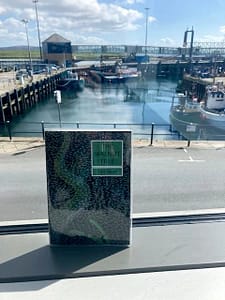
Ed Southorn’s new collection ‘SEA LAKE MOUNTAIN’

Ed Southorn has published a new collection, available from Walleah Press for $20 (includes postage within Australia).

Ed Southorn’s second poetry collection examines memory, landscape, history and myth, weighing the impacts of property development, population pressure and climate change in the Bega Valley on the far south coast of New South Wales. The second half of the collection explores storied spaces and places in Europe, America and the Australian outback.

Artist David Campbell provided the cover for the book, while poets Liam Ferney and Kristen Lang contributed blurbs:

Sea Lake Mountain is steeped in the littoral, the pull and push of tides in the Bega Valley. ‘The wave is every living thing/gone before the Moon/can intervene.’ Even the Monaro plains are an ‘ocean [of] nothing but land’. Southorn’s keen eye and sharp descriptive flair let the poems wash in the numinous without neglecting to acknowledge the ‘library of toppled shelves’ the settler gaze must sort through. For ‘I am water and my blood salt’.

LIAM FERNEY

These poems diversify our understandings, breaking the linearity of our human stories in favour of an ecology of thought as fluid as the world entwining it. The poems follow yearning, conflict, sadness, love, but always through immersion. Ed Southorn finds his moment, the poems tell us, ‘in a confluence of synchronicities’. Meeting these moments, we leave with a larger world inside us.

KRISTEN LANG

cover 'SEA LAKE MOUNTAIN' by Ed Southorn
                                   Ed Southorn’s poetry collection ‘SEA LAKE MOUNTAIN’

Available for $20, posted within Australia, from Walleah Press

Poet JH Prynne dies aged 89

Poet Jeremy Halvard Prynne died last week.

Prynne’s reputation for poetic innovation and rigorous scholarship earned the respect of many including John Kinsella, (who came to know Prynne from his time at Cambridge University where Prynne lectured) and Rod Mengham. ‘J.H. Prynne is possibly the most significant English poet of the late twentieth century’, the pair wrote in their essay (‘An Introduction to the Poetry of J.H. Prynne by Rod Mengham and John Kinsella’).

In the ‘London Review of Books’ last week, Ian Patterson (poet, translator and academic and Life Fellow of Queen’s College, Cambridge) wrote that:

‘Prynne’s poems have sometimes been dismissed by more mainstream cultural commentators as meaningless, absurdly difficult, unapproachable, pointless, elitist, or simply as nonsense or charlatanism. There is a long tradition of conservative lyric anecdotalism in English poetry, and in the way poetry is taught, that turns away from a poem that is not readily approachable. It’s true that poems like Prynne’s are difficult, in the way that a great deal of poetry is difficult if by that you mean it’s hard to approach at first reading. Poetry is an art that requires and rewards patient study, rereading, attending to paralinguistic features such as rhythm, rhyme, lineation, spacing on the page, and opening yourself to the poem, attending to the way it works on your feelings and in your body as well as on your mind, rather than just trying to manoeuvre what the poem ‘says’ into a plausible paraphrase.’

Further mention of Prynne’s poetry and career appears in ‘London Review of Books’  as well as at The Guardian https://www.theguardian.com/books/2026/apr/23/extraordinary-and-original-poet-jh-prynne-dies, and at Bloodaxe Books, which notes that ‘JH Prynne was Britain’s leading late Modernist poet. His austere yet playful poetry challenges our sense of the world, not by any direct address to the reader but by showing everything in a different light, enacting slips and changes of meaning through shifting language. Not since the late work of Ezra Pound and the Maximus series of Charles Olson have the possibilities of poetry been so fundamentally questioned and extended as they were in the life work of J.H. Prynne.’

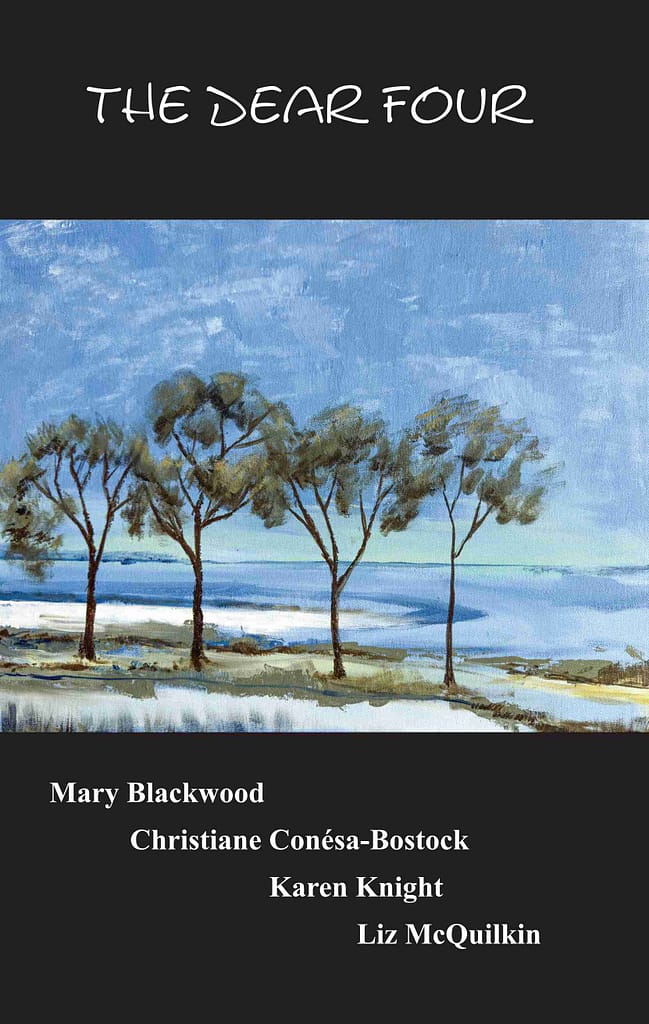
Robert Dessaix, launching ‘THE DEAR FOUR’

(From Robert Dessaix’s speech to launch THE DEAR FOUR, poetry by Mary Blackwood, Christiane Conésa-Bostock, Karen Knight and Liz McQuilkin – Hobart 14th December 2025)

I feel (in this year of Donald Trump, Ukraine, Sudan and Gaza) as if something has withered inside me. Something that’s always been there, isn’t there any more. There’s an emptiness. (And not the Buddhist sort.) I feel a sort of grief. Who doesn’t. Something vital I once had a grasp of has disappeared. Am I mildly demented? Have I misplaced something? What is it? (At my age, after all, you misplace things all the time: books, letters, your spectacles, people …) Please don’t let me lose my mind, pleads a night-time voice in Liz McQuilkin’s first poem in the collection … but she, with her squirrel psyche, has a store of poems to nourish her spirit.

This collection, The Dear Four (an eccentric title, too, arresting – Who’d have guessed what ‘dear’ means without being told?) The Dear Four gives me confidence, nevertheless, even without a store of poems, if I pay attention, I can find what’s been missing. I am enlivened by it – inspirited, we once said. (If only things were as they used to be …) Not every poem in the book will mend the wound – my particular wounds … how could it? But a surprising number make me feel whole. To my surprise. To my delight. (I don’t normally listen to what poets say, remember. The distillation I find in poetry is usually too radical for me.) Yet overwhelmingly these poems made me sing. One by one they made me take flight.

(More at https://walleahpress.com.au/launch-the-dear-four.html)

Vanessa Proctor, Helen Swain ~ Whispering Gums

Good, if belatedly, to come across a generous and thoughtful reading on the praiseworthy Canberra-based literary blogsite, Whispering Gums of a couple of poetry collections published over the past twelve months, Helen Swain’s Calibrating Home and Vanessa Proctor’s On Wonder.

The two books were both published in 2024, and it’s a little amusing because Tasmanian poet Helen Swain’s collection, Calibrating home, was published by the New South Wales-based 5 Islands Press, while Sydney poet Vanessa Proctor’s collection, On wonder, was published by the Tasmanian-based Walleah Press.

Helen Swain lives and works in Lutruwita/Tasmania. She has been a teacher, performer (performing in Tasmania, mainland Australia, Berlin and Paris) and community arts worker. Along with Mary Blackwood, Eleanor March, Gina Mercer and Lyn Reeves, Helen was part of a dedicated team behind the publication of Quicksilver Water, a 2022 anthology of women poets who’d been meeting and making art in the heart of Hobart for nine years representing an age group of eight to ninety-three years.

The Hobart City Council generously provided a grant to fund publication of the anthology as well as enabling Oasis to pay contributors, and to further gift some remaining copies to the wider Hobart community … causing one minor hickup, Hobart Bookshop had a purchase enquiry at the time, and got in touch in Gina. ‘Hmmm … not sure, it’s not meant to be for sale, but not to worry, we’ve a handful left’, and I think a copy eventually made its way into the hands of the would-be buyer. Not sure if money actually changed hands….

Gina Mercer launched Helen’s Calibrating Home in Hobart last November, noting ‘this is a very good book’ (you can read the launch speech online at Rochford Street Review) that will

’tilt your world – as you might tilt your glass of clear tea as you sit in the late afternoon sun – admiring the play of light and viscosity and shadow – as you sip both tea and poems… because having your world tilted by Helen’s hands is good. Her hands are steadying and precise and full of thought. Helen’s hands are knowing in all the best ways. They are enlivening, compassionate hands that hold that necessary, slippery “glow-worm” (‘Hospital Waiting Room’) on which we all depend – hope.’

Of Helen Swain’s ‘Calibrating Home’, Whispering Gums notes ‘The poems in this collection slip between past, present and future, often within the same poem, as you can see in “Traced”. There is a sense of struggle, but also of tenacity and endurance. War is evident, in specific poems like “Meeting up (for Michael O’Neill, killed in Ukraine May 2022” and in gentle poems like “Teacups” (“Grandmother’s teacups/survived the war”) where the domestic collides with violence. The shock of violence or war, and the cold displacement of people, is never far away in these poems. But, neither is the domestic, the peace, the connections, the gentleness (in “Suzi and the Spider”), and the humour (in “Mary”)’.

Of Vanessa Proctor’s On wonder, Whispering Gums notes that the book ‘was given to me by on old schoolfriend. It comes from a poet steeped in the haiku tradition, but it meets Swain at various points. One delightful synchronicity occurs between Swain’s “Suzi and the spider” which tells of Suzi gently releasing back into the wild a spider that has come into her house, and Proctor’s “A dragonfly” in which the narrator carefully unravels a spider’s silk from a dragonfly to set it free. Both speak of gentleness and respect for nature, and of connections between living things.

Vanessa’s book has been well reviewed elsewhere since publication in December 2024, including a thoughtful piece by Michael Sharkey in ‘The Australian’ earlier this year as well as another half dozen or so … you can find a couple on Greg Piko’s https://gregorypiko.com/2025/05/04/vanessa-proctor-on-wonder/ blog site, and  Samantha Sirimanne Hyde at Grattan Street Press in September.

Helen Swain’s ‘Calibrating Home’ is available for $26 at Five Islands Press, while Vanessa Proctor’s ‘On Wonder’ is available at Walleah Press for $22.


2025 Five Islands Poetry Prize | Shortlist

Five Islands Press has announced the Judges’ shortlist for the 2024–25 Prize.

Bathypelagia —Debbie Lim, Cordite Publishing Inc.
Portraits of Drowning — Madeleine Dale, University of Queensland Press
The Infant Vine Isabella — G. Mead, UWA Publishing
Past & Parallel Lives — Kaya Ortiz, UWA Publishing

The winning and order of commended books will be announced at a Zoom event on
Wednesday 3 December, from 5.00–6.00 pm (AEST Melbourne time). Join at:
https://unimelb.zoom.us/j/2338614152?pwd=aVhRZElvYjh1T2ZId2h1QW9ZbThSU
T09&omn=83583511486 Password: 106945

Everyone is welcome to attend to hear the judges’ report and readings from the finalists.

Please note submissions are open until 15 July next year for the 2025–26 Prize. Entry is
free. For details on how to submit, go to https://www.canberra.edu.au/five-islands-prize/


Robert Dessaix to launch ‘The Dear Four’: Hobart


TheDearFour-launch-invitation

An invitation to attend the launch by Robert Dessaix of the poetry collection ‘The Dear Four’, featuring new poems by Mary Blackwood, Christiane Conésa-Bostock, Karen Knight and Liz McQuilkin

Sunday 14th December 2.30pm

Royal Yacht Club of Tasmania, Marieville Esplanade, Sandy Bay, Hobart

Drinks available from the bar

RSVP: lizmcquilk@gmail.com by 30th November

Vanessa Proctor’s collection ‘On Wonder’ | review

Samantha Sirimanne Hyde has penned a laudatory review of Vanessa Proctor’s Dec 2024 poetry collection On Wonder, at Grattan Street Press (29th September, 2025).

The Japanese perception of sadness, particularly a tender, contemplative sadness, is often defined by the term ‘mono no aware’. This is often rendered as the pathos or frailty of all things: an understanding of the impermanence of all matter and the wistful reaction that comes from its acceptance. Proctor’s poetry is often touched with this leitmotif of finding beauty in what’s blemished, fragile or ephemeral. For instance, cherry blossoms, which epitomise beauty, transience and renewal in Japanese culture, are depicted in the poem, “The Scattering of Blossom”, shifting between life and death, beauty, sorrow and acceptance. The poem moves from Australia, where the cherry trees bloom along Sakura Avenue “at the old POW camp in Cowra”, a resting place for over two hundred Japanese soldiers “beneath a foreign soil”, to Rikugien Gardens in Japan, where the poet reflects on the pale pink blossoms and the impending birth of her child, and finally to a snapshot of luminous flowering wild cherry trees in the foothills of the Himalayas.

Proctor encourages the reader to look more deeply at the world and at ourselves with kindness and compassion, celebrating our interconnectedness with one another and with nature. On Wonder is a book of understated elegance with comforting alchemy, a collection to be savoured time and time again.


Sri Lankan born Samantha Sirimanne Hyde lives in the unceded land of the Wallumedegal people in NSW. She holds an MA in Creative Writing from Macquarie University. Her collection of 20 short stories is called The Villawood Express & other stories and over 300 of her haiku and tanka have appeared in poetry journals. Her debut novel, The Lyrebird’s Cry, is a tale of self-discovery of a gay man trapped into an arranged marriage.

Sunday 5th Oct, Hobart: Tas Poetry Festival feature reading by six poets

2.30 – 3.45pm, Sunday 5 October

Tasmanian Poetry Festival Feature Reading in Hobart

The Tasmanian Poetry Festival presents a special Hobart feature reading by award-winning poets:

Enjoy this delightful afternoon reading by some of Tasmania’s finest poets addressing themes of nature, family, attention, and joy.

Hosted by Fullers Bookshop, 131 Collins Street, Hobart.


About the poets:

Erin Coull is an editor and contributor for WhyNot and is a past winner of the Andrew Hardy Poetry Prize, and has been published in FortySouth, Togatus, The Trailblazer and WritetheWorld Review. Her writing explores quiet anxieties, uncertain futures and complex connections.

Susan Austin is an award-winning poet, mental health occupational therapist, eco-socialist activist and mother, who has two poetry collections and a verse novel. She will read poems about times when we feel lost – with parenting, relationships and work – and ways we re-establish connection with nature and each other.

Young Dawkins has been published in two collections and numerous literary journals, and has performed his work internationally at major festivals, main stages, competitions and countless questionable bars. His poems draw on autobiography.

Ben Walter is a Walkley award-winning essayist, and the author of a book of short stories, What Fear Was, and the new poetry collection, Lithosphere. His poems explore the Tasmanian natural world in surprising ways.

Esther Ottaway is the winner of the $25,000 Tim Thorne Prize for Poetry in the Tasmanian Literary Awards, and holds multiple national and international shortlistings. Her poems are about family bonds, Tasmanian life, experiences of joy, and winter swimming!

Louise Oxley‘s three collections include poems that have won major awards, attracted state and federal grants and earned residencies at Varuna the Writers House and the University of Prince Edward Island, Canada. She will read poems on the theme of mother and child.

Free event! Book here, or just attend on the day: https://www.fullersbookshop.com.au/event/tasmanian-poetry-festival-feature-reading-in-hobart/

This special event is a preview event leading up to the Tasmanian Poetry Festival full days of readings, held in Launceston from 10-12 October, and featuring Erin Coull, Liz Winfield, Les Wicks, Kim Nielsen-Creeley, Kit Kelen, Alex McKeown, and guest, Pam Schindler. Workshops include Constraint-Based Writing, Writing an Interior Monologue, Taking Your Words for a Walk, and Plan to be Published. You can view the program and book tickets at www.taspoetryfest.org

Louise Akers | 12 to 20 questions (from rob mclennan’s blog)

(from ‘rob mclennan’s blog’, 17 April 2025)

5 – Are public readings part of or counter to your creative process? Are you the sort of writer who enjoys doing readings?

I love doing readings–because they are fun and social and ephemeral experiences, but also it is a hell of a way to edit a poem. When I know I am reading something out loud in front of strangers, I will be totally ruthless in a way that only vanity can inspire. Also sometimes while I’m reading it, and really hearing and feeling its living reception I will change little things to allow for clarity or rhythm or some other immediate and interpersonal effect.

7 – What do you see the current role of the writer being in larger culture? Do they even have one? What do you think the role of the writer should be?

Oh, it’s hard not to just quote Walter Benjamin on this one. I think critique is important; I think it is important to register the fact that throwing language at a problem (“problem” standing in here very broadly and clumsily for any of the myriad social-political-environmental-economic cataclysms we are enmeshed in currently), policing the language around a problem, or even diagnosing a problem discursively are all deeply incomplete projects, while also realizing that that is not an excuse or a reason not to do those things. Very clunky sentence, but hopefully you get the drift.

(More at rob mclennan’s blog)

Louise Akers is a poet living in Brooklyn, NY. She is a PhD student in English at NYU and is the co-organizer of the small press and working group, the Organism for Poetic Research. Akers is the author of two books of poetry, Alien Year (Oversound, 2020) and Elizabeth/The story of Drone (Propeller Books, 2022).

Dulcetly (Kristy Bowen): Adventures in self-publishing

(from a post on Kristy Bowen’s blog Dulcetly | notes on a bookish life – 03 March 2025))

I was moving some books around on my shelf and realized I have now published just as many books via self-publishing as I did traditional publishing….

After 2020, I felt a shift in my relationship toward po-biz and publishing, as well as a general backlog and build-up of unpublished work. In those intervening years, I’ve had fairly long routines of writing poems daily (or at least fragments)  By the time 2021 had rolled around,  was sitting on three full-length manuscripts that I genuinely had no idea what to do with. I submitted at least two of them during reading periods for my current press, but nothing was picked up those go-rounds. I am not really a contest person, especially if they have high entrance fees and the idea of finding an forging another relationship with an indie seemed an up-hill climb.  And no one publisher could possibly take on as many books as I had stuffed away in my hard drive.

(More at Dulcetly)

Rae Armantrout | ‘The absence of certainty’, a conversation with Kate Lilley

(Cordite Poetry Review, 4th February 2025)

Kate Lilley: … One of the things you said when we were having a bit of back and forth about how we might do this was when I asked you what often gets left out, because everybody writes about (for good reason) the markedly intelligent, propositional, ‘thinky’ character of your work, it’s markedly ‘intellectual.’ You said emotion and affect tend to get left out. Why don’t we start there with some of these poems?

Rae Armantrout: Ok, I like that question. It’s true. People often talk about the ambiguity of my work and how to make meaning out of it – how meaning might be problematised, which are all intellectual problems that are very interesting to me. I like your word ‘proposition,’ Kate. One thing I like to do is to throw out a proposition that may or may not be true, it could conceivably be true, and then pose examples of what it might mean and look like for it to actually be true. Often, the examples are problematic, somehow. It’s like they’re chunky, unwieldy pieces of the world, and how do they line up with these propositions that I’m trying to use to describe it?

So, having said that I want to get around to emotion since I don’t talk about it much. I may not be good at talking about it, but I can tell you that every poem of mine starts with a feeling. And usually with a feeling I can’t identify, maybe because it’s complicated, kind of a compound feeling of ironic yet wistful or a sad yet angry combination of feelings. But also, sometimes, I need help understanding the source of the feeling, and that’s where a poem starts – when I try to identify the source of a feeling.

(Edited transcript of the conversation at Cordite Poetry Review)

(Complete interview online on the Australian National University’s Art and Social Sciences YouTube channel)

Five Islands Poetry Prize ~ for a First Book of Poetry

Terms & Conditions

  • This is an annual prize for a first already-published book-length collection of poetry by an Australian poet or a poet living and writing in Australia.
  • The author of the prize-winning book will receive $2750 and the publisher will receive $1100.
  • A book can be entered by the author or publisher.
  • The book must contain at least thirty pages of poetry, have an ISBN, and be available through retail sales outlets.
  • Self-published books are eligible as long as they meet the above criteria.
  • For the 2024-2025 Prize, books published between 1 July 2024 and 30 June 2025 are eligible.
  • Note: the prize aims to support professional publishers, in particular small-press, independent publishers.
  • Submissions are open until 15 July 2025.
  • There will be three judges, whose decision will be final.
  • The Prize will be announced in late November, and presented shortly afterwards.
  • Four copies of the submitted book are to be posted to PO Box 68 Brunswick Victoria 3056.
  • Books submitted will not be returned.
  • An email must be sent to Kevin Brophy at: kevinjb@unimelb.edu.au attesting that this is the poet’s first published book of poetry, and providing the book’s publishing date, and contact details for the poet and the publisher.

Step 1

Post four copies of the submitted poetry book to the address below. Please note, posted books should be received on or before 15 July 2025.

Five Islands Poetry Prize
PO Box 68
Brunswick Victoria 3056

Step 2

Email Kevin Brophy, attesting that this is the poet’s first published book of poetry, and provide contact details for the poet and the publisher. Please subject your email as “Five Islands Prize Entry”.


Five Islands Press Poetry Prize 2025

Alison J Barton – on 3CR’s Spoken Word, interviewed by Indrani Perera

Enjoyed a thoughtful interview with Wurundjeri poet Alison J Barton recently, aired on 3CR’s Spoken Word program (08 August 2024)…. Indrani Perera spoke to Alison about her collection, ‘Not Telling’, Alison’s debut full-length poetry collection published by Puncher and Wattman.

Perera began by asking about the book’s ‘intriguing’ title…

The title came to me because the unifying theme of the collection is language and speech and in fact silence and not speaking. It’s also a bit of a play on a line in one of the poems in the collection. That’s the unifying theme, but the book is also broken into three sections and they’re quite distinct, the sections. I have one about colonisation and Aboriginal Australian history, one that’s really about family relationships and just indeed human relationships, and another section that has poems that are written around psychoanalytic theory. But yes, the unifying theme is language, speech and silence. You see that coming up in most of the poems, I think.

I know people don’t talk about favourite children, but do you have a favourite section in the book?

Ah, that’s a good question. I haven’t thought about that, actually. Yeah, maybe I do, but I don’t want to say. But no, look, there are poems in each section that I’m quite fond of. I think the sections are so distinct that it’s pretty hard to pick a favourite.

Fair enough.

’Buried Light’ is the first of the poems Alison read throughout the half-hour program, introducing the topic of colonisation in Australia – something that, growing up in the 80’s, ‘ just wasn’t a thing. The history that I learnt was so revisionist it was ridiculous’, says Barton. Perera wondered what it was like as a First Nations poet to have a residency at Oxford University. (In the past, Aboriginal human remains were often obtained by researchers – some associated with Cambridge – and frequently without consent. Aboriginal groups have long demanded the repatriation of remains – and some have been returned – but the process has invariably been slow, and often obstructive)

Yeah, look, it was a great experience but, of course, I was very aware of that contradiction in being there and also I’ve reflected on it a lot since the fellowship.

and there’s a great deal left unsaid here in an interview packed within a half hour program, though Puncher & Wattman’s website offers more of the book’s detail and its depiction of the

ongoing legacy of colonial dispossession and the strength of its survivors through representations of the wretched damage caused by the invasion of Australia, as well as musings on sacred land and celebration of continued culture. It testifies to the systemic oppression of Aboriginal people, connecting present-day black trauma with its origins. Jolted by the life realities of who we were, and are, alongside exacting accounts of genocide, the reader is immersed in a rich and harrowing world.’

…………………………………….

It was about five years ago that Barton took up poetry.

I sort of thought that I couldn’t write poetry so it was something that I didn’t explore until it suddenly came to me about five years ago and I just haven’t been able to stop ever since.

‘Do you know what it was that prompted that shift from prose into poetry?’

What actually happened is a poem just came to me and it’s very rare for that to happen now but it just spontaneously came to me and I wrote it down and I realised it was a poem and I literally have not stopped writing poetry since then.

So it basically snuck up on you and ambushed you?

Exactly. Yeah, that’s a good way of putting it. And there’s something sort of mystical I think about the creative process.

Alison I’m wondering what inspires you to write?

That’s such a big question. Basically everything.

I am in a daily writing practice, so I’m putting something on paper every day and, yeah, anything and everything, I would say.

So everything’s sort of grist for the mill?

I think so, yes. And while I write every day, it’s usually stream of consciousness writing that I then read over later and turn into poetry.

So when you write, is it in paragraph form or are you using dot points?

No, neither, I very much am writing in an endless stream. I have a journal, I use paper and pen and I use grammar sparingly, but there are no paragraph breaks. It’s a very continuous line of thought.

And how long do you do that for each day?

Ideally I would do it for an hour, at least an hour each day, but of course I don’t always get to do an hour. For me, even if I write for a few minutes, I’m happy that I’ve written something each day. Sometimes it’s much longer.

Do you find that doing it daily helps you to then form poems?

Yes. Well, it gives me a lot of material to go over later and turn into poetry, I think if I didn’t do that, I would produce much less poetry. There have only been a couple of times in my career where I’ve sat down with the intention of writing a poem and not using any material, any sort of written material that I’ve produced prior and a poem has just come to me spontaneously.

Usually it’s through great effort.

So is it like your shortcut or your secret hack to writing poetry, doing that daily practice?

Yes, I think that’s right, yeah.

I really envy you writing every day.

Thank you … for some people they need to write, they must write, but they have to force themselves and for me for some reason it’s actually a pleasure.

That’s fabulous.

That’s a great place to be in as a writer. I feel very lucky.

…………………………………….

Writing can be isolating, but a good writing group offers encouragement, honest feedback, and shared understanding. Being part of a writing group means you’ve people to push you to improve, keep you on track. Alison was questioned about whether she belonged to a writer’s group, ‘or do you have somebody that you share your work with and get feedback as you’re going?’

Yeah, I am in a writer’s group with three other poets, it’s only something that we’ve started recently, probably in the last year, I would say, and it’s incredibly useful for refining poems, sometimes I’ll take a poem to that group and I’ll think this poem needs a lot of work. This is in its very early stages. And then the group will surprise me and say, Alison, this poem’s ready.

I think what’s great about that group as well is that we’re all writers, we’re all poets, so we are honest with each other. If something needs work, you know, we want to get better and we want to help each other.

So yeah,  there’s real trust in that group and I value that perspective. I feel like trust is be very important if you’re sharing work, especially poetry, which feels very personal.

I’m curious about your writing and if there are particular topics that you’re writing about.

In general, you mean?

Yeah.

No, I don’t, I really don’t restrict myself and I don’t want to force a poem about something. I have done that at times, but it’s kind of rare.

I think one of my early poetry mentors said to me something along the lines of, you have to let the poem be what it wants to be. And I think it’s very true. I think when I write a poem, it surprises me sometimes, you know, in subject matter sometimes or where it goes.

………………………………………………………………………………………………………………………………………………..

(To listen to the full recording, visit 3CR’s Spoken Word program).

Alison J Barton’s work has appeared in Australian and international journals and anthologies such as Meanjin, Cordite, Westerly, Mascara Literary Review, Australian Poetry Journal, Black Box Manifold and many more. In 2023 she was the inaugural winner of the University of Cambridge First Nations Writing Residence Fellowship. She has been the recipient of several fellowships with Varuna House and the winner of a number of international writing residencies. Alison’s poetry appeared in the Best of Australian Poems 2022 and 2023 and has been recognised in numerous prizes. She’s appeared in podcasts for the Guilty Feminist and Poetry Says.

Alison J Barton’s collection ‘Not Telling’ is available from Puncher & Wattmann retailing for $27.


Ron Riekki | WE’RE SITTING AROUND A TABLE NOT FAR FROM THE RUSSIAN BORDER

US author Ron Riekki’s writing takes the measure of topics some might prefer not be discussed – protest, authoritarianism, immigration – as well as issues of which there’s too little discussion – prisons, overpopulation…. Below, references to some recent work …

                                                                      and
the Chinese artist talks about holding up signs in Hong
Kong that were all white, not allowed to have signs with
actual words, so this haunting image, this effective image
of hundreds of artists and writers and protestors and students
holding up these white signs, ghost signs meant to haunt
politicians …


(from Riekki’s poem ‘WE’RE SITTING AROUND A TABLE NOT FAR FROM THE RUSSIAN BORDER’, published 29th March 2025 in ‘Verse News‘)


And in an unrelated interview, published in ‘The Adirondack Review‘ of Winter 2021, Riekki’s queried about the effect of the pandemic on his work. He replies that he’d been interested in writing a pandemic book previous to covid, but ‘Then the pandemic happened and I realized it was too late.’

These days, ‘if you pitch a pandemic-related book, you have to jump into the monstrous slush pile.  But it’s been making me think about other issues that are right in our face that people are ignoring right now, but that we better put a light on early before things explode.  I wonder what it is that we’re missing that’s right in front of us now.  Maybe overpopulation?  The prison system?  I kind of feel that the next thing that’s going to be a massive concern for us is going to be those two things.  It’s probably a reason why I try to write about both….’


(Ron Riekki wrote U.P.: a novel (Great Michigan Read nominated) and edited The Way North: Collected Upper Peninsula New Works (2014 Michigan Notable Book), Here: Women Writing on Michigan’s Upper Peninsula (2016 Independent Publisher Book Award), and And Here: 100 Years of Upper Peninsula Writing, 1917-2017 (Michigan State University Press, 2017.)

RIP David Bircumshaw

Sorry to learn of the loss of English poet David Bircumshaw recently. Had thought I might get to catch up with him on a visit to England mid last year, but it didn’t eventuate. We published a couple of issues together (British and Australian versions) of a short-lived poetry journal (‘The Chide’s Alphabet’) years back; can’t recall whether the British original was print or online (or both), the Australian issues were modest print versions. RIP


2024 Anne Elder Award judges panel announced

Australian Poetry has announced the three judges for the Anne Elder Award 2024 panel. They are Jeanine LeaneTheodore Ell, and Ella Skibeck-Porter. Theodore was the 2022 Anne Elder Award co-winner with Harry Reid (a judge last year) and Ella was Highly Commended in the 2023 Award.

2024 Anne Elder Award panel:

Jeanine Leane is a Wiradjuri writer, poet and teacher from the Murrumbidgee River near Gundagai. Her poetry has won numerous awards and prizes, including the David Harold Tribe Prize 2023. Jeanine is widely published in the areas of Aboriginal literature,  literary critique, and writing identity and difference. She is currently a First Nations Writer in Residence at the University of Melbourne where she previously taught Creative Writing and Aboriginal Literature. Jeanine’s current poetry collection, Gawimarra: Gathering  (University of Queensland Press), is short-listed for the VPLA 2024 Poetry Prize.


Theodore Ell is a writer and honorary lecturer in literature at the Australian National University. His poetry collection Beginning in Sight shared the 2022 Anne Elder Award. From 2018 to 2021 he lived in Lebanon, accompanying his wife on a diplomatic posting. Ell’s essay ‘Façades of Lebanon’, about witnessing the 2019 Lebanese revolution and surviving the 2020 Beirut port explosion, won the 2021 Calibre Essay Prize, and his memoir Lebanon Days was published in 2024. Ell’s poetry, essays, translations and non-fiction have been published in Australia, Italy, the United Kingdom and Lebanon.


Ella Skilbeck-Porter is a poet living in Naarm/Melbourne. Her debut collection These are Different Waters (Vagabond 2023) was shortlisted for the Helen Anne Bell Poetry Bequest and the Mary Gilmore Award and was Highly Commended in the Anne Elder Award. Her work has been widely published in journals and anthologies including Best of Australian Poems 2024, Living Systems: Poetry from Asia Pacific, HEAT, Otoliths, Rabbit and Cordite Poetry Review.

Helen Swain’s poetry collection ‘Calibrating Home’ | launch speech by Gina Mercer (Nov 2024)

Gina Mercer, Hobart | 24th November 2024:

So, here is a book. It’s Helen’s book. It’s a very good book. Filled with – and ‘about the goodness of people’. You, all of you – you are a ‘goodness of people’. Gift yourself this very good book. Gift one to any of your people who love goodness. Who need this brilliant balance of balm and grim. Oh, for goodness’ sake – buy a heap. It’ll make Helen happy. It’ll make Bronwyn, the indefatigable and ever-helpful bookseller, happy. And Helen’s perspicacious publisher, 5 Islands Press. And Suzi – why, even the wee spider will be happy.

So here goes, here, I launch this very good book. Helen’s book. Here – it flies into your delighted arms and hearts. Because we know deeply about the goodness of people. That goodness, and this very good book of Helen’s poetry, are our best protection against the weather or whatever is coming.

Read Gina’s full launch speech at Rochford Street Review.

Vale Judith Mok

Sorry to learn of Judith Mok’s death last month. From The Hot Press Newsdesk – 28th November 2024

“Judith was a remarkable woman, a force of life, a powerhouse, with incredible life experience,” a statement from the Centre Culturel Irlandais in Paris reads.

Tributes are continuing to pour in for Judith Mok, following the sad news of the acclaimed classical singer, vocal coach and writer’s death this week.

Her passing was confirmed by her publisher, Antony Farrell of Lilliput Press, who stated in an online post that Judith “died on the morning of Monday 26th with her husband, writer Michael O’Loughlin, keeping vigil.”

“She was a doughty soul and personality, who bore her cancer fearlessly,” his statement continues.


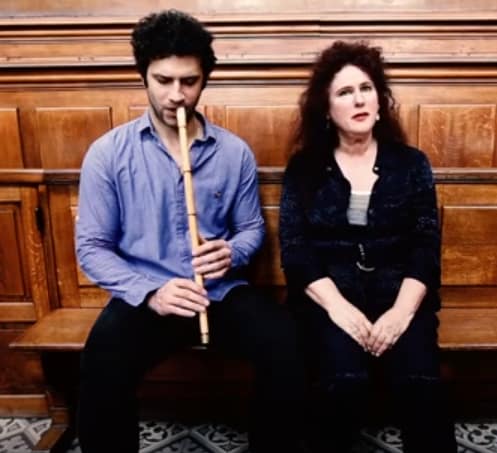
(Sephardic song Addio Querido performed by Judith Mok and Mani Koshravesh in the Centre Culturel Irlandais in Paris. Filmed by Oisin Byrne, 2020. From Judith Mok’s website).


‘I’D never quite met anyone like Judith before, and I found out afterwards, of course, that there was nobody like her,” says writer and poet Michael O’Loughlin. “We started talking on the first night we met, and we’re having that same conversation 29 years later. We find that we still argue about the same things!”

(from the Irish Independent, September 2011)


As a footnote, I was fortunate enough ten years ago to be introduced to Michael O’Loughlin at a Dedalus Press launch in Dublin. In retrospect, I wish I’d known more about his poetry at the time, might have enquired about his career as  ‘one of the few genuine, intellectual, working-class voices in Irish poetry’ (Poetry International). ‘Pleasure to meet you,’ I said, ‘I thought you played a great game against Collingwood last weekend.’ (Where’d that spring from? Regretted the words immediately.) Quick as a flash he shot back, very generously, with ‘Yes, I was quite pleased with my performance myself.’

The ubiquitous becomes sublime: Adrienne Eberhard launches ‘undercurrents’ by Jane Williams

undercurrents by Jane Williams’, Ginninderra Press 2023, was launched by Adrienne Eberhard at The Hobart Bookshop on Thursday 29 June 2023.

Thank you for joining us tonight for the launch of Jane Williams’ latest collection, undercurrents, published by Ginninderra Press. Like most of you, I imagine, I have been a fan of Jane’s work for a very long time, over two decades now, lured by its seeming-simplicity that masks the undercurrents beneath.

I first met Jane at a Tasmanian Poetry Festival, organised by Tim Thorne, when my second son was a baby in his pram. Jane, who is the same age as me, was attending one of the sessions with one of her daughters who was in her late teens, and it both amazed and gladdened me to meet this poet who had already published a number of books and raised two daughters. It gave me hope that both were possible, that anything was possible! Jane’s poetry, as I came to read it and seek it out, confirmed this; in her poetry, anything is possible. The ordinary becomes the extraordinary, the ubiquitous becomes sublime. Humans are angels, and the holy is found in our everyday lives. Jane’s poetry works a quiet magic – from seemingly simple ideas the extraordinary bursts.

Read the launch speech at Rochford Street Review.

Jane Williams reading from her 2023 collection undercurrent.

‘Class’: new (free) downloadable anthology of poems (Meuse Press, Aust)

Maybe of interest? New (free) downloadable pdf anthology of poems entitled ‘Class’ (Meuse Press, NSW Australia, edited by Les Wicks) featuring 74 contributors (45 Australiana along with international contributors published in 14 languages) — at https://meusepress.tripod.com/Meuse.htm (scroll down the right hand side of the page and click on Class.pdf) with contributors including Margaret Bradstock, Kit Kelen, Jennifer Compton, Philip Hammial, Richard James Allen, Jennifer Maiden, Beth Spencer, Louise Wakeling, Margaret Ruckert, Martin Longford, Lesley Synge, Ross Donlon, Kathryn Hummel and many more….

Elanna Herbert ~ ACT Literary Awards 2024

Lovely to see Elanna Herbert’s 2023 poetry collection ‘sifting fire writing coast’ has been shortlisted in the ACT Literary Awards, along with Sandra Renew’s ‘Apostles of Anarchy’, K. A. Nelson’s ‘Meaty Bones’, Tim Metcalf’s ‘The Moon the Bone’, and Paul Hetherington’s ‘Sleeplessness’. Good luck to all.


Anne Elder Award —Australian Poetry announces Call-Out

  1. Open call for entries – Monday, 15 January 2024
  2. Close of entries – Tuesday, 12 March 2024, 5pm (AEST). Books must be postmarked no later than Tuesday, 12 March 2024.
  3. Winner announcement – May 2024


Information and enquiries
Jacinta Le Plastrier
Email: ceo@australianpoetry.org
Note: Responses to enquiries will not be sent until after 15 January. Please note the new AP address is now: AP, Anne Elder Award, GPO Box 1753, Naarm/Melbourne, VIC 3000. The GPO box number is essential.


The award is named after Anne Elder (1918-1976), a dancer with the Borovansky Ballet in the 1940s who later in life became a notable poet. Her poetry attracted praise from many critics for its vigour, depth of reference and distinctive artistry.  Sponsored by the Australian Communities Foundation, this prestigious, national, annual award is for a sole-authored first book of poetry of 20-minimum pages in length, published in Australia.


Established in 1977, the prize has offered important recognition to poets at a critical point in their writing lives, and its alumni represent some of Australia’s best-known and highly respected poets. The winner is awarded $1,000, and there is also the opportunity for the judging panel, which for the 2023 Award will be announced in late January, to award other books a commendation or special mention.


Books published between 1 January 2023 and 31 December 2023 are eligible for entry into the 2023 Anne Elder Award.


Submission Guidelines & Eligibility

  1. Open to Australian residents only
  2. Entries must be in English. Bilingual volumes are acceptable as long as one of the languages in which the poems are written/translated is English
  3. Book should be a sole-authored first collection of poetry published in 2023
  4. Book must be 20+ pages in length and have been legally deposited with the National Library of Australia
  5. A book can only be considered a first volume if the author has not had previous volumes of poetry of 20+ pages published either in Australia or elsewhere
  6. Chapbooks are also eligible if they meet the above guidelines—please note, if a poet has entered a chapbook previously, they cannot re-submit a longer collection
  7. Entrants who have previously published in another genre are eligible as long as the entry submitted for this award is the first volume of poetry published by the author
  8. Co-authored entries are not eligible for the award
  9. First prize $1,000. Winners and commended entrants will receive a copy of Selected Poems of Anne Elder (Lauranton Press)
  10. The judges reserve the right not to award a prize
  11. The judges’ decision is final and no correspondence will be entered into.


How to Enter

  1. Send 3 copies of the book to: Anne Elder Award Nominations, c/o Australian Poetry, GPO Box 1753, Naarm/ Melbourne Vic 3000.
  2. Entry fee $35 (including GST) is payable at the time of entry. Payment is via an invoice generated by AP. Please contact Jacinta at ceo@australianpoetry.orgso she can organise an invoice, to be paid via EFT. Please also let her know when you have mailed your copies so she can be in contact if they do not arrive.

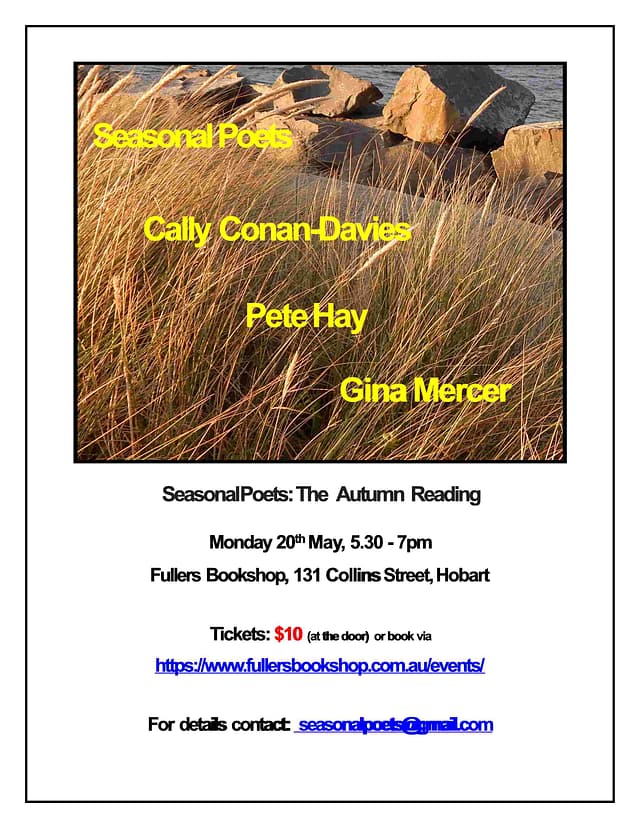
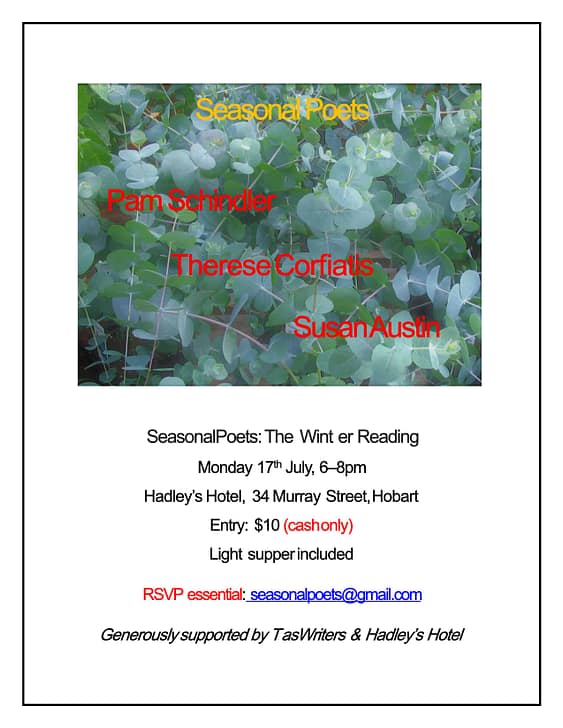
Seasonal Poets – The Summer Reading | Monday February 26th (Hobart)

Seasonal Poets returns to Hobart on Monday 26th February for the Summer Reading with poets Pamela Leach, Irene McGuire and Peter Jerrim.

Seasonal Poets’ new venue is Fullers Bookshop 131 Collins Street and tickets are $10.00 at the door or via the Fullers website: www.fullersbookshop.com.au./events

The $10.00 which no longer needs to be cash includes a glass of wine or non-alcoholic beverage.

Please note the new start time of 5:30.

For further details contact: seasonalpoets@gmail.com.

(Forwarded by Anne Collins, Gina Mercer, Irene McGuire
co-curators: Seasonal Poets)

Koraly Dimitriadis — book launch, Launceston 29th February 2024

The TPF 2024 kicks off its first pre-festival event with a book launch by Koraly Dimitriadis – a Melbourne poet, performance artist, film maker and short story writer.

Join us upstairs at 6 pm on the 29th February at the Plough Inn (lift available) 170 Brisbane St., Launceston to hear this wonderful and multi-talented woman.

Koraly is on her book tour and will also be performing at Silver Words in Hobart on 28th February.

Ticket link:- https://www.trybooking.com/COZAU

Arts Tasmania is a major sponsor of the Tasmanian Poetry Festival in 2024.


Update from Liquid Amber Press – 2024 publications, and beyond

(from Liquid Amber’s newsletter | 19th January 2024)

Publications for 2024 – and beyond

What an amazing round of submissions we had for the Liquid Amber Publication Call! Thank you to everyone who submitted – for your willingness to share your wonderful work with us. We would certainly love to have been able to publish more titles – but are thrilled to announce our list for 2024.

  • Jenny Pollak Clarion
  • Dominique Hecq Volte Face
  • Nathan Curnow Canaan
  • Stephanie Powell Small Acts
  • Rose Lucas Remarkable as Breathing

And in 2025, we look forward to publishing:

  • Anne Elvey Intents
  • Angela Costi The Heart of the Advocate
  • E Anne Gleeson The Deepest Thing

Liz Lefroy and Jonty Watt, a Tasmanian Poetry Festival event – 16th Nov 2023

Liz Lefroy and Jonty Watt – Launceston, November 16th 2023.


Liz Lefroy

Visiting UK poet Liz Lefroy

Liz’s opening poems of the evening involved “that very British sport of queuing,” the first of which – “In the Queue in the Waitrose Cafe, I Meet My Love” – can be read online at Liz’s website, at Liz Lefroy – Poet.

Liz and Jonty Lefroy

Liz: “I love noticing the small things that happen in life. And that’s kind of what happens in the next poem in which my son Jonty, who I’m absolutely delighted has been travelling with me for half the time we’ve been in Australia, features. It’s called ‘Michelangelo’s David'”.

(In a personal blog post back in July of 2016, Liz explained this poem is also set in a queue, but in Florence. ‘… it’s also about love, language, and the fluidity and permeability of borders between people and cultures. It’s about the joy of the taken-for-grantedness of those exchanges: it’s about knowing the words pizza, gelato, cappuccino without having to try. I read the poem with new energy, as an act of poetry.’

I didn’t plan for this, queuing with my son …


Liz Evie and Jonty

Liz, Evie and Jonty


Liz Lefroy, Erin Coull, Sophie Campbell and Zeke Lanham

Liz: “I’ve wanted to come to Australia since I was twelve, when I touched down and we were coming out of the airport in Perth I felt emotional and moved … even caught up with an old schoolfriend in Sydney the other day.”

“So yes to friendship! Yes to poetry! Thank you for having me, really appreciate it. I also want to say: shall we give our young poets another round of applause … Evie had said to me, how would it be having some young local poets read first, and I can’t think of anything better to do. In my other life, I’m a teacher….’


Colin, wrapping up: “Once again, thank you very much Liz and Jonty, this was more than I could have anticipated, a really interesting, amazing experience. I really like the feeling I get from your poem about Western Australia – taking what is the everyday and reminding us that it’s a very different world here physically from the one from where you’ve come. Thanks very much people for turning out, I was really glad that we could get Liz and Jonty into this session and it’s reminded us that we can extend the poetry festival with one-off events such as this throughout the year. I’ll very briefly mention the fact that we’ve been mightily supported this year by the Launceston City Council and by Stella and Harry Kent as well as by other sponsors, and I think it’s important we carry that support over into the fortieth anniversary of the poetry festival next year, making it the longest poetry gig of its kind in Australia. Once again, thank you very much … really impressive.”

Australian poetry news — Five Islands Press

Oystercatcher Enterprises Ltd, a not-for-profit company recently founded by Mark Tredinnick and Steve Meyrick, is proud to announce its intention to revive Five Islands Press as a publisher of new poetry and writing about poetry and other lyric works.

Founded in 1986 by Ron Pretty, and named for the five islands off Port Kembla, where Ron lived and wrote, Five Islands has published many of Australia’s finest poets. When Ron stepped back from active involvement with the press in 2007, the fine publishing tradition that he established was continued for over a decade by his successors, with the Press publishing a further 44 books by emerging and established poets before announcing, in 2018, that it would cease publishing new work. Since 2020, the imprint has been managed by Dr Gareth Jenkins, Managing Editor of Apothecary Archive.

Dr Jenkins welcomed the change. “It has been a pleasure connecting with Five Islands readers and writers over the last three years. I always felt like I was just an archivist of the press and its long history so I’m very pleased it will get a new lease of life through Mark and Steve’s initiative.”

Mark Tredinnick, Managing Editor of Five Islands, outlined Oystercatcher’s plans. “It’s our intention to publish at the press an exciting range of new titles, the best lyric work of our best writers, poetry that is timeless and timely, intelligent and intelligible, beautiful and urgent, poetry that is both accomplished and accessible to audiences well beyond the poetry specialists who are most of the readers of new poetry at present.”

“We’re grateful to Gareth for agreeing to transfer the imprint to our new company, and for his vital role in preserving the imprint during a period when its history and tradition of the press could well have been lost.”, Dr Tredinnick said, “I’m really pleased that Gareth has agreed to collaborate with Oystercatcher in rebuilding FIP as we grow it and, with luck, change the shape of Australian poetry, in particular broadening its readership.”

“Our aims are close to those that the founder of Five Islands Press, the late Ron Pretty, spent his life promoting,” explained Mark. “In his own poetry, in his writings on the craft, in his teaching and mentoring and, importantly through Five Islands Press, Ron wanted to make poetry that took people deeper into their daily lives and minds. And he wanted that poetry to reach readers who might not otherwise read it. So, in responding to what we see as the urgent need for more poetry publishing in Australia—especially of lyric poetry, poetry of wisdom and accomplishment and craft—it seemed sensible to carry on what Ron began, to revive a revered press he founded and, with others like Kevin Brophy, built into the most respected poetry press of its day.”

“I owe a debt to Steve Meyrick, too, a fine emerging poet, for seeing in the renewal of Five Islands a way to do some good, of the kind we’re both committed to—for poetry, for the manifold Australian poetries, and the places and lives they witness—while also honouring a press that has already done so much pioneering work in these areas. Steve lives on Wodi Wodi land, within sight of the five islands, and I’m not far inland on Gundungurrah country, so it gives us great joy to rebirth this press where it began. Poetry’s realm, it has been said, is the parish or the watershed, and it is the world. That idea guides our hopes for the press, and the oystercatchers of the shores of the five islands will hold us accountable.”

Steve, who was formerly CEO of a successful economics consultancy, will take on the role of Commercial Director of Five Islands Press. “Much work lies ahead of us, developing the structures and processes that will enable Five Islands Press to become again—and remain—a force in poetry publishing for many years”, Steve said. “We expect it’ll be twelve months before our publishing activity fully hits its stride. But we’re excited to announce that the first publication of the Five Islands Press in its new incarnation is Mark Tredinnick’s Nine Carols, a small book of carols written by Mark, which Alan Holley has set for four voices. The Australian Chamber Choir, which first commissioned Holley to write them some carols, premiered one of the carols (“The Carol of the Two Crows”) in 2022 and will sing that and “Koel Carol” in its 2023 Christmas series; Fiore Ensemble sings three more of them this November in Melbourne, and the book, including a new Advent Overture (a ghazal) written for the occasion, appears in November to catch the Christmas trade to accompany the performances by ACC and Fiore. The book is stunningly designed and illustrated by Gerhard Bachfischer, and printed and stitch-bound by Carbon8 in Marrickville. It perfectly showcases these beautiful contemporary carols, instances of the plainspoken lyricism Five Islands hopes to publish more of in its reincarnation. Other publishing initiatives will be announced early in 2024.”

Pedlars Poetry Open Mic — Launceston, 14th November 2023

The Pedlars Open Mic Poetry night is on the second Tuesday next month:  the 14th November.

The competition for November will be THE POETRY HANDICAP !

This means that the poets who have won competitions in the past, who have been published and/or are well known poets are handicapped, giving newer poets a greater chance of winning!  So enter the competition if you haven’t done so before, and get all your friends to enter! 

The winner will be decided upon by the MC of the night.  The winner will receive a book prize, a certificate,  a bottle of wine, and a mystery prize.

So get out your pens — or ipads out — and start writing…!

As usual our Pedlars Open Mic will be held at Sports Garden Hotel in a room off the back bar.  Meals at Sports Garden are great, so come early and order a meal if you can to support our venue.

The readings/performances will begin at 7.30 p.m. – we finish at 9.30 p.m

Come a little earlier and put your name down if you wish to read as we like to start promptly at 7.30. 

There are two open mic brackets, and the Poetry Handicap competition.

It’s gold coin donation.  Carol will be collecting on the night.  See you there! 


Marilyn

Perth Poetry Festival

*********
Perth Poetry Festival is continuing its accessibility commitment to those who are unable to attend events in-person OR who live regionally, interstate or internationally.
There will be a large number of events that you can attend virtually via Zoom. These events include:
– WAPoets Presents, Saturday Sept 9, 6-9pm
– In Conversation with Srijato, Sunday Sept 10, 1-3pm
– Gala Launch, Thursday Sept 14, 7-9.30pm
– OUTspoken, Friday Sept 15, 7-8pm
– Women’s Poetry, Friday Sept 15, 8.30-9.30pm
– Perth Poetry Club, Saturday Sept 16, 2-4pm
– Crossing Borders: Multicultural Poetry, Saturday Sept 16, 7-8pm
– Floetry, Saturday Sept 16, 8.30-9.30pm
– ReVERBerations, Sunday Sept 17, 3-6pm
– Festival Finale, Sunday Sept 17, 6.30-9pm
Please note that all of the above times are in Australian Western Standard Time (AWST)
To participate in WA Poets Presents via ZOOM:
For all other PPF2023 ZOOM events:
Please note that Zoom link for Perth Poetry Club will be posted into this event closer to the date.

Perth Poetry Festival takes place on Whadjuk Noongar Land and it is, was and always will be Aboriginal Land.

See less

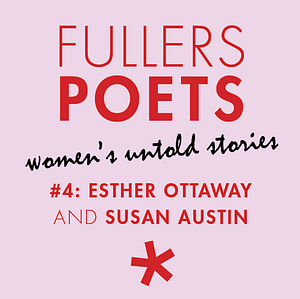
Fullers Poets in Conversation: Esther Ottaway & Susan Austin, 10 August

5.30pm – 6.30pm, Thursday 10 August

Fullers Poets in Conversation – Esther Ottaway and Susan Austin

Venue: Afterword Café, Fullers Bookshop, cnr Collins and Victoria Streets

How intelligent and seemingly social women can be exhausted from undiagnosed autism/ADHD; and how some women end up travelling on unseen, gruelling medical and IVF rollercoasters to become pregnant: Esther and Susan will converse on these issues and on the role of poetry in helping to cope with, and raise awareness about, these challenges. They will read compelling poems from their acclaimed new books, She Doesn’t Seem Autistic and Dancing With Empty Prams.

Join Esther and Susan to go in-depth on these important and unexplored topics in literature, and ask your questions in the Q&A time.

Esther Ottaway is the winner of the Tasmanian Literary Awards Tim Thorne Prize for Poetry and People’s Choice Award, the Tom Collins Poetry Prize, the Queensland Poetry Festival Ekphrasis Award, and has been shortlisted in the international prizes, the MPU, Montreal, Bridport and Mslexia. Her new collection is She Doesn’t Seem Autistic (Puncher & Wattmann).

Susan Austin is a poet, eco-socialist activist and occupational therapist. She facilitates group programs, including a creative writing program, in a mental health clinic in Hobart. Her first poetry collection, Undertow, was published by Walleah Press, an earlier version winning First Commended in the Best First Book category of the IP Picks competition. She was awarded an Australia Council for the Arts grant to work with Gina Mercer on her verse novel Dancing With Empty Prams. In 2021 she won First Prize and Highly Commended in the Fellowship of Australian Writers Tasmania Poetry Prize and was Commended in the Woorilla Poetry Prize. Susan has been a guest performer at various writing festivals and has been widely published in newspapers and journals.

Book here: https://www.fullersbookshop.com.au/event/fullers-poets-womens-untold-stories/

A new Tasmanian blog — Kim Nielsen-Creeley

Artist and poet Kim Nielsen-Creeley has begun a blog on her website, with her first post about her experience of this year’s Cygnet Folk Festival.

The Cygnet Folk Festival 2023 mantra is Back in Full Swing. After such a rich day, I’m feeling it.

Professional comedian Jenny Wynter had a Masterclass, Freeing the Funny from 11 – 3.30 today, so I bit the bullet and joined up, having become very interested in improv, after Cameron and Sonja Hindrum’s Literary Lounge at Junction Art Festival in Launceston.

SCAP Writers, featuring Irish poet Kevin Higgins—Sept 2022

This SCAP writers on Zoom is introduced by Donna Campbell and Linda Jackson and features the writing of Rachel McJury, Katharine McFarlane, Jo Gilbert, David Stakes and the master poet of satire, Kevin Higgins. 

Kevin Higgins

“… death arrives, impeccably dressed.”

(Poem ends)

“I spent yesterday” (Kevin continues conversationally), ‘in the Accident & emergency Department in Galway with an issue, and we were saying—a group of us sitting and waiting to be seen—”It’s quite like prison, really: what are you in for now that you’ve made it this far down the corridor? It’s not something small…. “


Melbourne Poetry Map

A note from Indrani Perera’s newsletter ‘The Poet’s Express’, (November 2022 issue) exploring Eleanor Jackson’s creation, the Melbourne Poetry Map.

Take a walking tour around the city of Naarm (Melbourne, Australia) courtesy of some of the city’s finest poets. Curated  by poet and performer, Eleanor Jackson, the Melbourne Poetry Map is a brilliant way to discover a city.

About

The Melbourne Poetry Map: Audio Graffiti is an archive of ten “poetry journeys”, each of which will take between 20 – 45 mins to complete, depending on how fast you travel, how well you know the city and how long you want to spend at each location. That said, it’s nice not to do things in a hurry.

The Map is curated and produced by Eleanor Jackson, and has been supported by the Queen Victoria Women’s Centre, Peril Magazine, Melbourne’s UNESCO City of Literature Office, Overload Poetry Festival and City of Melbourne.

It was created in 2010, with new journeys added in 2011-2012, and again in 2019.

Each journey exists as a map of directions and a playlist of audio tracks designed to be listened to in their corresponding locations. Sometimes the location of the poem is quite specific, sometimes it’s a little bit vague – don’t get het up if you’re not in the right place at the right time. Poetry is all about being in the wrong place at the right time.

If you do find you’re getting a bit lost, why not ask a local Melburnian for some helpful directions! Apparently, they’ll be the ones dressed in all black.

We hope you’ll love exploring the psychogeography of this incredible city. As snapshots in time, some poets pay tribute to places that are no longer there, or places that have changed in their use and designation. We say, just roll with it.

Good luck!

Review, David Mason poetry collection ‘Pacific Light’ (Los Angeles Review of Books, 20 Nov 2022)

Thoughtful words, both by and about US poet David Mason, now resident in Tasmania.

Siham Karami reviews Mason’s Pacific Light (Forty South Publishing, Sept 2022)….

In this collection, we sense it in the very first poem, “On the Shelf,” whose title rhymes with and is the same metric length as that of the final poem, “Note to Self” — another indication of the care with which Mason organizes his effects. There we are invited to observe the smallest thing, a spider’s shed skin, which the speaker “thought twice before touching,” because the spider’s “soul” is still “able to frighten.” He wonders if his own “shed skins / in houses where my name has been removed” will elicit an emotional response, if “some words of mine” will thus “go on living,” without asserting it. The question remains humbly open.

There’s reference too, to previous conversation with Mason in the form of a link to Leath Tonino’s 2015 interview with the poet, published in The Sun.

Tonino: As you’ve described it, the Greek view seems particularly fitting for a poet. I like the idea of poets as people writing from the brink, with the clarity and intensity of the about-to-die. It makes me think of the Zen Buddhist tradition in which a master often writes a final poem on his deathbed.

Mason: That happens in the Western tradition as well. Many poets write their own epitaphs. Take Robert Frost’s: “I had a lover’s quarrel with the world.” That’s just a beautiful idea. We’re always a little at odds with the world, always wrestling with it, fighting it, beating our head against it. But we also love it very much. Elsewhere Frost says, “Earth’s the right place for love: / I don’t know where it’s likely to go better.” You’ve got a body, and the body can love as well as suffer. Sometimes love is suffering, right?

I think poets as a group often do have an essentially Greek view of existence. I don’t mean they are all influenced by the Greeks. There are obviously Christian poets and Buddhist poets and many others with different theological standpoints. But the awareness of death seems common to all. It’s almost the nature of poetry.

Tonino: But obviously poetry doesn’t have to be only about loss, grief, and death.

Mason: Right. There’s a spectrum. Sometimes it’s about transforming loss. We are all transformed by grief. We change in the way a tree struck by lightning changes. Artists try to capture that in a poem or a minuet or a painting or a sculpture.

A student was asking me just today: Why is it so hard to write about happiness? I replied that it’s hard to write well about anything — it’s just damn hard to get the words down right — but it’s especially hard to convey the joyful aspects of life without becoming sentimental. Sadness, too, can be maudlin, but it’s particularly true of happiness.

And yet there are happy works of art out there, works that are brimming with gaiety, to use W.B. Yeats’s word. Even the tragedies often crackle with a kind of life energy. You feel revitalized by partaking in them. Somebody once speculated that the writer Flannery O’Connor must be a cynical person, because her short stories are so dark. Her answer, which I’m paraphrasing, was that no completely cynical or nihilistic person can write fiction. In a sense, the very act of creation is fundamentally an acknowledgment of life.

I read a lot of contemporary poetry and often find myself feeling that there’s no vitality to it. It’s as if the author were dead inside, or just writing for professors. There’s no human pulse there. The poem doesn’t beat like a heart. All the best literature has that pulse. It makes you feel alive to read it.

WestWords—David Adès and Peter Boyle in conversation [24th Nov 2022]

More than an hour of poetry and conversation between poets David Adès and Peter Boyle, on Peter’s selected theme— exploring the unknown in life.

DAVID

Peter, with the theme that you’ve selected ‘Exploring the unknown in life’, you’re reading poems today from your last two books ‘Ideas of travel’, and ‘Notes towards the dream book of endings’. Both of those titles suggest to me the notion of exploration.

How do those two books reflect your theme?

PETER

I think both of those books reflect the idea of, or are based around the premise of, trying to write poetry that doesn’t start from what you know but is working its way towards what you don’t yet know. So it’s poetry that’s deliberately not paraphrasable—not exactly storytelling, not obviously related to some kind of theme that you could spell out in advance. So it has that exploratory quality, the sort of openness to the various things that life might unfold that we don’t yet know. So multiple dimensions of reality….

DAVID

You’d be familiar with this, there’s a very old conversation in poetry about whether poets—and probably in literature generally—should write about what they know. I remember as a seventeen-year-old wannabe writer I was told not to write anything until I had something to say. I wrongly didn’t think I had anything to say as a seventeen-year-old and that was possibly the worst advice I’ve ever been given. How much of writing for you is about exploring the unknown?

PETER

Well, I think for me writing has got to be about exploring the unknown in a sense that if it’s something that I could say to someone because I know it already, if it’s—you know—just my opinions about some this, that or the other topic, then to me it just doesn’t have the energy to push me into creative poetry….


Peter Boyle


Woorilla Poetry Prize 2022

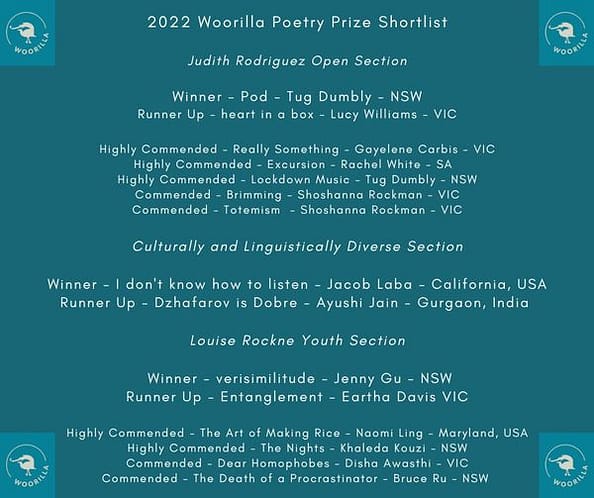
The Woorilla Poetry Prize was judged this year by Kevin Brophy and Alicia Sometimes, with the awards event taking place in Emerald, Victoria.

Kevin Brophy spoke briefly about the judging process. ‘I guess I want to remind you at the start that judging a poetry competition is a very human process. There is a human at the end of the poems, trying to receive the poems and trying to be everything that a judge is meant to be, but in the end having to be simply a lover of poetry, and react to the poems as a lover and admirer of poetry and what poets do … which is to renovate language.’

First Prize went to Tug Dumbly, with Lucy Williams runner-up. The three Highly Commended Awards went to Rachel White, Gayelene Carbis and Tug Dumbly, while the two Commended Poem awards both went to Shoshanna Rockman.

A video recording of the event is online.

Launch of ‘Reaching Light’, by Robert Adamson [Sydney, July 2022]

Robert reading and in conversation with his Flood Editions USA editor/publisher & poet Devin Johnston, with readings by Sarah Holland-Batt and Michele Seminara.


The very sad news is that Robert Adamson is gravely ill. 

*          *          *          *          *

Normally, I’d not think twice about the mention here of a literary event—a book launch—yet I’m vaguely aware that doing so on this occasion could possibly be construed as no more than zeroing in on a topical note of interest.

However….

*          *          *           *            *

When Tim Thorne fell ill, I found myself hesitant to engage, ask how he was going … generally, just unwilling to intrude. In retrospect, it was a rubbishy form of interaction on my part—albeit under trying circumstances. I regret I didn’t make a greater effort…. Physically, Tim was slowing down, but mentally he was still off and running…. We shared a moment together, one session during the 2021 Tasmanian Poetry Festival. The state election had been called that very day, and scheduled for the 1st May. I made some reference to it, to which Tim quickly replied oh yes, and that’s going to put a very different interpretation on May Day, isn’t it? and he laughed.

I should also have said, oh by the way I appreciate and admire you so very much; for your generosity, for all you’ve achieved…. But I didn’t.

So goodbye rubbishy decisions.

I don’t know Bob Adamson’s work well, and my indirect association with him has only occurred since he provided back cover blurbs for one or two of the poetry collections I’ve published (Vanessa Page’s ‘Confessional Box’ comes to mind) some years ago. My belated appreciation of his poetry is due to the arrival in our home of a copy of the 2016 anthology ‘Contemporary Australian Poetry’ (Puncher & Wattman), where the work of poets is, according to surname, arranged in alphabetical order. Such a great anthology, so many very fine poems, but I always experienced difficulty getting past the opening five poems in the book—Adamson’s—’Via Negativa: The Divine Dark’, especially. Such fine poems all…. Bless you Bob for making vivid, and sharing, your perceptions.

Anne Collins—book launch

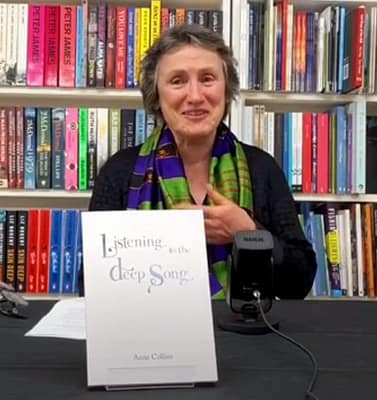
Lovely to see that Anne Collins has launched her newest collection of poems and prose—’Listening to the Deep Song’ (Bright South)—in Hobart last week.

cover Listening to the Deep Song Anne Collins


The book was launched at Hadley’s Hotel on 11th November by Petrina Meldrum:

I’d like to say how happy I am to be back in Hobart to share in the launch of Anne’s latest book, Listening to the Deep Song, and how nice it is to see so many familiar faces. Thank you all for coming along to support Anne and to celebrate with her.

When I first met Anne some six years ago, her manuscript, for all intents and purposes, was ready to be sent out to publishers. I remember clearly, when Anne brought it along to one of our early meetings, how impressed I was with the idea she had had, and with how she had gone about bringing it into existence.

As the intervening years flew by, the manuscript grew larger, and today, here we are, with this beautifully written book in our hands.

I think most of us are aware of Anne’s interest in Spain and the Spanish culture, but not necessarily of the depth of her involvement. In Listening to the Deep Song she shares, without restraint, her experiences.

Through multi-layered vignettes and some exquisite poetry, she takes us on a journey through Spain’s regions and major cities, through its seedy back streets, its world renown museums, and its quirky architecture. If you’re planning a trip to Spain, you can throw away your guide book and take Anne’s book with you instead. She’ll guarantee to get you lost at night in the back streets of Seville, or help you lose yourself in the whimsy of Miró’s universe in Barcelona.

Spain, of course, is not one country but a number of autonomous regions, each with their own language and cultural heritage, which they guard fiercely.

Anne recognises this by dividing her book into sections and allocating a flamenco rhythm or compás to each region. These rhythms reflect her sense of an underlying mood as she travelled through Spain.

On returning to Hobart, to her ‘Spanish life’, she has this to say:

Curiously in Hobart I have a Spanish life. I enjoy the exhilaration of flamenco dance classes… For short periods of time, I am immersed in flamenco energy. These experiences help me in finding my own flamenco self, my own flamenco confidence, still with much to learn.’

In the ‘Afterword: I am touching you’, a heart-warming piece, she tells us of her experience during Covid-19 isolation, a time when many put their lives on hold, but not Anne, she was Zooming her way to Madrid several times a week to attend flamenco classes online.

Following her journey, we become aware that there is another dimension to Anne and we are left, as a consequence, with a more intimate sense of who she is.

On attending a flamenco performance in Seville in a 16th century Sephardic courtyard at La Casa de la Memoria she records:

I feel an unexpected stirring of ecstasy and sorrow, a kind of loss deep within, of what I am not sure, but like the poet Félix Grande, I want to cry like a new born. What has this to do with me – an everyday 21st century stranger to my own roots and here for this brief moment? What yearning pulls me beyond their words of protest I barely understand, into ‘the gratitude, the anguish, the joy, the revelation’, the raw wailing core of this art we call flamenco?

We see a more playful Anne, in Barcelona, visiting one of Gaudí’s buildings, La Casa Batlló.

From her poem, In Gaudí Wonderland:

Inside the Casa Batlló the building seems

to sway and dance and smile

and I want to leap about

as the curves of my breasts and hips

align with the curves of the cave-like walls…

I imagine living here in this building

that honours a sense of joy.

Feel gracious and light, tender, seductive, playful,

free of straight lines and rigid postures

as if some essential fluidity

has re-awoken deep inside me.

Throughout the book there is a questioning going on, a desire to learn more – to have a deeper understanding, to belong. This is what Spain does to you if you let it: it draws you in and never lets you go. There is a sense of this happening to Anne as she gives herself over to Spain, while at the same time questioning why this is happening to her.

Her trips to Spain span a period of thirteen years, a long enough period for her to have noticed changes, both good and bad, all of which she shares with us. The diverse knowledge she has gained in this time is masterly woven into her vignettes, leaving us with signposts and pathways to follow if we wish to know more. The vignettes, at times a conversation with Spain, would give any traveller a masterclass in how to travel, in how to be more engaged with what lies beneath the surface.

Interspersed with the vignettes is Anne’s poetry. Some of the poems are born of her long interest in the life and work of Federico García Lorca.

Lorca’s first major work, Poema del Cante Jondo Poem of the Deep Song – has clearly influenced Anne’s choice of title for the book, however, the poems she has chosen to respond to, form a conversation with a wider range of his work.

This poetic dialogue with Lorca’s work opens up a new way of reading into it, a way, through poetry, of showing the relevance of his work in a 21st century context.

In Anne’s poem, Learning to Spell, After the life of Federico García Lorca, which I’d like to read to you, she quotes phrases from two of Lorca’s poems, Landscape and Sleepwalking Ballad.

Learning to Spell

The boy learns to spell leaf

it turns to leaves on a yellow tree.

Leaf through the mistake of years–

a complicated task, a lot of rubbing out.

There’s knife and shelf, the rule’s the same

do your homework. By mistake the evening

a knife-edge wind cuts the leaves.

The alarm, the shelves full of books,

the guards are spell-bound.

The boy changes into a bird

watches through the mist on the panes

writes sentences with the word leaf,

a complicated task, a lot of rubbing out.

They leaf through the shelves.

After the wind there was only one leaf left.

On the page a trail of tears, the stanzas stretched out.

Her other poems reflect on her connection with and her understanding of Spain, and on her association with the art of flamenco. The flamenco poems make your heart beat to a different rhythm as you appreciate the degree to which this artform has become part of Anne’s life, and she part of the ‘flamenco family’.

I can truly recommend Listening to the Deep Song to you.

And now, I’ll hand over to Anne who is going to share some of her beautifully written pieces with us. Anne…


In conjunction with Hobart Bookshop, Anne’s also recorded a short video explaining more clearly her love of Lorca along with ‘everything Spanish’,  here.


in his endorsement of Anne’s book, Peter Boyle writes—

“Part travel diary, part meditation on Spain and its cultures, part poetic dialogue with the poetry of Lorca, Anne Collins’ “Listening to the Deep Song” is a beautifully written testimony to her long enthusiasm for the many sides of Spanish culture. Bringing together her training in flamenco dance, her love of Lorca’s poetry and several of her journeys through Spain, Anne Collins offers her readers a personal response to a unique blend of cultures that continues to speak to the 21st century world. Varied and many-layered, marked by close observation and thoughtful questioning, this is a delightful book.”


Finally, the publisher’s description…

Like a traveller’s journal written in prose and poetry, Listening to the Deep Song records Anne Collins’ travels through various regions of Spain, which took place over many years. The book offers a meditation on Spain’s many-layered history and culture, reflecting on history, landscape, expressions of culture, and change. It reveals places of connection and friction within Spain and across the world; as far as Anne’s home in lutruwita-Tasmania.

The writing turns on a poetic dialogue and an embodied praxis; the latter being expressed through both Anne’s physical immersion in Spain, and her practice and knowledge of flamenco dance. The latter engages with, especially, the life and works of Federico Garcia Lorca, as well as with other poets and writers of, and about, Spain.

Listening to the Deep Song is deeply personal, yet it offers much that resonates deeply with contemporary concerns. Anne Collins’ writing is varied, thoughtful, observant, poignant and beautiful.


‘Listening to the Deep Song’ is available from Bright South. It sells for $30.
Book launch—Gayelene Carbis’ ‘I Have Decided To Remain Vertical’; Melbourne 16 Oct 2022, launched by Marion May Campbell

Plenty of support for Gayelene Carbis, when Marion May Campbell launched her new poetry collection—’I Have Decided To Remain Vertical’—at Readings in St Kilda last month.

With Claire Gaskin MC-ing the event, local choir The Red Hot Singers — (‘This is not a choir, it’s a singing group … in other words, informal’, someone clarified; another pointed out ‘We’re all part of Soul Song’, a subset; we get out and about!’) — provided an African musical intro as a prelude to Marion May Campbell’s launch address. Much like Kevin Brophy in Melbourne (and Pete Hay in Hobart and Cameron Hindrum in Launceston), Campbell is a favoured ‘go to’ person when it comes to launching poetry in Melbourne, (she launched Susan Hawthorne’s ‘Dark Matters’ at Collected Works five years ago, back in the days when Kris and Retta welcomed all & sundry to their fabulous bookshop, ‘up the stairs and to the left: or take the lift!’)

Claire urged punters to ‘buy a book, to support Gayelene, to support poetry, to support Readings, to support the wonderful publishers who publish poetry’ before introducing Marion May Campbell, whose bio she proceeded to read. ‘If you haven’t read all those books [of Marion’s], you know, you really haven’t lived so you have to make sure you do that … a wonderful writer, a beautiful person who’s won many awards and supported many a writer … (Gayelene’s nodding!) Please warmly welcome Marion May Campbell.’

Marion spoke of the miracle of several key poems in this new collection presenting an integration ‘of a kind of terror and of comic Alice-like defiance. Surreality is presented with hyper-real acuity…. Poetry-making often snatched from the doors of disaster is both agent and catalyst for the I-persona — and I won’t call the ‘I persona’ Gayelene, because it’s so variable as well, and protean … takes on different shapes all the time. Her triumphant survival, no matter into what pits life and love have thrown her, is always done with great comic brio – and often hilarity, all the more liberating for the near-catastrophe that she skirts.’

‘I had a much longer version of this already-too-long speech, which quoted a lot of these poems—I would have liked to write about every poem in the collection….

.   .   .   .   .

‘In various inventive ways Gayelene’s work, so far—in her plays, stories, and now two poem collections—has explored both the comedy of feminine identifications, and the devastation wreaked by models of masculinity that men, and boys, strive to enact, or refuse at their peril.

.   .   .   .   .

“Again, the last line is an unmitigated triumph. ‘I hold my pen like a knife’.

.   .   .   .   .

“Here fabulism triumphs over sadness with magical metamorphosis, yet the humble domestic broom, remembering its origin, offers a retreat. And I’m reminded here of that Turkish proverb, When the axe came to the forest, the trees whispered—the handle’s one of us.’

‘Oh Gayelene, thank you for such fabulous, transfiguring work. Congratulations, from the heart.’


‘Marion … thank you for your beautiful, and passionate and erudite response to my work, and for launching my book into the world in words that are so uniquely you, thank you—from my heart, thank you.’

‘I think we should all go home now…. I mean do I need to say or read anything? Yes I do, Yes I do. I need to say thank you. These poems were written over many years, some a very long time ago. I spent years and hours working towards this book, and it’s just … me and the work … but it really takes a community to create and make a book. I’d like to firstly thank Puncher & Wattmann whom I’m thrilled to be published by, huge thank you to David Musgrave….

‘A huge thank you to Marion May Campbell, and Kathleen Mary Fallon, for extraordinary generosity over many years. Kathleen, thank you for suggesting the title, Marion really pushed for this one amongst the Kathleen Fallon list of possible titles … well not pushed, that’s not Marion’s style: she presented ‘elequent arguments’. Initially I thought, it’s too long, it sounds weird … and then I thought, ooh, I wrote that line. Now I think it’s a perfect title for the book….’

Gayelene proceeded to read a number of poems from her book, a reading of which Lyndon Walker has since written generously and reflectively,  “A fine and powerful reading of your work. Very moving, and very funny – you have that balance there. You are one of the best readers/performers of your own work in this country.”

Bringing the event to a close, the Red Hot Singers once again took to the floor. ‘Gayelene … do you wanna? … come and sing with us.’

‘Oh, yeah sure. You twisted my arm….’

(to view the full launch event, visit here … to purchase the book, visit here).

Alice Allan—3CR’s ‘Spoken Word’

It was good hearing poet and podcaster Alice Allan in conversation with 3CR’s Waffle IronGirl on the ‘Spoken Word’ show, on the 20th October 2022.

Alice has published a couple of poetry titles—’The Empty Show’ (Rabbit Books), and the chapbook ‘Blanks’ (Slow Loris)—but considers herself primarily a podcaster. She produces the weekly podcast ‘Poetry Says’, an entertaining, erudite, often funny podcast with interesting writers—including Cassandra Atherton, Bonny Cassidy, Pam Brown, John Kinsella, Alison Whittaker, Ellen van Neervan, among others. Currently the podcast series has reached episode 197, it’ll be interesting to learn in due course, her plans for episode 200.

Alice notes the show has ‘evolved’.

‘Yeah. Well, I started it very much as a poetry beginner, six years ago, I think I’m even more of a beginner now than I was then’. She says she now fully understands the scope of what she took on back in 2016—back then, she had no idea. ‘I think it’s evolved because I can ask my guests better questions. I think I’ve grown a bit as an interviewer, and I can see the conversation more effectively now.’ 

What she loves most about putting the show together is that she gets to introduce people to poets beyond the bios that you’d find, for instance, in the back of Black Ink’s annual ‘Best Australian Poems’, (2003 to 2018). Previously she’d felt the world of poetry closed off to her, but these days ‘when I get to invite people onto the show, get to hear them um and ahh, laugh and make fun of themselves and read their poems in their own voice, that really excites me. I think about the version of myself where I started back in 2007. Understanding that these are people just like you and me.’

Asked by compere Waffle IronGirl about honesty and letting yourself ‘show’ … and about ‘perhaps even the dreaded word— (though) maybe dreaded only by me—authenticity,’ Alice responded appreciatively that she loved ‘that you underscore how difficult that word is—”authenticity”‘.

‘I’m playing a role to start with as the host,’ she explained, ‘but also with each interviewee. I come with a set of expectations, I often come with a lot of fear. I hope I’m getting better at digging a little bit deeper with people.’ (Here Allan remains customarily—but unnecessarily, in my opinion—modest; the relaxed and intimate podcast environment of ‘Poetry Says’ has triggered many delightfully ruminative exchanges—the following, for example, from a 2019 interview with poet Bonny Cassidy:

ALLAN: I remember talking to you around the time that Chatelaine was about to come out and you talked about feeling a certain level of separation from the work, even at that stage. I totally understand that now, with my own collection on the verge of coming out, it feels … so far away. And it’s a weird thing because you have this moment where it all publicly culminates, but actually in your world….

CASSIDY: It’s old news…

ALLAN: … it’s kind of over! So how do you feel about your three books?

CASSIDY: I think I’ve come to really own past work the past few years, such that it always feels very present to me. I’m very proud of it even though to me it is old and belongs to a certain phase of my writing, particularly with formative work, like when I look at Certain Fathoms now … there was a time when I’d look back on it and go … aaagh, I wish I could go back and revise it; or, hope no-one reads that now.

And I kind of got to a point where I thought, you really have to come to terms with that Bonny, you’ve got to stop looking at your first book and a) being so hard on it, and b) not really seeing it for what it is. I spent some time re-reading it and thinking ohh, okay, I see the DNA that goes from the first book through to the second and the third. And I honour that. Without that book, I wouldn’t have written the second one, without the second one I wouldn’t have written the third one, there’s this interdependency.… You can’t just cut it off and go, oh that was me then and let’s not talk about that now, that’s irrelevant. It’s not at all! It’s totally relevant. It’s an artefact, but … it’s something I made with thought and purpose, and it’s informed later work. It’s informed the ways that my three-and-a-half readers (laughs) might see my writing….

So I’m really fond of all the books, really fond of them. I don’t go back and re-read as a matter of course. I did think recently of doing that and maybe just setting aside a day—you know, maybe just spend this with my own words. I spend so much time consuming other people’s words day in, day out, maybe I should go back and just sit with my own, and be a reader of myself.

Roland Barthes has this statement about how the author can certainly go back to their own text, but they will only ever do so as a guest. And I really like that idea of going back and … you know … visiting your own work, and taking pleasure in it as a visitor—rather than going back with a cringe, or going back and seeing it as a kind of inscription of yourself. It’s not a tombstone!)

On the state of poetry and spoken word as it stands in Australia, Alice Allan says she’d ‘love for there to be more fun, love for us to play and laugh more’. She feels ‘very allergic personally’ to a serious strain she sees running through Australian poetry. ‘I don’t mind if it’s there. But I do mind if it’s all that’s there. I’m excited to see those moments where spoken word starts to inform poetry that purely exists on the page, by which I mean when we have a poet who is not thought of as—quote unquote—a spoken word poet, get up there and deliver their work in a way that cares about the audience. Don’t see that very often, though.’ 

Asked of what might be missing or deficient from the Australian podcasting scene, Alice is adamant: much is missing. ‘We need many, many more female voices. We need many, many more voices from people of colour.’ She recommends people check out the Barron Field experience, being made by Justin Clemens and his friends out of the Melbourne School of continental philosophy. ‘That show is nuts. Just three philosophers yelling at each other for way too long. And it’s fantastic. I want more shows like that, I want less production!’

And on the question of recommended reads, she singled out Eleanor Jackson’s ‘Gravidity and Parity‘ (Vagabond Press), a title that was shortlisted for the Small Press Network Book of the Year in 2022, and highly commended in both the 2022 Victorian Premier’s Literary Awards and the ASAL Mary Gilmore Award 2022. (‘As soon as I opened it and realized what she was doing, I was like, oh, hold the phone…. Yeah, it really blew me away!’); along with Harry Reid’s ‘Leave Me Alone‘ (‘I came to that book with exceptionally high expectations. And Harry has not let me down.’) She’s also had the chance to chat with Tracy Ryan a couple of months ago. ‘And I read pretty much everything of Tracy’s I could get my hands on in preparation, including “Rose Interior“, her tenth collection, out this year. She’s really a poet working at the height of her powers.’

Episodes of ‘Poetry Says’ are online at Poetry Says. 3CR’s interview with Alice Allan is online at Spoken Word.

Tasmanian poet Tim Slade, reading ‘Thylacine’

Tim Slade’s been writing poetry for a decade, his work has appeared in publications as diverse as The Weekend Australian, The Koori Mail, Australian Poetry Anthology, Growing Up Disabled In Australia and Cordite Poetry Review. Originally from Hobart, he settled in the tiny Tasmanian town of Pioneer a decade ago where he’s drawn inspiration for much of his poetry. 

Tim’s poetry collection The Walnut Tree, was published in April 2021 by Daniela Brozek Cordier’s imprint Bright South Publishing, and launched by Pete Hay at Petrarch’s Bookshop, Launceston.

Tim Slade at the launch of The Walnut Tree

Coincidentally, both Slade and Hay—in their most recent collections—praised the work of a Scottish poet who lived out his life on a far flung island on the opposite side of the globe, Orcadian George Mackay Brown.  Honouring Brown, Tim mailed a copy of his book to the local library in Stromness, Orkney Islands, where the book is now available to borrow.   ‘On the harbour in Stromness, the view from this library is perhaps the most picturesque in the world,’ Tim writes.

Tim recently produced a Youtube video of ‘Thylacine’, one of the poems featured in his collection. As well, Warwick Hadfield read the poem on RN’s Breakfast programme in July this year. ‘Thylacine’ was previously published in Communion 15.


Red Room—Showcasing Tasmanian poetry and musicians. Mona, 27th August

Red Room Poetry Month features an afternoon of free entertainment at Mona in Hobart, Saturday 27th August at 1-2.15pm.

Come for the art, the architecture, the aesthetic, stay for the poetry. In partnership with MONA, come along to see/hear/feel some of Tasmania’s finest wordsmiths and spoken word artists including Esther Ottaway, Rebecca Young, Rohan King, Kathryn Lomer, Damon YoungWarren Mason and hosted by Bert Spinks plus live music by acclaimed troubadour Ben Salter and sets either side by legendary local jazz ensemble the Spike Mason Quartet.


Rebecca Young, performing at the 2020 Tasmanian Poetry Festival, Launceston. (March 2020)


Other work:

04 Sep 2003: Sarah Day’s launch of Kathryn Lomer’s ‘Extraction of Arrows’ (University of Queensland Press)

01 Dec 2003: Tim Thorne’s review of Kathryn Lomer’s ‘Extraction of Arrows’ (University of Queensland Press)

27 Feb 2014: Philomena Van Risjwick’s launch of Kathryn Lomer’s ‘Night Writing’ (University of Queensland Press)

27 May 2021: Jane Williams’ launch of Esther Ottaway’s ‘Intimate, low-voiced, delicate things’ (Puncher & Wattmann)


Kathryn Lomer, with Ray Liversidge and Nathan Curnow. (Queensland Poetry Festival, 2012)


‘Otoliths’: issue 65, southern autumn issue

Issue sixty-five of Otoliths, the southern autumn 2022 issue, is now up.


This issue, which marks the beginning of the seventeenth year of the journal’s existence, contains a mix of — sometimes mixed — photographs, paintings, short stories, poetry, interviews, magazine columns, & manifestos from an international contributor list including Karl Kempton, Linda King, Mark Pirie, Dario Zumkeller, AG Davis, Mark Cunningham, Sanjeev Sethi, Ken Friedman, Demosthenes Agrafiotis, James Cochran, Jim Leftwich, hiromi suzuki, Michael J. Leach, Elancharan Gunasekaran, Louise Landes Levi, KJ Hannah Greenberg, Chuck Joy, Marco Giovenale, Jimmy Crouse, Andrew Cyril Macdonald, Nicholas Alexander Hayes, Mario José Cervantes, Timothy Pilgrim, Alan Catlin, Paul Ilechko, Jim Meirose, Adam Fieled, Gregory Stephenson, John Sweet, Sterling Warner, Jack Galmitz, Lynn Strongin, Texas Fontanella, Richard J. Fleming, Sarah Bilodeau, M.J. Iuppa, John M. Bennett, Carla Bertola & John M. Bennett, Harvey Huddleston, bofa xesjum, fred flynn, John McCluskey, Ben Egerton, John Gallas, Nathan Whiting, Laurent Grison, Volodymyr Bilyk, Xe M. Sánchez, Ellen Wardman, Barbara Parchim, Bruce Robinson, Jeff Bagato, jim mccrary, Gale Acuff, Grzegorz Wróblewski, harry k stammer, Howie Good, Jen Schneider, Alberto Vitacchio, richard lopez & Márton Koppány, Heather Sager, Keith Polette, Michael Basinski, Luis Cuauhtémoc Berriozábal, Daniel f Bradley, Dave Read, Robert Beveridge, Tom Beckett, Mary Kasimor, Connor van Bussel, R. S. Stewart, Tony Beyer, Daniel de Culla, John Levy, Joanne Bechtel, Kenneth Rexroth, Nathan Anderson, Jeff Harrison, Bill Wolak, Clara B. Jones, Nicole Raziya Fong, Charles A. Perrone, Russ Bickerstaff, Paul Dickey, Sabine Miller, Keith Nunes, Diana Magallón, Bob Lucky, Cecelia Chapman & Jeff Crouch, bart plantenga, Joshua Martin, Jillian Oliver, Réka Nyitrai, Marilyn Stablein, Jerome Berglund, Christopher Barnes, Peter Cherches, Jürgen O. Olbrich & Hubert Kretschmer, Kay Kestner, Cameron Morse, Eric Hoffman, Gavin Lucky, Kiriti Sengupta, Patrick Sweeney, Robin Wyatt Dunn, Jane Simpson, Elmedin Kadric, Kit Kennedy, Steven Tran, dan raphael, Andrew Taylor, Charlotte Jung, Michael Borth, Carol Stetser, Penelope Weiss, Marcia Arrieta, John M. Bennett & Jim Leftwich, Márton Koppány, Rich Murphy, Cecelia Chapman, J. D. Nelson, Kit Willett, Angelo ‘NGE’ Colella, H. A. Sappho, Martin Stannard, Michael Brandonisio, Paul Pfleuger, Jr., Katrinka Moore, David Jalajel, Keith Higginbotham, Susan Gangel, Judith Skillman, Bob Heman, & Guy R. Beining.  

Notes from a launch: Esther Ottaway’s ‘Intimate, low-voiced, delicate things’

My take on Jane Williams’ launch of Esther Ottaway’s poetry collection ‘Intimate, low-voiced, delicate things’ in Launceston last year — please visit here.

‘I’ve been a fan of Esther Ottaway’s poetry since her first, small, powerful book Blood Universe some fourteen years ago.’ she said. ‘The long wait has been well worth it and … I suspect Intimate, low-voiced, delicate things could not have been conceived, written, crafted and let go of any sooner because the result is so intellectually and emotionally gratifying. This is a book about the deepest connections we make – with lovers, family, friends but ultimately self.’ (Jane Williams)

Ralph


Poetry evening, Launceston — Tuesday 12th April 2022

After a break, poetry is back in Launceston on Tuesday 12th April, in the back bar area of the Sports Garden Hotel, corner of George and Cimitiere Streets. It will be a re-launch of POETRY PEDLARS.

Arrive between 7 p.m. and 7.30 for a 7.30 reading start, but come earlier if you want to read in order to put your name down on the list.

 No Guest Reader this month (just in case the event attracts only a small audience due to Covid),  but “because of this we will have two reading brackets, so bring an extra poem or two to read…”

The competition for this month is to write a poem around the theme “It’s Pay day”  – however you interpret it.

Winner gets a bottle of wine and a book, as well as a certificate to say you’ve won.

Colin Berry


Review, Jane Williams’ ‘Points of Recognition’

Alison Clifton reviews Points of Recognition, one of two of Jane’s collections to appear in 2021 (the other: Between Breaths, Silver Bow Publishing, Canada).

‘Jane Williams’ Points of Recognition is inherently human poetry. Her concerns are wide-ranging: from empathy to idiosyncrasy, the mundane to the marvellous, compassion to passion, diffidence and restraint to ecstasy and excess. Always she is wondering, inquiring. What does it mean to be human? And what does it mean to be inhumane, even inhuman, in our treatment of others?’

(Read more: Alison Clifton, StylusLit)

Launch — Les Wicks’ poetry collection ‘Time Taken — New & Selected’

Time Taken — New & Selected’, (Puncher & Wattman) is Les Wicks’ fifteenth poetry collection.

2022 will mark the 50th anniversary of Wicks’ first poem publication. His imprint Meuse Press will turn 45. He has been presenting workshops around Australia across 35 years.

Time Taken is a New & Selected collection revisiting his best poems across this time span, the culmination of a lifetime’s work.

Time Taken will be launched by Martin Langford at the Friend in Hand Hotel, 58 Cowper St, Glebe, Sydney, upstairs bar, on Sunday 13th March at 2.30pm

Geoff Goodfellow at Adelaide Festival, 7th March 2022

Geoff Goodfellow returns to Writers’ Week with a reading of his new verse novella, ‘Blight Street, (Walleah Press), featuring Geoff and performers Roslyn Oades and Nic Darrigo.

(From the festival’s notes):
“Set in the northern suburbs of Adelaide, ‘Blight Street’ is written in the language and idiom of the culture it portrays. Harrowing but tender, ‘Blight Street’ draws on the vital themes that characterise Geoff’s writing: the working class struggle, the tragedy of addiction and the celebration of love.”

The reading (a free event, no need to book) is timed for 10.45 am, Monday 7th March, Plane Tree Stage, Pioneer Women’s Memorial Garden. It will followed by a short interview with Geoff, chaired by Rick Sarre.

Tasmanian Poetry Festival, September 2022

Noting from the festival’s facebook page … the 2022 festival is now planned for September in several venues over two weekends, with some events on the weekend of the 17th and 18th and the main Festival on the following weekend, from Friday the 23rd to the 25th of September.

The festival also hopes to have some other poetry events in the lead up to the Festival, similar to last year.

Poets (including some musicians) will include people from different parts of Tasmania as well as some from the Mainland and further afield (COVD permitting).

At this point, guest poets include: Therese Corfiatis, Anne Kellas, Dave Mason, Thomas Bailey, Ren Alessandra, Daniel J. Townsend and Fleassy Malay. There will also be open mic opportunities.

The Festival was originally planned for March, but has been moved to September following the influx of COVID infections post border opening.

‘Otoliths’ issue sixty-four, southern summer 2022

A southern summer issue of otoliths’ (issue sixty-four), is online featuring the work of 120—130 writers and artists including Tony Beyer, Les Wicks, Pete Spence, John M. Bennett, Eileen R. Tabios, Sheila E. Murphy, Cameron Morse, Alyssa Gillespie and many more.

Nothing by editor Mark Young in the issue, but you can savour some recent work in the latest issue of Rochford Street Review.

Ron Moss — ‘Cloud Hands’ (Nov 2021)

Ron C. Moss is a Tasmanian poet and artist whose haiku and short form poetry, has appeared in leading journals and anthologies across the world. His award-winning poems have been featured many times and translated into several languages. ‘Cloud Hands’ (Walleah Press) is the fourth major collection of Ron’s previously published haiku, and it brings together work from more than twenty years of writing.

Laurie Brinklow — ‘My island’s the house I sleep in at night’ (Oct 2021)

Being an islander means that you aren’t like everyone else.” Bounded by water, you can live your life with certainty knowing where your edges are. Drawn from interviews with artists from Newfoundland and Tasmania, these poems capture what it means to be an islander. To know every rock and tickle, “the sea your road/the hole in the sky/your light to travel by.” In My island’s the house I sleep in at night, Brinklow — jointly published by Walleah Press, and Island Studies Press, Prince Edward Island, Canada — weaves stories and images with her own poetic imaginings. These are poems steeped in community memory, about belonging to a place like nowhere else, a kitchen party full of islanders telling stories about the patch of rock they call home.


Harry Laing — ‘unsettled’ (April 2021)

‘unsettled; (Walleah Press)

‘unsettled’ is a collection of broad thematic and formal range. Laing renders our history, our current ecological crisis and some of our contemporary mores into a rich, tumbling music, as memorable as it is accessible. The poems that revisit the author’s past are especially poignant: closing some doors as the windows open to poetry’s crisp, delicious air.

(Aidan Coleman)

Castlemaine poetry reading

Tuesday 24th November 2009 — Travelled over to Victoria with Jane on the weekend, to the Castlemaine readings run by Ross Donlon at the Guildford pub. Caught up with Robyn Rowland again, she invited us to stay with her in Ireland some time if our visits coincide, ‘I rent a lovely little cottage on Ireland’s west coast, overlooking the sea – for three months at a time,’ she said.

Ross runs a good poetry event. Sixty-five or seventy people in attendance, not easy to secure a seat.

Listened to an open section of eight poets [good poems too] as well as the launch of a chapbook from BN Oakman and a reading by Robyn Rowland.

Ross habitually reads a couple of poems to introduce the reading … one, on this occasion, a poem about hens by Sarah Day, a recent guest to Castlemaine … it struck a chord, (I’d visited friends not long ago, really took to their four gorgeously plumed hens who are destined to die of old age: they’re doted on by the family’s children who view them as pets so they’ll never reach the cooking pot) … Sarah presents powerful images, but (more than that) does so with integrity, walks the talk

BN Oakman’s full of energy, witty, humble. ‘If there’s one thing a reader appreciates, it’s a good listener. You’ve been that this afternoon, thank you.’ Robyn Rowland – particularly enjoyed the poems where the personal came to the fore, one poem spoke of the weight of depression, the relief once it’d been lifted. [More to the point, as she added with humour, what to do with all that energy once the weight of depression had lifted]. Also presented was some moving poetry on her relationship with her mother. I’d not heard Robyn read before — thoroughly absorbing.

North to Garradunga: An afternoon at the Republic

Various things draw me to Hobart’s Republic Hotel this afternoon, not least the fact that Pete Hay is reading today. Compere Liz Winfield opens proceedings with work by Barney Roberts and Magenta Bliss (Jenny Boult), a recital that both renews our appreciation of their respective talents and accentuates our  loss. Some of us are making the trip to Launceston for Bliss’ funeral next Thursday.  Continuing on a happier note, Liz announces the results of this year’s Bruce Dawe Poetry Prize. ‘Last year as you’ll remember, it was won by Louise Oxley, this year it’s the turn of Jane Williams.’ Both women are among the audience for the afternoon’s readings.

First to the microphone is visitor Shaun Levin – originally South African but now a resident of London – and Hobart City Council’s International Writer in residency. ‘Much of my work is about love, and sex,’ he says, ‘which I’m missing cos I haven’t been home for three weeks…’

‘But you’re open to offers, right?’ calls some wit from the audience.

Levin grins without missing a beat. He’s the editor of Chroma, a queer literary journal publishing work from writers and visual artists based in the UK. This afternoon he reads from his recent novella, Seven Sweet Things – his writing is funny, droll, in-your-face.

Next to read is local writer Kathryn Lomer. She’d missed the last reading at the Republic, she explained, having been hospitalised for a few days with a life-threatening illness. Kathryn mentioned the name of the illness, ‘something to do with the colon’ she said, adding that investigation had led her to realise the poet A.D Hope had suffered from the same affliction. ‘We both underwent life-saving operations … saved his life, saved mine. Hope went on to write about his. “I’ve always been partial to a colon; but a semi-colon is better than a full stop.”

Lomer reads from old and new work, including ‘Heart to heart’ published in the most recent issue of Island (no. 102), and displaying her effortless capacity to write of the trials of the heart – ‘… parts of our hearts already comatose/ from long-ago mishaps in love’. As she offers words to the microphone I wonder again at the sheer quality of her first collection An Extraction of Arrows (UQP), the winner of the Anne Elder Award and short-listed for the 2004 Adelaide Writers’ Festival. (How difficult is that, faced with competition from every decent poetry collection published in the country over the preceding two years?)

The experience of motherhood is never far from Kathryn’s consciousness, it comes out in her writing, in her conversation. ‘I think we could learn from a survey of four-year-olds on their recollections of the experience of birth,’ she says in response to something raised by Shaun Levin, the previous reader. “I asked my son what he remembered about his birth. His immediate response was, “It was too dark, then I slid down a slide and Mummy bit me” ’. (Do our children ever forgive their writer parents for any of this, Kathryn wonders?).

Another poem is dedicated to Anne Morgan, ‘who put me on to kayaking’. It’s a poem from what she hopes will be her second collection ‘by a publisher who’s intimated they may be able to publish it …  in 2007’. It’s funny, Lomer adds, ‘people always tell me this is a great poem about relationships but it’s really just a poem about kayaking’.

I can’t help thinking how good an experience it’d be to publish Lomer myself, if only I had the resources. The things that matter most in the relationship between a press and the work it publishes – the things that make a book effortless and natural to promote – is always apparent to me when listening to Kathryn read her work, it’s in her earthiness, in the lack of self-consciousness about her writing, in her lively imagination.

Pete Hay introduces a sombre note to proceedings. Remarking on the passing of Magenta Bliss (Jenny Boult) this week, he mentioned how he’d had the privilege of delivering the eulogy at the funeral of Barney Roberts a little time ago. “Scott, Roberts, Bliss in the past three months … we’re losing too many fine poets, too fast’, he laments.

Hay reads from his recent collection Silently on the Tide, the poetry spilling out from this much loved man of letters. Of the thylacine, he reads:

The tiger is an absence, and here’s a marvel.
In the common soul wells a mourning,
a sense of an essence lost from the land
and we have made it so.
We have rendered the land incomplete
and it is not to be redeemed.
It is the very land that grieves, perhaps,
gathering us up.

Hay – generous as ever – makes mention of the presence of Cameron Hindrum in the audience. Cameron, the Director of the annual Tasmanian Poetry Festival,  is in Hobart to present Jenny Barnard with the Poetry Cup she’d won at the festival. ‘Cameron’s an extremely good link-man’, Hay says, adding that like a good many other people ‘I got my ass kicked by Jenny in the Cup’. He finishes his set with a wry smile and some welcome new work. ‘The book goes on, becomes part of history … and the poet moves on, to the next.’

Hindrum is welcomed to the microphone. ‘The Launceston Poetry Cup has escaped Launceston,’ he says mournfully, ‘has come to Hobart for the first time since Tony Rayner lifted it in 1997’. The Cup is duly presented – ‘it’s yours for a year Jenny, no wild parties with it’ – and there’s opportunity for Jenny to read her prize-winning piece.

Liz Winfield takes a few moments to launch the latest issue of Poets Republic, the bi-monthly A3 poetry broadsheet she’s faithfully produced for the past two years. It’s a freebie, five hundred copies of it are distributed by literary organisations and bookshops throughout Tasmania. ‘This issue marks its second anniversary,’ she says, ‘the next one will appear early in the new year”.

It’s been a good afternoon.

Chris Mansell —Poetry in a time of fire

‘I go into schools to do poetry workshops/readings. Everyone’s very keen on poetry in schools. It’s part of the curriculum in my state (though less than it used to be) and teenagers still write it (and SMS each other small poems — usually doggerel, often obscene) and some teachers still love it. During the course of question time someone always asks how much money I make (and I think, “If I was making a lot of money, would I be here?”) but I say, “Put up your hand if you’ve bought a music CD or a book of poems this year.” A forest of hands goes up. “Keep your hand up if you bought poetry.” A forest falls. There are a few stragglers left. Then I say (being an Australian poet), “Keep your hand up if the book of poetry you bought was by a living Australian poet.” Ah, clear felled. Almost always. Then I say to them: “What was the question again?” ‘ – Chris Mansell on the difficulties of publishing poetry, online at poetry.about.com, 14th September, 2005.