Five Islands Poetry Prize – 2025 winner announced

Madeleine Dale’s Portraits of Drowning published by University of Queensland Press is the
winner of the 2025 Five Islands Prize for a first book of poetry.

Madeleine will receive $3000 and University of Queensland Press will receive $1200.

From the judges: ‘a thrilling, moving and thought-provoking collection of poems, meticulously researched but always empathic and intimate. She has a remarkable dexterity with form and theme… Literary allusions and deep research sit alongside an adventurous, rangy, slightly wild approach to form, structure and poetic composition. We congratulate Madeleine on this assured and singular book, we know it will find a wide readership.’

The shortlisted books:

HIGHLY COMMENDED
Bathypelagia by Debbie Lim (Cordite Publishing Inc.)

COMMENDED
The Infant Vine by Isabella G Mead (UWA Publishing)
Past & Parallel Lives by Kaya Ortiz (UWA Publishing)

Note that submissions are now open until 15 July for the 2025–26 Prize. Entry is free.

For all details on how to submit, go to https://www.canberra.edu.au/five-islands-prize/

2025 Five Islands Poetry Prize | Shortlist

Five Islands Press has announced the Judges’ shortlist for the 2024–25 Prize.

Bathypelagia —Debbie Lim, Cordite Publishing Inc.
Portraits of Drowning — Madeleine Dale, University of Queensland Press
The Infant Vine Isabella — G. Mead, UWA Publishing
Past & Parallel Lives — Kaya Ortiz, UWA Publishing

The winning and order of commended books will be announced at a Zoom event on
Wednesday 3 December, from 5.00–6.00 pm (AEST Melbourne time). Join at:
https://unimelb.zoom.us/j/2338614152?pwd=aVhRZElvYjh1T2ZId2h1QW9ZbThSU
T09&omn=83583511486 Password: 106945

Everyone is welcome to attend to hear the judges’ report and readings from the finalists.

Please note submissions are open until 15 July next year for the 2025–26 Prize. Entry is
free. For details on how to submit, go to https://www.canberra.edu.au/five-islands-prize/


Five Islands Poetry Prize ~ for a First Book of Poetry

Terms & Conditions

  • This is an annual prize for a first already-published book-length collection of poetry by an Australian poet or a poet living and writing in Australia.
  • The author of the prize-winning book will receive $2750 and the publisher will receive $1100.
  • A book can be entered by the author or publisher.
  • The book must contain at least thirty pages of poetry, have an ISBN, and be available through retail sales outlets.
  • Self-published books are eligible as long as they meet the above criteria.
  • For the 2024-2025 Prize, books published between 1 July 2024 and 30 June 2025 are eligible.
  • Note: the prize aims to support professional publishers, in particular small-press, independent publishers.
  • Submissions are open until 15 July 2025.
  • There will be three judges, whose decision will be final.
  • The Prize will be announced in late November, and presented shortly afterwards.
  • Four copies of the submitted book are to be posted to PO Box 68 Brunswick Victoria 3056.
  • Books submitted will not be returned.
  • An email must be sent to Kevin Brophy at: kevinjb@unimelb.edu.au attesting that this is the poet’s first published book of poetry, and providing the book’s publishing date, and contact details for the poet and the publisher.

Step 1

Post four copies of the submitted poetry book to the address below. Please note, posted books should be received on or before 15 July 2025.

Five Islands Poetry Prize
PO Box 68
Brunswick Victoria 3056

Step 2

Email Kevin Brophy, attesting that this is the poet’s first published book of poetry, and provide contact details for the poet and the publisher. Please subject your email as “Five Islands Prize Entry”.


Five Islands Press Poetry Prize 2025

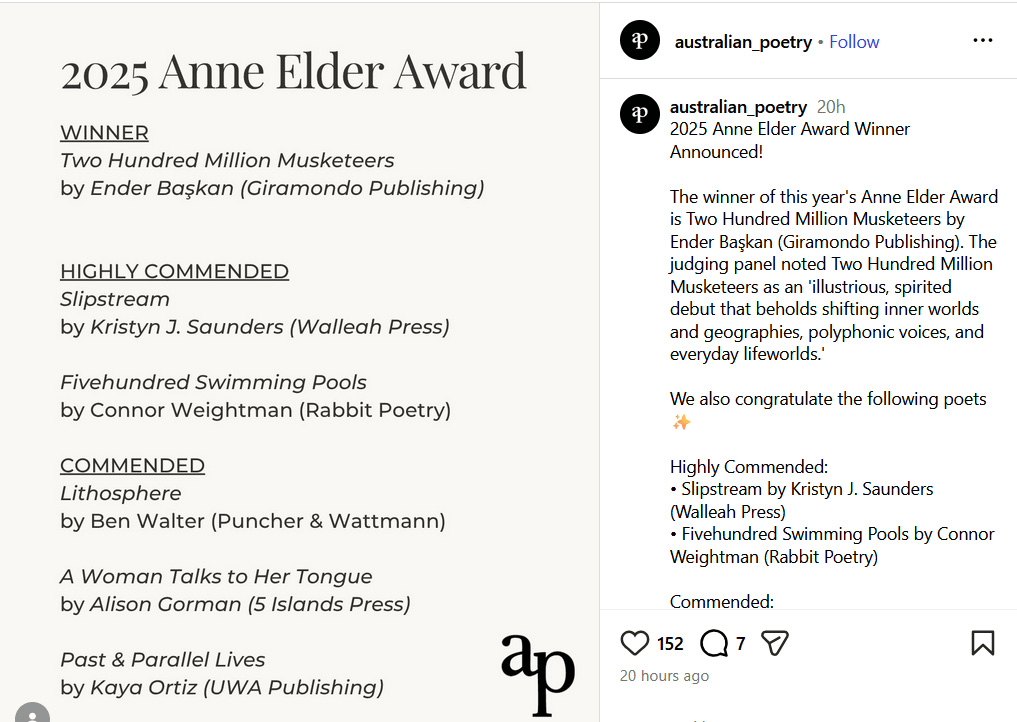
2024 Anne Elder Award judges panel announced

Australian Poetry has announced the three judges for the Anne Elder Award 2024 panel. They are Jeanine LeaneTheodore Ell, and Ella Skibeck-Porter. Theodore was the 2022 Anne Elder Award co-winner with Harry Reid (a judge last year) and Ella was Highly Commended in the 2023 Award.

2024 Anne Elder Award panel:

Jeanine Leane is a Wiradjuri writer, poet and teacher from the Murrumbidgee River near Gundagai. Her poetry has won numerous awards and prizes, including the David Harold Tribe Prize 2023. Jeanine is widely published in the areas of Aboriginal literature,  literary critique, and writing identity and difference. She is currently a First Nations Writer in Residence at the University of Melbourne where she previously taught Creative Writing and Aboriginal Literature. Jeanine’s current poetry collection, Gawimarra: Gathering  (University of Queensland Press), is short-listed for the VPLA 2024 Poetry Prize.


Theodore Ell is a writer and honorary lecturer in literature at the Australian National University. His poetry collection Beginning in Sight shared the 2022 Anne Elder Award. From 2018 to 2021 he lived in Lebanon, accompanying his wife on a diplomatic posting. Ell’s essay ‘Façades of Lebanon’, about witnessing the 2019 Lebanese revolution and surviving the 2020 Beirut port explosion, won the 2021 Calibre Essay Prize, and his memoir Lebanon Days was published in 2024. Ell’s poetry, essays, translations and non-fiction have been published in Australia, Italy, the United Kingdom and Lebanon.


Ella Skilbeck-Porter is a poet living in Naarm/Melbourne. Her debut collection These are Different Waters (Vagabond 2023) was shortlisted for the Helen Anne Bell Poetry Bequest and the Mary Gilmore Award and was Highly Commended in the Anne Elder Award. Her work has been widely published in journals and anthologies including Best of Australian Poems 2024, Living Systems: Poetry from Asia Pacific, HEAT, Otoliths, Rabbit and Cordite Poetry Review.

Anne Elder Award 2024

  1. Open call for entries – Monday, 27 January 2025.
  2. Close of entries – Monday, 17 March 2025, 5pm (Books must be postmarked no later than Monday, 17 March 2025.)
  3. The announcement of Judges takes place in February, after the award opens. There is a separate announcement on this.
  4. Winner announcement – May 2025.


Information and enquiries
Jacinta Le Plastrier
Email: ceo@australianpoetry.org
Note: Responses to enquiries will not be sent until after 15 January. Please note the new AP address is now: AP, Anne Elder Award, GPO Box 1753, Naarm/Melbourne, VIC 3000. The GPO box number is essential.


The award is named after Anne Elder (1918-1976), a dancer with the Borovansky Ballet in the 1940s who later in life became a notable poet. Her poetry attracted praise from many critics for its vigour, depth of reference and distinctive artistry.  Sponsored by the Australian Communities Foundation, this prestigious, national, annual award is for a sole-authored first book of poetry of 20-minimum pages in length, published in Australia.

Established in 1977, the prize has offered important recognition to poets at a critical point in their writing lives, and its alumni represent some of Australia’s best-known and highly respected poets. The winner is awarded $1,000, and there is also the opportunity for the judging panel, which for the 2024 Award will be announced in February, to award other books a commendation or special mention.

Books published between 1 January 2024 and 31 December 2024 are eligible for entry into the 2024 Anne Elder Award.


Submission Guidelines & Eligibility

  1. Open to Australian residents only.
  2. Entries must be in English. Bilingual volumes are acceptable as long as one of the languages in which the poems are written/translated is English.
  3. Book should be a sole-authored first collection of poetry published in 2024. Pub-dates will be checked.
  4. Book must be 20+ pages in length and have been legally deposited with the National Library of Australia.
  5. A book can only be considered a first volume if the author has not had previous volumes of poetry of 20+ pages published either in Australia or elsewhere.
  6. Chapbooks are also eligible if they meet the above guidelines—please note, if a poet has entered a chapbook previously, they cannot re-submit a longer collection.
  7. Entrants who have previously published in another genre are eligible as long as the entry submitted for this award is the first volume of poetry published by the author.
  8. Co-authored entries are not eligible for the award.
  9. First prize $1,000. Winners and commended entrants will receive a copy of Selected Poems of Anne Elder (Lauranton Press).
  10. The judges reserve the right not to award a prize.
  11. The judges’ decision is final and no correspondence will be entered into.

How to Enter

  1. Send 3 copies of the book to: Anne Elder Award Nominations, c/o Australian Poetry, GPO Box 1753, Melbourne/Naarm Vic 3000.
  2. Entry fee $35 (including GST) is payable at the time of entry. Payment is via an invoice generated by AP. Please contact ceo@australianpoetry.org so we can organise an invoice, to be paid via EFT. Please email ceo@australianpoetry.org also when you have mailed your copies so we can be in contact if they do not arrive.

‘I fly, I drive. We’re all complicit’: Richard Flanagan on vanishing species and refusing the Baillie Gifford prize money

Richard Flanagan has won the Baillie Gifford prize for nonfiction with his book ‘Question 7’.

“This book is about my father and my mother,” he says, “their love for each other and the way they used love to find meaning in a world they knew to otherwise be meaningless. I think everyone is confronted at a certain point with the knowledge that the universe is empty of meaning. So the question is: how do we go on? They found meaning through kindness and goodness to each other and to others. They practised that love and they fought for that love for decades. It ceased to be what I thought was an illusion, and became their hard-fought-for reality. It became a truth – it was really a form of magic, and they the magicians. I realised it was an immense achievement. They came from very poor backgrounds: they understood the hardness and harshness of this life, yet they found wonder within it everywhere.”

Flanagan has delayed accepting the fifty thousand pounds prize until he is able to sit down with Ballie Giffard to discuss his climate crisis concerns over the company’s involvement in fossil fuels.

Read Alex Clark’s full article at The Guardian (21st November 2024).

Elanna Herbert ~ ACT Literary Awards 2024

Lovely to see Elanna Herbert’s 2023 poetry collection ‘sifting fire writing coast’ has been shortlisted in the ACT Literary Awards, along with Sandra Renew’s ‘Apostles of Anarchy’, K. A. Nelson’s ‘Meaty Bones’, Tim Metcalf’s ‘The Moon the Bone’, and Paul Hetherington’s ‘Sleeplessness’. Good luck to all.


Small Press Network — Book of the Year Award 2023

News from Small Press Network’s latest newsletter…

BOTY shortlist
We recently announced the six books shortlisted for this year’s SPN Book of the Year Award (plus two titles that received honourable mentions from the judges).

They are:

  • The Branded (Jo Riccioni, Pantera)
  • Our Members Be Unlimited (Sam Wallman, Scribe)
  • Paradise (Point of Transmission) (Andrew Sutherland, Fremantle Press)
  • Against Disappearance: Essays on Memory (ed. by Leah Jing McIntosh & Adolfo Aranjuez, Liminal/Pantera)
  • Mabu Mabu (Nornie Bero, Hardie Grant)
  • Losing Face (George Haddad, UQP).

Honourable mentions go to Lockdown (Chip Le Grand, Monash University Press) and This All Come Back Now: An Anthology of First Nations Speculative Fiction (ed. by Mykaela Saunders, UQP).

The winner will be announced on Friday 24 November. The award event will be hosted by the Wheeler Centre as part of their ‘Next Big Thing’ series

See https://smallpressnetwork.com.au/book-of-the-year-award/book-of-the-year-award-2023-shortlist/ for more details.

Small Press Network—2022 Book of the Year Award: winner Eleanor Jackson

The Small Press Network (SPN) this evening announced the winner of the 2022 Small Press Network Book of the Year Award (BOTY): Gravidity and Parity by Eleanor Jackson, published by Vagabond Press! 

Below, from Small Press Network’s Fiona Wallace’s interview with Eleanor earlier in the month:

Q. Your poems have a powerful sense of immersion in the present-day world. The COVID-19 pandemic, Black Lives Matter movement, Trump’s presidency and the incorporation of technology are brought naturally to the fore, rather than operating as impartial and immaterial backdrops. Can you talk about the importance of reflecting moments of time in your writing practice?   

I definitely wanted these poems to have a very particular timestamp. For better or worse. At the time I worried the issues would date. Sadly, some of them haven’t. 

I have long been interested in the idea of poetry as a documentary practice. I don’t think that knowledge or form is neutral, and I’ve been curious what we learn when trying to represent ‘reality’ as it happens. And this feels like a ‘momentous time’, for our community, for our cultures, for our society as a whole, and I was conscious of wanting to record that in real time. But even momentous times can feel simultaneously deeply prosaic and even boring. So I wanted to try and capture a time with a telescoping quality, sometimes looking at the minute and sometimes looking at the enormous.

Read the interview in full.


36

Eleanor Jackson at the 2013 Tasmanian Poetry Festival, Launceston

52

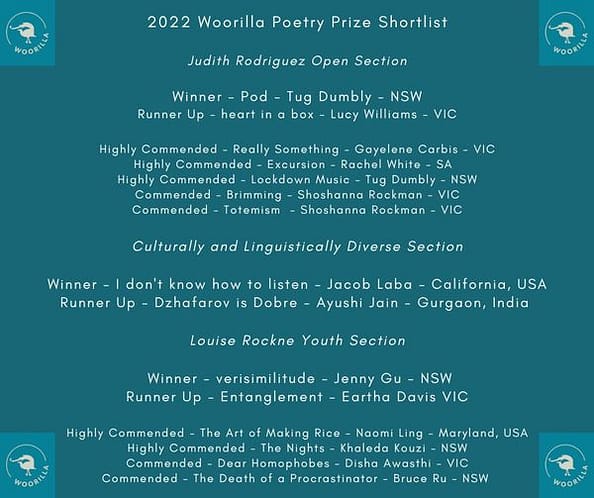
Woorilla Poetry Prize 2022

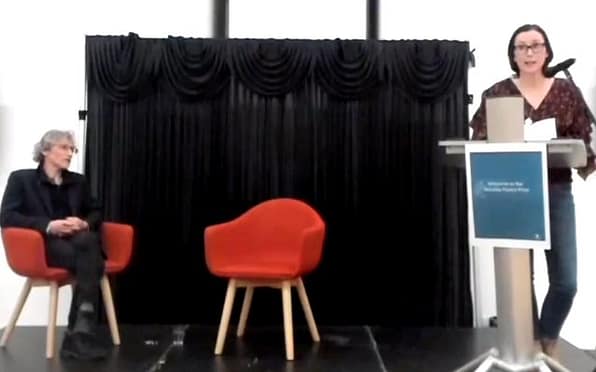
The Woorilla Poetry Prize was judged this year by Kevin Brophy and Alicia Sometimes, with the awards event taking place in Emerald, Victoria.

Kevin Brophy spoke briefly about the judging process. ‘I guess I want to remind you at the start that judging a poetry competition is a very human process. There is a human at the end of the poems, trying to receive the poems and trying to be everything that a judge is meant to be, but in the end having to be simply a lover of poetry, and react to the poems as a lover and admirer of poetry and what poets do … which is to renovate language.’

First Prize went to Tug Dumbly, with Lucy Williams runner-up. The three Highly Commended Awards went to Rachel White, Gayelene Carbis and Tug Dumbly, while the two Commended Poem awards both went to Shoshanna Rockman.

A video recording of the event is online.

Small Press Network: 2022 Book of the Year Award—Shortlist

This year’s shortlisted titles for Small Press Network’s Book of the Year Award have been announced. They are:

The BOTY 2022 winner will be presented in partnership with the Wheeler Centre as part of its Next Big Thing series, on 25 November 2022 at 6:30 pm. You can find the event details here.

I mention this in part cos it reminds me of entering Pete’s book in the award a couple of years ago, (and it won). I was asked to write something for use as part of the award presentation. I suggested yes I could (see below) but that I’d feel less comfortable reading it live. That’s okay, we can take care of that, I was told. (In the event, what I wrote was way too long and just a short segment was used)….

As to Pete….

One evening some years ago I was driving a taxi late at night, parked down in the vicinity of Hobart’s waterfront. Two women – tourists from New Zealand, I was to learn — climbed into the cab. They’d attended a literary event an hour or two earlier. They were cheerful and relaxed and happily exchanged literary perceptions of the evening in the comfort of the back seat of the vehicle. Generous and inclusive, they invited me to share their conversation, to which I responded by noting that for many Tasmanian writers —particularly those who wrote of the environment — a closer affinity was felt with the landscape of New Zealand than with the ‘… sunburnt country, A land of sweeping plains’ of Dorothea Mackellar’s Australia.

The pair asked if I could suggest the name of a praiseworthy Tasmanian writer, someone who’d perhaps slipped under their radar back home in New Zealand. I mentioned Pete, describing him as a poet and essayist and one of our country’s most respected environmentalists. Of the many reasons I might have offered in an appreciation of Pete’s work, I settled for just one — the fare was only running Salamanca to New Town, after all — and that was ‘generosity’. And I tried in my own words to recall for them a conversation years past when Pete had suggested ‘I don’t write because I think I’ve profound truths that other people would benefit from having exposure to. I don’t write to provide anyone with answers, I write to provide people with dilemmas. My essays – even my poetry lately – are written to set up tensions that are ultimately not resolved. I explore the tensions, but I don’t conclude.’

For their benefit, I’d have also mentioned — if the words had come to mind — Richard Flanagan’s support for Pete’s previous essay collection, Vandiemonian Essays, wherein Richard wrote, ‘All (these essays) are written with wit and without fear, with an erudition lightly worn, and with a pen dipped in a large love of this world. All can be read with both joy and curiosity… ’

It’s Richard’s allusion to ‘joy and curiosity’, coincidentally, that I’d recommend as an approach to Pete’s current essay collection, ‘Forgotten corners’ — that, along with an openness to being challenged, informed and entertained.

***

As the cab pulled to a stop, one of the women turned to me, remarking ‘I know it’s eleven-thirty in the evening, but I’m about to jump on the internet and learn a little more about Pete Hay — right now!’

The other leaned in towards me. ‘And I guarantee it, she will!’