https://www.youtube.com/watch?v=j2ZaU2hCdOY&list=RDj2ZaU2hCdOY&index=1
Month: November 2022
Reading David Marr’s ‘Stories, Essays & Speeches’ (Black Inc 2018)
Reading David Marr’s publication of a few years ago, ‘Stories, Essays & Speeches’ … it surprises me at times the way that personal connections have a habit of arising unexpectedly. In Marr’s essay on John Gorton, he mentions Gorton’s elevation to Minister for the Navy in 1958, explaining Gorton being told ‘never to use the old aircraft carrier Sydney, moored in the mothball fleet off the zoo in Sydney Harbour.’ Gorton, so Marr records, says ‘We went and had a look at her. She was full of barnacles and had to be cleaned out. But we just gradually got her out. We said we needed the Sydney for operations on the coast with the Army. we made her a bit better, and then said we could send her to New Zealand on combined operations. As a result she was ready for Vietnam when she was wanted. We wouldn’t have had any troops and materials to send to Vietnam but for the Sydney.’
I served on the Sydney for a year, ferrying soldiers back and forth between Oz and Vietnam on a couple of occasions. Tried writing about the experience…
Mention of Anzac Day brings back a flood of memories, chiefly of soldiers returning home aboard what was
popularly termed ‘the Vung Tau ferry’ — HMAS Sydney, an ageing aircraft carrier with empty hangars specially fitted to sleep hundreds of returning vets side by side on makeshift beds. At night a projector screened movies at one end of the hangar where bums on seats were provided for on hard wooden stools which by turn skidded across the hangar floor from one bulkhead to the other with the rise and fall and sideways pitch of the ship as it sailed inexorably through the night, heading home. And on arrival, the possibility of a march through Townsville, or Brisbane, with patrons disgorging from pubs to offer frothy schooners of ale to the marching men: ‘Have one on me mate!’ Or gliding through Sydney Heads into the shelter of the harbour and patrolling aft on duty watch, observing the bobbing lines of well-worn army uniforms snaking in the white of the ship’s wake as soldiers changed from jungle greens for the last time, into ceremonial dress for the march through Sydney’s streets.
LINK—Giles Hugo’s interview with David Marr, published Famous Reporter 7, April 1993.
Review, David Mason poetry collection ‘Pacific Light’ (Los Angeles Review of Books, 20 Nov 2022)
Thoughtful words, both by and about US poet David Mason, now resident in Tasmania.
Siham Karami reviews Mason’s Pacific Light (Forty South Publishing, Sept 2022)….
In this collection, we sense it in the very first poem, “On the Shelf,” whose title rhymes with and is the same metric length as that of the final poem, “Note to Self” — another indication of the care with which Mason organizes his effects. There we are invited to observe the smallest thing, a spider’s shed skin, which the speaker “thought twice before touching,” because the spider’s “soul” is still “able to frighten.” He wonders if his own “shed skins / in houses where my name has been removed” will elicit an emotional response, if “some words of mine” will thus “go on living,” without asserting it. The question remains humbly open.
There’s reference too, to previous conversation with Mason in the form of a link to Leath Tonino’s 2015 interview with the poet, published in The Sun.
Tonino: As you’ve described it, the Greek view seems particularly fitting for a poet. I like the idea of poets as people writing from the brink, with the clarity and intensity of the about-to-die. It makes me think of the Zen Buddhist tradition in which a master often writes a final poem on his deathbed.
Mason: That happens in the Western tradition as well. Many poets write their own epitaphs. Take Robert Frost’s: “I had a lover’s quarrel with the world.” That’s just a beautiful idea. We’re always a little at odds with the world, always wrestling with it, fighting it, beating our head against it. But we also love it very much. Elsewhere Frost says, “Earth’s the right place for love: / I don’t know where it’s likely to go better.” You’ve got a body, and the body can love as well as suffer. Sometimes love is suffering, right?
I think poets as a group often do have an essentially Greek view of existence. I don’t mean they are all influenced by the Greeks. There are obviously Christian poets and Buddhist poets and many others with different theological standpoints. But the awareness of death seems common to all. It’s almost the nature of poetry.
Tonino: But obviously poetry doesn’t have to be only about loss, grief, and death.
Mason: Right. There’s a spectrum. Sometimes it’s about transforming loss. We are all transformed by grief. We change in the way a tree struck by lightning changes. Artists try to capture that in a poem or a minuet or a painting or a sculpture.
A student was asking me just today: Why is it so hard to write about happiness? I replied that it’s hard to write well about anything — it’s just damn hard to get the words down right — but it’s especially hard to convey the joyful aspects of life without becoming sentimental. Sadness, too, can be maudlin, but it’s particularly true of happiness.
And yet there are happy works of art out there, works that are brimming with gaiety, to use W.B. Yeats’s word. Even the tragedies often crackle with a kind of life energy. You feel revitalized by partaking in them. Somebody once speculated that the writer Flannery O’Connor must be a cynical person, because her short stories are so dark. Her answer, which I’m paraphrasing, was that no completely cynical or nihilistic person can write fiction. In a sense, the very act of creation is fundamentally an acknowledgment of life.
I read a lot of contemporary poetry and often find myself feeling that there’s no vitality to it. It’s as if the author were dead inside, or just writing for professors. There’s no human pulse there. The poem doesn’t beat like a heart. All the best literature has that pulse. It makes you feel alive to read it.
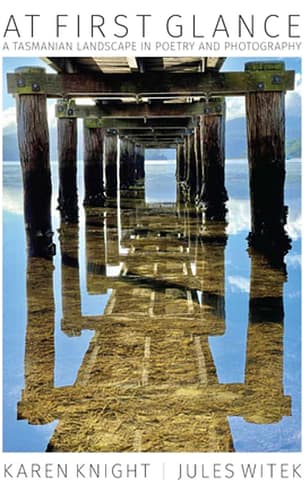
Launch speech—Karen Knight’s & Jules Witek’s ‘AT FIRST GLANCE’
Launch also covers Jules Witek’s photographic exhibition, both were launched by Liz McQuilkin, at Triabunna on 12th November 2022
WestWords—David Adès and Peter Boyle in conversation [24th Nov 2022]
More than an hour of poetry and conversation between poets David Adès and Peter Boyle, on Peter’s selected theme— exploring the unknown in life.
DAVID
Peter, with the theme that you’ve selected ‘Exploring the unknown in life’, you’re reading poems today from your last two books ‘Ideas of travel’, and ‘Notes towards the dream book of endings’. Both of those titles suggest to me the notion of exploration.
How do those two books reflect your theme?
PETER
I think both of those books reflect the idea of, or are based around the premise of, trying to write poetry that doesn’t start from what you know but is working its way towards what you don’t yet know. So it’s poetry that’s deliberately not paraphrasable—not exactly storytelling, not obviously related to some kind of theme that you could spell out in advance. So it has that exploratory quality, the sort of openness to the various things that life might unfold that we don’t yet know. So multiple dimensions of reality….
DAVID
You’d be familiar with this, there’s a very old conversation in poetry about whether poets—and probably in literature generally—should write about what they know. I remember as a seventeen-year-old wannabe writer I was told not to write anything until I had something to say. I wrongly didn’t think I had anything to say as a seventeen-year-old and that was possibly the worst advice I’ve ever been given. How much of writing for you is about exploring the unknown?
PETER
Well, I think for me writing has got to be about exploring the unknown in a sense that if it’s something that I could say to someone because I know it already, if it’s—you know—just my opinions about some this, that or the other topic, then to me it just doesn’t have the energy to push me into creative poetry….
 Peter Boyle
Small Press Network—2022 Book of the Year Award: winner Eleanor Jackson
The Small Press Network (SPN) this evening announced the winner of the 2022 Small Press Network Book of the Year Award (BOTY): Gravidity and Parity by Eleanor Jackson, published by Vagabond Press!
Below, from Small Press Network’s Fiona Wallace’s interview with Eleanor earlier in the month:
Q. Your poems have a powerful sense of immersion in the present-day world. The COVID-19 pandemic, Black Lives Matter movement, Trump’s presidency and the incorporation of technology are brought naturally to the fore, rather than operating as impartial and immaterial backdrops. Can you talk about the importance of reflecting moments of time in your writing practice?
I definitely wanted these poems to have a very particular timestamp. For better or worse. At the time I worried the issues would date. Sadly, some of them haven’t.
I have long been interested in the idea of poetry as a documentary practice. I don’t think that knowledge or form is neutral, and I’ve been curious what we learn when trying to represent ‘reality’ as it happens. And this feels like a ‘momentous time’, for our community, for our cultures, for our society as a whole, and I was conscious of wanting to record that in real time. But even momentous times can feel simultaneously deeply prosaic and even boring. So I wanted to try and capture a time with a telescoping quality, sometimes looking at the minute and sometimes looking at the enormous.

Eleanor Jackson at the 2013 Tasmanian Poetry Festival, Launceston

Colette—from the short story ‘Grape Harvest’
She wanted some more bacon, and cut into the peasant bread, made of pure wheat, brown but succulent, and demanded from the gnarled giant an account of the war of 1870. It was brief.
“What’s to say? It wasn’t a very pretty sight … I remember everybody falling all around me and dying in their own blood. Me, nothin’ … not a bullet, not a bayonet. I was left standing, and them on the ground … who knows why?’
He fell into an indifferent silence, and the faces of the women around us darkened. Until then, no mother deprived of her sons, no sister accustomed to double work without her brother, had spoken of the war or those missing, or groaned under the weariness of three years….
Sidonie-Gabrielle Colette (28 January 1873 – 3 August 1954)
Woorilla Poetry Prize 2022
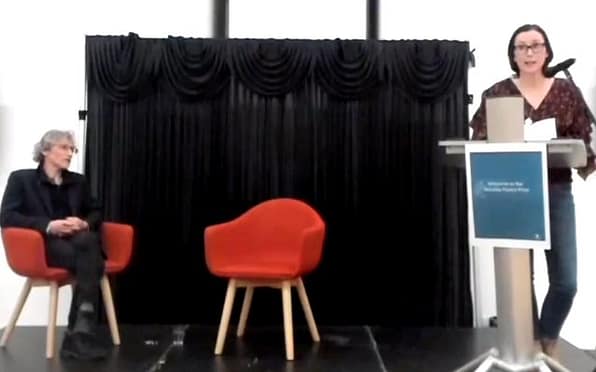
The Woorilla Poetry Prize was judged this year by Kevin Brophy and Alicia Sometimes, with the awards event taking place in Emerald, Victoria.
Kevin Brophy spoke briefly about the judging process. ‘I guess I want to remind you at the start that judging a poetry competition is a very human process. There is a human at the end of the poems, trying to receive the poems and trying to be everything that a judge is meant to be, but in the end having to be simply a lover of poetry, and react to the poems as a lover and admirer of poetry and what poets do … which is to renovate language.’
First Prize went to Tug Dumbly, with Lucy Williams runner-up. The three Highly Commended Awards went to Rachel White, Gayelene Carbis and Tug Dumbly, while the two Commended Poem awards both went to Shoshanna Rockman.
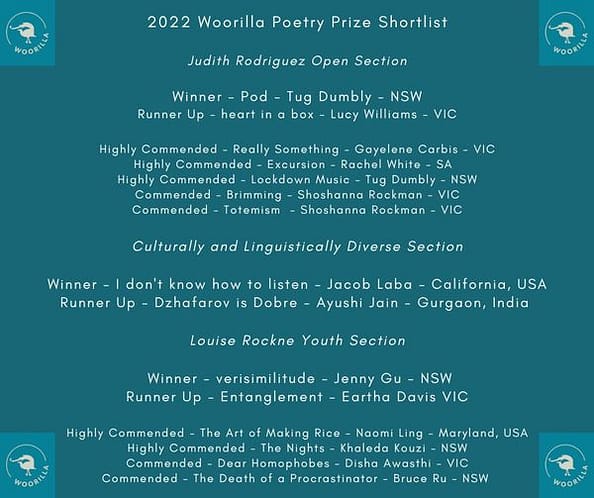
A video recording of the event is online.
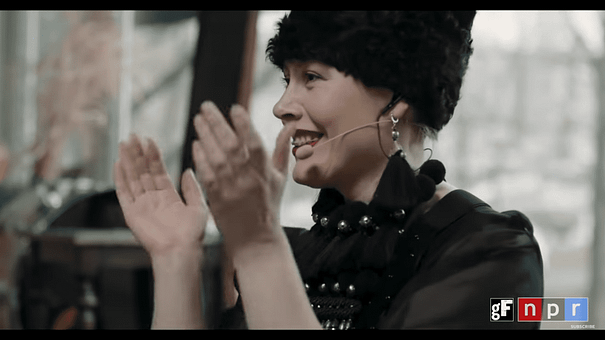
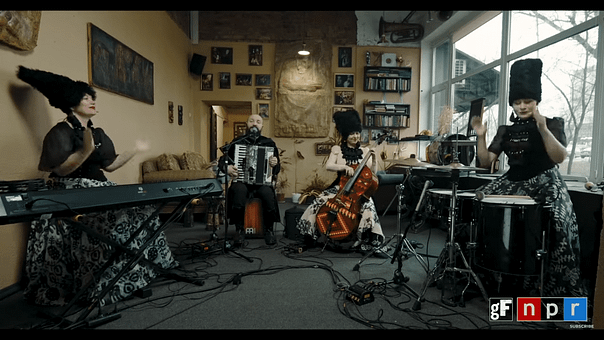
Ukrainian folk music quartet DakhaBrakha—NPR Music Tiny Desk (Home) Concert
2022 Tasmanian Literary Awards—shortlists announced
Lovely to see Lyn’s book made it to the shortlist, sorry Pete’s didn’t (he had two nominations that made the longlist)… sorry too for Adrienne who also had a couple of longlistings. (And for Jane, of course). Meanwhile, congrats to those who made it through.
There’s a link to the shortlists on this page, as well as a link to the longlists.
The Joan Didion estate sale
Sophie Haigney, writing for ‘The Paris Review’ (17th Nov 2022) about the artefacts being auctioned in the US at the Joan Didion estate sale….
Then there were the three lots of blank notebooks, tied with twine. They went for $9,000, $11,000, and $11,000 each. They were empty, some still wrapped in plastic, yet they were totally talismanic. I wondered: Would you write in these notebooks, having paid that price? Perhaps that’s the whole appeal—to write in a blank space that Didion might once have intended to use herself. Maybe the buyer had a hidden wish that somehow her intent might infiltrate their own work—that in owning these notebooks they might crack some secret code to making sentences like hers. There are sillier superstitions. But more likely, I think, you would have paid too much for these notebooks to ever touch them, and they would sit in a drawer or on a desk, unused and empty, just as they sat on hers.
Csik Zenekar—Hungarian folk music ensemble
Jane’s poetry residency in Slovakia in 2016 led to an introduction to Hungarian and Slovak music. This, from Csik Zenekar, (recorded 2009)….

Launch of ‘Reaching Light’, by Robert Adamson [Sydney, July 2022]
Robert reading and in conversation with his Flood Editions USA editor/publisher & poet Devin Johnston, with readings by Sarah Holland-Batt and Michele Seminara.

The very sad news is that Robert Adamson is gravely ill.
* * * * *
Normally, I’d not think twice about the mention here of a literary event—a book launch—yet I’m vaguely aware that doing so on this occasion could possibly be construed as no more than zeroing in on a topical note of interest.
However….
* * * * *
When Tim Thorne fell ill, I found myself hesitant to engage, ask how he was going … generally, just unwilling to intrude. In retrospect, it was a rubbishy form of interaction on my part—albeit under trying circumstances. I regret I didn’t make a greater effort…. Physically, Tim was slowing down, but mentally he was still off and running…. We shared a moment together, one session during the 2021 Tasmanian Poetry Festival. The state election had been called that very day, and scheduled for the 1st May. I made some reference to it, to which Tim quickly replied oh yes, and that’s going to put a very different interpretation on May Day, isn’t it? and he laughed.
I should also have said, oh by the way I appreciate and admire you so very much; for your generosity, for all you’ve achieved…. But I didn’t.
So goodbye rubbishy decisions.
I don’t know Bob Adamson’s work well, and my indirect association with him has only occurred since he provided back cover blurbs for one or two of the poetry collections I’ve published (Vanessa Page’s ‘Confessional Box’ comes to mind) some years ago. My belated appreciation of his poetry is due to the arrival in our home of a copy of the 2016 anthology ‘Contemporary Australian Poetry’ (Puncher & Wattman), where the work of poets is, according to surname, arranged in alphabetical order. Such a great anthology, so many very fine poems, but I always experienced difficulty getting past the opening five poems in the book—Adamson’s—’Via Negativa: The Divine Dark’, especially. Such fine poems all…. Bless you Bob for making vivid, and sharing, your perceptions.
Anne Collins—book launch
Lovely to see that Anne Collins has launched her newest collection of poems and prose—’Listening to the Deep Song’ (Bright South)—in Hobart last week.

The book was launched at Hadley’s Hotel on 11th November by Petrina Meldrum:
I’d like to say how happy I am to be back in Hobart to share in the launch of Anne’s latest book, Listening to the Deep Song, and how nice it is to see so many familiar faces. Thank you all for coming along to support Anne and to celebrate with her.
When I first met Anne some six years ago, her manuscript, for all intents and purposes, was ready to be sent out to publishers. I remember clearly, when Anne brought it along to one of our early meetings, how impressed I was with the idea she had had, and with how she had gone about bringing it into existence.
As the intervening years flew by, the manuscript grew larger, and today, here we are, with this beautifully written book in our hands.
I think most of us are aware of Anne’s interest in Spain and the Spanish culture, but not necessarily of the depth of her involvement. In Listening to the Deep Song she shares, without restraint, her experiences.
Through multi-layered vignettes and some exquisite poetry, she takes us on a journey through Spain’s regions and major cities, through its seedy back streets, its world renown museums, and its quirky architecture. If you’re planning a trip to Spain, you can throw away your guide book and take Anne’s book with you instead. She’ll guarantee to get you lost at night in the back streets of Seville, or help you lose yourself in the whimsy of Miró’s universe in Barcelona.
Spain, of course, is not one country but a number of autonomous regions, each with their own language and cultural heritage, which they guard fiercely.
Anne recognises this by dividing her book into sections and allocating a flamenco rhythm or compás to each region. These rhythms reflect her sense of an underlying mood as she travelled through Spain.
On returning to Hobart, to her ‘Spanish life’, she has this to say:
‘Curiously in Hobart I have a Spanish life. I enjoy the exhilaration of flamenco dance classes… For short periods of time, I am immersed in flamenco energy. These experiences help me in finding my own flamenco self, my own flamenco confidence, still with much to learn.’
In the ‘Afterword: I am touching you’, a heart-warming piece, she tells us of her experience during Covid-19 isolation, a time when many put their lives on hold, but not Anne, she was Zooming her way to Madrid several times a week to attend flamenco classes online.
Following her journey, we become aware that there is another dimension to Anne and we are left, as a consequence, with a more intimate sense of who she is.
On attending a flamenco performance in Seville in a 16th century Sephardic courtyard at La Casa de la Memoria she records:
I feel an unexpected stirring of ecstasy and sorrow, a kind of loss deep within, of what I am not sure, but like the poet Félix Grande, I want to cry like a new born. What has this to do with me – an everyday 21st century stranger to my own roots and here for this brief moment? What yearning pulls me beyond their words of protest I barely understand, into ‘the gratitude, the anguish, the joy, the revelation’, the raw wailing core of this art we call flamenco?
We see a more playful Anne, in Barcelona, visiting one of Gaudí’s buildings, La Casa Batlló.
From her poem, In Gaudí Wonderland:
Inside the Casa Batlló the building seems
to sway and dance and smile
and I want to leap about
as the curves of my breasts and hips
align with the curves of the cave-like walls…
I imagine living here in this building
that honours a sense of joy.
Feel gracious and light, tender, seductive, playful,
free of straight lines and rigid postures
as if some essential fluidity
has re-awoken deep inside me.
Throughout the book there is a questioning going on, a desire to learn more – to have a deeper understanding, to belong. This is what Spain does to you if you let it: it draws you in and never lets you go. There is a sense of this happening to Anne as she gives herself over to Spain, while at the same time questioning why this is happening to her.
Her trips to Spain span a period of thirteen years, a long enough period for her to have noticed changes, both good and bad, all of which she shares with us. The diverse knowledge she has gained in this time is masterly woven into her vignettes, leaving us with signposts and pathways to follow if we wish to know more. The vignettes, at times a conversation with Spain, would give any traveller a masterclass in how to travel, in how to be more engaged with what lies beneath the surface.
Interspersed with the vignettes is Anne’s poetry. Some of the poems are born of her long interest in the life and work of Federico García Lorca.
Lorca’s first major work, Poema del Cante Jondo – Poem of the Deep Song – has clearly influenced Anne’s choice of title for the book, however, the poems she has chosen to respond to, form a conversation with a wider range of his work.
This poetic dialogue with Lorca’s work opens up a new way of reading into it, a way, through poetry, of showing the relevance of his work in a 21st century context.
In Anne’s poem, Learning to Spell, After the life of Federico García Lorca, which I’d like to read to you, she quotes phrases from two of Lorca’s poems, Landscape and Sleepwalking Ballad.
Learning to Spell
The boy learns to spell leaf
it turns to leaves on a yellow tree.
Leaf through the mistake of years–
a complicated task, a lot of rubbing out.
There’s knife and shelf, the rule’s the same
do your homework. By mistake the evening
a knife-edge wind cuts the leaves.
The alarm, the shelves full of books,
the guards are spell-bound.
The boy changes into a bird
watches through the mist on the panes
writes sentences with the word leaf,
a complicated task, a lot of rubbing out.
They leaf through the shelves.
After the wind there was only one leaf left.
On the page a trail of tears, the stanzas stretched out.
Her other poems reflect on her connection with and her understanding of Spain, and on her association with the art of flamenco. The flamenco poems make your heart beat to a different rhythm as you appreciate the degree to which this artform has become part of Anne’s life, and she part of the ‘flamenco family’.
I can truly recommend Listening to the Deep Song to you.
And now, I’ll hand over to Anne who is going to share some of her beautifully written pieces with us. Anne…
In conjunction with Hobart Bookshop, Anne’s also recorded a short video explaining more clearly her love of Lorca along with ‘everything Spanish’, here.
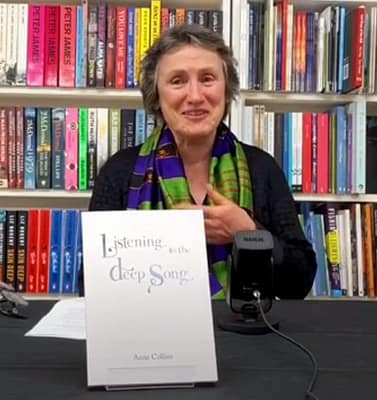
in his endorsement of Anne’s book, Peter Boyle writes—
“Part travel diary, part meditation on Spain and its cultures, part poetic dialogue with the poetry of Lorca, Anne Collins’ “Listening to the Deep Song” is a beautifully written testimony to her long enthusiasm for the many sides of Spanish culture. Bringing together her training in flamenco dance, her love of Lorca’s poetry and several of her journeys through Spain, Anne Collins offers her readers a personal response to a unique blend of cultures that continues to speak to the 21st century world. Varied and many-layered, marked by close observation and thoughtful questioning, this is a delightful book.”
Finally, the publisher’s description…
Like a traveller’s journal written in prose and poetry, Listening to the Deep Song records Anne Collins’ travels through various regions of Spain, which took place over many years. The book offers a meditation on Spain’s many-layered history and culture, reflecting on history, landscape, expressions of culture, and change. It reveals places of connection and friction within Spain and across the world; as far as Anne’s home in lutruwita-Tasmania.
The writing turns on a poetic dialogue and an embodied praxis; the latter being expressed through both Anne’s physical immersion in Spain, and her practice and knowledge of flamenco dance. The latter engages with, especially, the life and works of Federico Garcia Lorca, as well as with other poets and writers of, and about, Spain.
Listening to the Deep Song is deeply personal, yet it offers much that resonates deeply with contemporary concerns. Anne Collins’ writing is varied, thoughtful, observant, poignant and beautiful.
‘Listening to the Deep Song’ is available from Bright South. It sells for $30.
Didion: ‘the civil war was yesterday’
Haven’t decided on Didion. Some things she writes are breezily anecdotal—and no more—at other times she hits the spot. Here she’s in Greenville, Mississippi, reflecting on New Orleans and the South with locals. The year is 1970.
The time warp: The Civil War was yesterday, but 1960 is spoken of as if it were about 300 years ago.
(from ‘South and West’. The reference to 1960 may be alluding to the possibility of JFK’s election).
Poets on the Line—featuring Gina Mercer (18th Nov)
‘Poets on the Line’ is zoom event organised by Ross Donlon from Agitation Hill (Castlemaine, Victoria) this Friday 18th November, from 6 – 7 pm.
Zoom link will be posted in a few days. Featured poet for this first event is Gina Mercer.
Format is of a 20 minute reading, then Q & A involving the audience, concluding with Gina’s encore.

Hobart launch—Jan Colville’s ‘a small universe’
Jan is releasing a new chapbook of her poetry, a small universe! (published by Bright South).
Where: Hobart Bookshop
When: 24th of November, at 5.30pm
Please rsvp: rsvpbrightsouth@gmail.com or call (03) 6223 1803

Book launch—Gayelene Carbis’ ‘I Have Decided To Remain Vertical’; Melbourne 16 Oct 2022, launched by Marion May Campbell
Plenty of support for Gayelene Carbis, when Marion May Campbell launched her new poetry collection—’I Have Decided To Remain Vertical’—at Readings in St Kilda last month.

With Claire Gaskin MC-ing the event, local choir The Red Hot Singers — (‘This is not a choir, it’s a singing group … in other words, informal’, someone clarified; another pointed out ‘We’re all part of Soul Song’, a subset; we get out and about!’) — provided an African musical intro as a prelude to Marion May Campbell’s launch address. Much like Kevin Brophy in Melbourne (and Pete Hay in Hobart and Cameron Hindrum in Launceston), Campbell is a favoured ‘go to’ person when it comes to launching poetry in Melbourne, (she launched Susan Hawthorne’s ‘Dark Matters’ at Collected Works five years ago, back in the days when Kris and Retta welcomed all & sundry to their fabulous bookshop, ‘up the stairs and to the left: or take the lift!’)

Claire urged punters to ‘buy a book, to support Gayelene, to support poetry, to support Readings, to support the wonderful publishers who publish poetry’ before introducing Marion May Campbell, whose bio she proceeded to read. ‘If you haven’t read all those books [of Marion’s], you know, you really haven’t lived so you have to make sure you do that … a wonderful writer, a beautiful person who’s won many awards and supported many a writer … (Gayelene’s nodding!) Please warmly welcome Marion May Campbell.’

Marion spoke of the miracle of several key poems in this new collection presenting an integration ‘of a kind of terror and of comic Alice-like defiance. Surreality is presented with hyper-real acuity…. Poetry-making often snatched from the doors of disaster is both agent and catalyst for the I-persona — and I won’t call the ‘I persona’ Gayelene, because it’s so variable as well, and protean … takes on different shapes all the time. Her triumphant survival, no matter into what pits life and love have thrown her, is always done with great comic brio – and often hilarity, all the more liberating for the near-catastrophe that she skirts.’

‘I had a much longer version of this already-too-long speech, which quoted a lot of these poems—I would have liked to write about every poem in the collection….
. . . . .
‘In various inventive ways Gayelene’s work, so far—in her plays, stories, and now two poem collections—has explored both the comedy of feminine identifications, and the devastation wreaked by models of masculinity that men, and boys, strive to enact, or refuse at their peril.
. . . . .
“Again, the last line is an unmitigated triumph. ‘I hold my pen like a knife’.
. . . . .
“Here fabulism triumphs over sadness with magical metamorphosis, yet the humble domestic broom, remembering its origin, offers a retreat. And I’m reminded here of that Turkish proverb, When the axe came to the forest, the trees whispered—the handle’s one of us.’

‘Oh Gayelene, thank you for such fabulous, transfiguring work. Congratulations, from the heart.’

‘Marion … thank you for your beautiful, and passionate and erudite response to my work, and for launching my book into the world in words that are so uniquely you, thank you—from my heart, thank you.’
‘I think we should all go home now…. I mean do I need to say or read anything? Yes I do, Yes I do. I need to say thank you. These poems were written over many years, some a very long time ago. I spent years and hours working towards this book, and it’s just … me and the work … but it really takes a community to create and make a book. I’d like to firstly thank Puncher & Wattmann whom I’m thrilled to be published by, huge thank you to David Musgrave….
‘A huge thank you to Marion May Campbell, and Kathleen Mary Fallon, for extraordinary generosity over many years. Kathleen, thank you for suggesting the title, Marion really pushed for this one amongst the Kathleen Fallon list of possible titles … well not pushed, that’s not Marion’s style: she presented ‘elequent arguments’. Initially I thought, it’s too long, it sounds weird … and then I thought, ooh, I wrote that line. Now I think it’s a perfect title for the book….’

Gayelene proceeded to read a number of poems from her book, a reading of which Lyndon Walker has since written generously and reflectively, “A fine and powerful reading of your work. Very moving, and very funny – you have that balance there. You are one of the best readers/performers of your own work in this country.”
Bringing the event to a close, the Red Hot Singers once again took to the floor. ‘Gayelene … do you wanna? … come and sing with us.’
‘Oh, yeah sure. You twisted my arm….’

(to view the full launch event, visit here … to purchase the book, visit here).
Fourth Australian Haiku Anthology—Call for submissions
The Australian Haiku Society has announced a call for submissions for the Fourth Australian Haiku Anthology (4AHA) that will showcae the work of poets who are writing haiku in Australia today.
It is almost a decade since the previous Australian haiku anthology was released and the landscape has changed significantly since then. The society’s mission is to publish a collection that will be representative of the diversity in approach taken to writing haiku in this country at this time.
Submissions are welcomed by poets who are Australian by nationality or who currently reside here. There are no constraints with respect to form or the inclusion of seasonal references; both haiku and senryu are welcomed and may be published or unpublished.
The editorial team for the anthology will be Lyn Reeves, Beverley George and Rob Scott.
SUBMISSION GUIDELINES
Submit up to five of your best haiku and/or senryu by completing the submission form at the society’s website. The deadline for submissions is 1st December 2022.