Poems are …

‘Poems are not puzzles, of course. Poems are like horses. They have a life of their own, and challenge you to encounter them on terms about which you cannot be altogether clear. Having said that, once upon a time I was in a field with a horse and he looked at me and I looked at him and it was pretty clear whose field it was.’

Martin Stannard, 2005

Dublin Review of Books – Spring 2026 issue

Dublin Review of Books

About  –

The ‘Dublin Review of Books‘ was founded in Spring 2007 as an online journal offering a space for reflection on literature, history, arts, society, politics and culture. It publishes long-form essays and shorter pieces, in both cases usually tied to recently published books. It is free.

The Spring 2026 issue –

Includes John Alderdice on biographies of John Hume and David Trimble, a new poem from Eiléan Ní Chuilleanáin, Stefan Collini on James Bryce’s once great reputation, Quassim Cassam on bullshit, Lynsey Black on Presbyterian piety and promiscuity, Lori Allen on the plight of Palestinians and other strangers, Eoin O’Malley on the enigma of Leo Varadkar, Ruby Eastwood on the young Virginia Woolf, Maurice Earls on the rise, fall and possible revival of Irish Catholicism, our new Rereadings series featuring Allan Bloom’s The Closing of the American Mind and more.

From the editors – 

This is the first of four issues coming out this year. Each season will bring a new drb issue offering original, engaging copy on a broad range of themes from the arts and imaginative literature to history, politics and ideas. Blogs will continue to be published between issues, as reflected in the most recent series of blogs published on April 29.

The next issue –

Due out in early June and will include Edna Longley on Seamus Heaney, Luke Gibbons on John McGahern, a new poem by James Harpur, and Ruth Harris looking back at her awarding-winning history of the Dreyfus affair, discovering new and fascinating parallels with our times.

Vica Bayley MP | Author Katherine Scholes

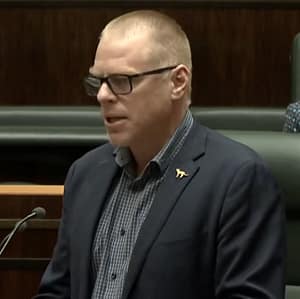
Vica Bayley MP’s adjournment speech – local author Katherine Scholes, 15 April 2026 in the Tasmanian House of Assembly
 

Vica Bayley

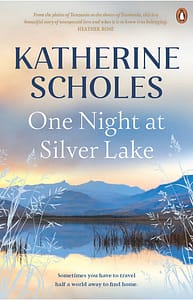
Thank you Honorable Speaker. I rise tonight to talk about the launch of Katherine Scholes’s tenth novel, One Night at Silver Lake, an event that has
literally just concluded in Nipaluna Hobart. Katherine is a friend, neighbor,
inspiration, and internationally bestselling author who’s sold over 2 million books. Her writing has been translated into over a dozen languages, and she’s won literary awards in Australia and overseas. Katherine has been awarded the Bicentennial Medal for her contribution to Australian
society and in 2025 she was inducted into the Tasmanian Honour Roll of Women.

The soldout event tonight was mc’d by Katherine’s peer, acclaimed author Heather Rose and featured a conversation with journalist, academic and media leader Dr. Joce Nettlefold.

In 2023 Nipaluna became a UNESCO City of Literature, a recognition of our outstanding contribution to writing, long list of award-winning, best-selling authors, and depth of talent in grassroots literature. This month alone, at least half a dozen books by Tasmanian authors have been launched.

Katherine is part of that legacy.
 
Katherine has been writing books for over 40 years, often bringing Tasmanian stories and landscapes to readers from near and far. Her first book, The Boy and the Whale, a children’s story set on Flinders Island, was a bestseller in Germany, where it’s still popular decades after its release.
 
Katherine was born in 1959 in what was then Tanganyika, now Tanzania.
She’s written seven novels set there during the independence era of the early 1960s. Her work explores all the big themes of life set against a complex background of colonial and postcolonial societies. In this new book, she brings her main character from Tanzania to Tasmania. In doing so, Katherine links her two homelands. In the story, this connection is symbolised by kangaroo grass. Remarkably identical species of this plant grow in both countries. Their origins lying in the ancient supercontinent Gondwana.
 
In honour of this, Katherine spent part of publication day last week having an illustration of the grass inked on her ankle, her first tattoo.
 
This new book also reaches into Katherine’s Welsh ancestry. Her grandfather was a coal miner and many people may not know of the role of Welsh people, particularly coal miners, in the colonisation of the east coast of Tasmania.
 
Last week, I heard Katherine interviewed on the ABC and expressed how important it was to her that in bringing a character from Tanzania to find a new home in Tasmania, a connection was made with the original owners and custodians of this island, the Palawa.
 

Katherine was married for over 40 years to much loved and admired Tasmanian filmmaker Roger Scholes. His death in 2022 evoked an outpouring of grief in the creative and conservation communities of Lutruwita. My colleague Cassy O’Connor spoke beautifully about Roger following his passing in this very chamber. Katherine was halfway through writing One Night at Silver Lake when Roger died. They had collaborated closely on everything,  books, film, including the iconic feature film The Tale of Ruby Rose. They spent time upriver during the Franklin blockade, and their doco about the protest is a classic of activist filmmaking and an important contribution to the historical record.

After Roger’s death, it was a difficult task for Katherine to continue writing, but she pushed through courageously finishing this book, which is already gathering praise.
 
Katherine and Roger both earned their living as full-time artists. This is very hard to do. Communities benefit greatly from what artists contribute, but their work is undervalued, usually underpaid or not paid at all. Governments must properly support the arts.
 
Creativity runs in the family, and both of Katherine’s and Roger’s sons are active in the arts scene. Johnny founded the successful street arts organization, Vibrance, and has a piece showing today in Hobart currently at TMAG (Tasmanian Museum and Art Gallery). Lindon is a composer and painter as well as being a psychiatrist. As AI transforms society, the role of art in people’s lives will only grow in importance.
 
I conclude with immense congratulations to Kath on the publication of this novel. I’m halfway through reading it and soon to set off with the main character Sara on the long journey from Tanzania to Tasmania to fictitious Rhondda on the east coast. I can’t wait for her to get here to properly understand Katherine’s skill in using words to paint a landscape. A landscape I know and love in detail.
 
Seeing this this work published and launched is an incredible testament to Katherine. Not just her skills, skill in the craft, but her resilience, tenacity,
and determination. I know how hard it was to return to writing following Roger’s death. But she has prevailed and has produced a piece of work that does our UNESCO status proud and will stand alongside her other works as a masterpiece of both scene and story.
 

Thank you.

Katerine Scholes - 'One Night at Silver Lake'
Katherine Scholes – One Night at Silver Lake

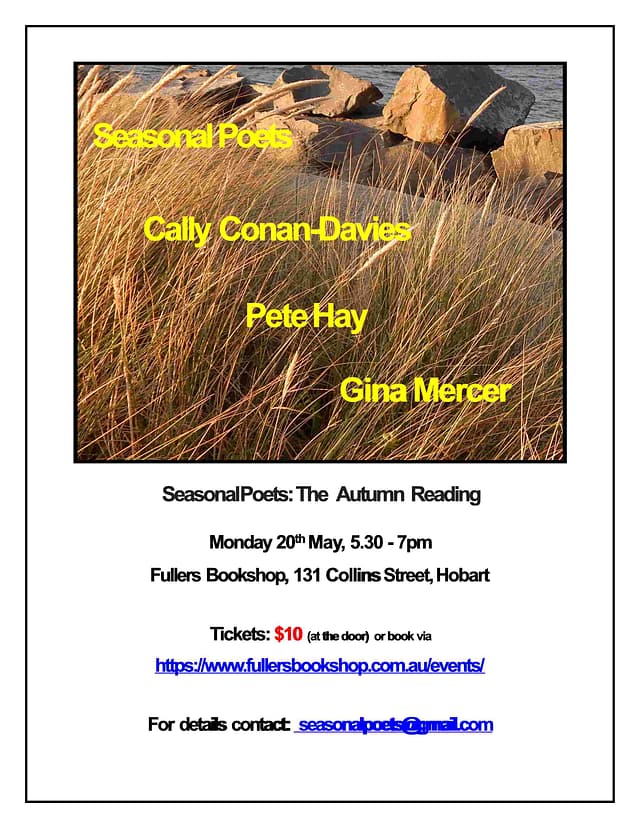
Seasonal Poets Autumn Reading – Hobart, May 18th

5.30pm Monday, May 18: Seasonal Poets Autumn Reading

To be held at Fullers Bookshop, Collins Street, Hobart, featuring Liz Winfield, Susan Austin and Jane Williams.

Liz Winfield is widely published and a stalwart of Tasmania’s poetry community. Her soon to be released book is In My Heart, A Rainforest.

Susan Austin is a poet, eco-socialist activist and mental health occupational therapist. She has published three collections of poetry, and was longlisted in the Tasmanian Literary Awards.

Jane Williams is a poet of gentle, compassionate insight. To hear her read is to be immersed in fierce and thought-full understandings of the overlooked. Her tenth collection of poems, Afterimage, will be released soon.

Tickets are $12.00 and include a glass of wine or non-alcoholic beverage. Tickets can purchased at the door or at Trybooking

Ed Southorn’s new collection ‘SEA LAKE MOUNTAIN’

Ed Southorn has published a new collection, available from Walleah Press for $20 (includes postage within Australia).

Ed Southorn’s second poetry collection examines memory, landscape, history and myth, weighing the impacts of property development, population pressure and climate change in the Bega Valley on the far south coast of New South Wales. The second half of the collection explores storied spaces and places in Europe, America and the Australian outback.

Artist David Campbell provided the cover for the book, while poets Liam Ferney and Kristen Lang contributed blurbs:

Sea Lake Mountain is steeped in the littoral, the pull and push of tides in the Bega Valley. ‘The wave is every living thing/gone before the Moon/can intervene.’ Even the Monaro plains are an ‘ocean [of] nothing but land’. Southorn’s keen eye and sharp descriptive flair let the poems wash in the numinous without neglecting to acknowledge the ‘library of toppled shelves’ the settler gaze must sort through. For ‘I am water and my blood salt’.

LIAM FERNEY

These poems diversify our understandings, breaking the linearity of our human stories in favour of an ecology of thought as fluid as the world entwining it. The poems follow yearning, conflict, sadness, love, but always through immersion. Ed Southorn finds his moment, the poems tell us, ‘in a confluence of synchronicities’. Meeting these moments, we leave with a larger world inside us.

KRISTEN LANG

cover 'SEA LAKE MOUNTAIN' by Ed Southorn
                                   Ed Southorn’s poetry collection ‘SEA LAKE MOUNTAIN’

Available for $20, posted within Australia, from Walleah Press

Poet JH Prynne dies aged 89

Poet Jeremy Halvard Prynne died last week.

Prynne’s reputation for poetic innovation and rigorous scholarship earned the respect of many including John Kinsella, (who came to know Prynne from his time at Cambridge University where Prynne lectured) and Rod Mengham. ‘J.H. Prynne is possibly the most significant English poet of the late twentieth century’, the pair wrote in their essay (‘An Introduction to the Poetry of J.H. Prynne by Rod Mengham and John Kinsella’).

In the ‘London Review of Books’ last week, Ian Patterson (poet, translator and academic and Life Fellow of Queen’s College, Cambridge) wrote that:

‘Prynne’s poems have sometimes been dismissed by more mainstream cultural commentators as meaningless, absurdly difficult, unapproachable, pointless, elitist, or simply as nonsense or charlatanism. There is a long tradition of conservative lyric anecdotalism in English poetry, and in the way poetry is taught, that turns away from a poem that is not readily approachable. It’s true that poems like Prynne’s are difficult, in the way that a great deal of poetry is difficult if by that you mean it’s hard to approach at first reading. Poetry is an art that requires and rewards patient study, rereading, attending to paralinguistic features such as rhythm, rhyme, lineation, spacing on the page, and opening yourself to the poem, attending to the way it works on your feelings and in your body as well as on your mind, rather than just trying to manoeuvre what the poem ‘says’ into a plausible paraphrase.’

Further mention of Prynne’s poetry and career appears in ‘London Review of Books’  as well as at The Guardian https://www.theguardian.com/books/2026/apr/23/extraordinary-and-original-poet-jh-prynne-dies, and at Bloodaxe Books, which notes that ‘JH Prynne was Britain’s leading late Modernist poet. His austere yet playful poetry challenges our sense of the world, not by any direct address to the reader but by showing everything in a different light, enacting slips and changes of meaning through shifting language. Not since the late work of Ezra Pound and the Maximus series of Charles Olson have the possibilities of poetry been so fundamentally questioned and extended as they were in the life work of J.H. Prynne.’

Recent reviews | Adès | Oxley | Fry | Southorn

David Ades, ‘The Toolmaker and Other Poems, reviewed by Martin Duwell (‘Australian Poetry Review’, April 2026)

A slim volume, The Toolmaker and Other Poems seems, on the surface, a deliberate corrective to A Blink of Time’s Eye. It’s a set of portraits, all in a similar fifteen-line format, in which the personality of the poet doesn’t enter in any obvious way. The first poem is about a toolmaker and his knowledge that one day his tools might fail him, knowledge that enables him to have a more balanced and humane approach to the work itself. This is obviously pregnant with allegorical possibilities about the poet’s own vocation. On the book’s cover, however, the author explains how, having written the first as a way of suggesting that his own career as a lawyer leads others to an inadequate sense of what his self is really about, other poems in the same mode “insisted on being written”.

Purchase


Louise Oxley, ‘Range Light’, reviewed by Martin Duwell, (‘Australian Poetry Review’, March 2026)

There are seventeen years between Buoyancy, Louise Oxley’s second book, and this new one. There were five years between her first book, Compound Eye – little larger than a chapbook, really – and Buoyancy. Barely over a hundred poems in more than twenty years must make Louise Oxley the most restrained of Australia’s better poets. This new book, while a little thinner than Buoyancy, has poems of as high a standard and has a lot of connections with that earlier book.

Louise Oxley

Purchase


Kathryn Fry, ‘To Speak of Grasses’, reviewed by Stephanie Greene, (‘StylusLit’, March 2026)

The lasting impression of Kathryn Fry’s latest poetry collection, To Speak of Grasses, rests in its evocation of wonder. These poems explore the living world, through nature, art, music and family, attending, most of all, to awareness of being. In the titular poem ‘To Speak of Grasses’ – which appears in the first section of the book – the poet travels through the Pilbara, observing both continuity and impermanence as ‘home-spun hummock grasses grow the land’, which she finds ancient in form, rich in wildlife. ‘It‘s hard to process the time taken’, she writes, ‘to gouge shapes   to foster life’ (8-9). In this poem, as in many others, there are subtle references to brutality and sadness.

Purchase


Ed Southern, ‘Pareidolia’ reviewed by Jane Frank (‘StylusLit’, March 2026)

In the blurb I provided for this striking first full collection of poetry, I noted the poet’s ‘wide ranging and sensory appreciation of history, mythology, art, land and coast,’ as well as his unrelenting interrogation of fundamental human questions in ways that surprise the reader and draw us in. These are also poems that pay close attention to public events and frame them expertly— at times, a kind of documentary poetics— in keeping with Southorn’s career background as a newspaper reporter of 32 years in Australia and the United Kingdom.

Purchase

Women’s team walks off in protest

The North Korean women’s soccer team marched off the field in protest in Sydney last night over a goal allowed to the Chinese women’s team in a 2026 Women’s Asian Cup match.

Not the best example of good sportmanship, but worth mentioning are ex-player Australian Kate Gill’s observations as reported in The Guardian….

“It got me thinking about the bigger picture of it all and how lucky we are to live in a country where we have autonomy over the decisions we make,” she says. “But for a country that’s so shut off from the world and not exposed to good sporting standards or expectations, they’re probably acting how they’ve been told to.

“When I was looking back at it, the directions always came from the support staff and head coach who coordinated the players to walk off the pitch or retaliate. I would hate to be the player on the North Korea team who thought that kind of thing wasn’t right, and they didn’t want to act in those ways. What would be the repercussions for that?”


Literary journal Meanjin magazine finds new life

The literary journal Meanjin will return to the city it was born in that bears its Indigenous name.

The Queensland University of Technology announced on Wednesday it had acquired the 85-year-old journal, whose life was cut short by Melbourne University Press in September.

QUT’s successful bid marked a full circle for Meanjin, which was founded in Brisbane/Meanjin by Clem Christesen in 1940 before moving to Melbourne in 1945.

The QUT vice-chancellor, Prof Margaret Sheil, said the new ownership agreement committed to maintaining the journal’s rigorous standards by safeguarding its editorial independence and the appointment of a dedicated editorial board.

(Read more | Kelly Burke’s article at https://www.theguardian.com/books/2026/feb/11/meanjin-literary-journal-new-life-queensland-australia (The Guardian, 11th February 2026)

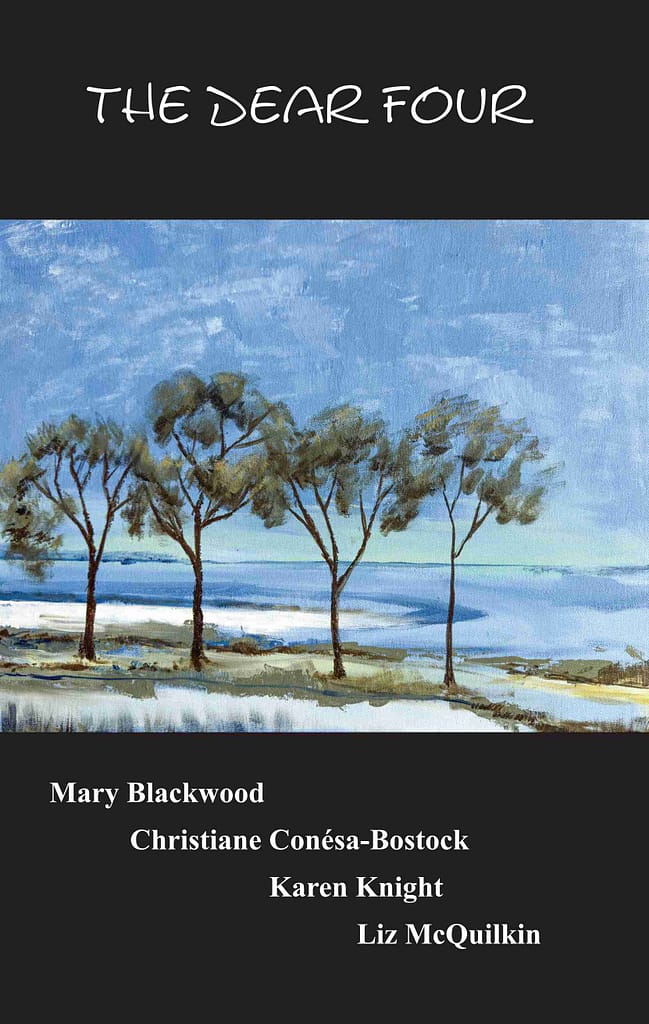
Robert Dessaix, launching ‘THE DEAR FOUR’

(From Robert Dessaix’s speech to launch THE DEAR FOUR, poetry by Mary Blackwood, Christiane Conésa-Bostock, Karen Knight and Liz McQuilkin – Hobart 14th December 2025)

I feel (in this year of Donald Trump, Ukraine, Sudan and Gaza) as if something has withered inside me. Something that’s always been there, isn’t there any more. There’s an emptiness. (And not the Buddhist sort.) I feel a sort of grief. Who doesn’t. Something vital I once had a grasp of has disappeared. Am I mildly demented? Have I misplaced something? What is it? (At my age, after all, you misplace things all the time: books, letters, your spectacles, people …) Please don’t let me lose my mind, pleads a night-time voice in Liz McQuilkin’s first poem in the collection … but she, with her squirrel psyche, has a store of poems to nourish her spirit.

This collection, The Dear Four (an eccentric title, too, arresting – Who’d have guessed what ‘dear’ means without being told?) The Dear Four gives me confidence, nevertheless, even without a store of poems, if I pay attention, I can find what’s been missing. I am enlivened by it – inspirited, we once said. (If only things were as they used to be …) Not every poem in the book will mend the wound – my particular wounds … how could it? But a surprising number make me feel whole. To my surprise. To my delight. (I don’t normally listen to what poets say, remember. The distillation I find in poetry is usually too radical for me.) Yet overwhelmingly these poems made me sing. One by one they made me take flight.

(More at https://walleahpress.com.au/launch-the-dear-four.html)

Five Islands Poetry Prize – 2025 winner announced

Madeleine Dale’s Portraits of Drowning published by University of Queensland Press is the
winner of the 2025 Five Islands Prize for a first book of poetry.

Madeleine will receive $3000 and University of Queensland Press will receive $1200.

From the judges: ‘a thrilling, moving and thought-provoking collection of poems, meticulously researched but always empathic and intimate. She has a remarkable dexterity with form and theme… Literary allusions and deep research sit alongside an adventurous, rangy, slightly wild approach to form, structure and poetic composition. We congratulate Madeleine on this assured and singular book, we know it will find a wide readership.’

The shortlisted books:

HIGHLY COMMENDED
Bathypelagia by Debbie Lim (Cordite Publishing Inc.)

COMMENDED
The Infant Vine by Isabella G Mead (UWA Publishing)
Past & Parallel Lives by Kaya Ortiz (UWA Publishing)

Note that submissions are now open until 15 July for the 2025–26 Prize. Entry is free.

For all details on how to submit, go to https://www.canberra.edu.au/five-islands-prize/

Vanessa Proctor, Helen Swain ~ Whispering Gums

Good, if belatedly, to come across a generous and thoughtful reading on the praiseworthy Canberra-based literary blogsite, Whispering Gums of a couple of poetry collections published over the past twelve months, Helen Swain’s Calibrating Home and Vanessa Proctor’s On Wonder.

The two books were both published in 2024, and it’s a little amusing because Tasmanian poet Helen Swain’s collection, Calibrating home, was published by the New South Wales-based 5 Islands Press, while Sydney poet Vanessa Proctor’s collection, On wonder, was published by the Tasmanian-based Walleah Press.

Helen Swain lives and works in Lutruwita/Tasmania. She has been a teacher, performer (performing in Tasmania, mainland Australia, Berlin and Paris) and community arts worker. Along with Mary Blackwood, Eleanor March, Gina Mercer and Lyn Reeves, Helen was part of a dedicated team behind the publication of Quicksilver Water, a 2022 anthology of women poets who’d been meeting and making art in the heart of Hobart for nine years representing an age group of eight to ninety-three years.

The Hobart City Council generously provided a grant to fund publication of the anthology as well as enabling Oasis to pay contributors, and to further gift some remaining copies to the wider Hobart community … causing one minor hickup, Hobart Bookshop had a purchase enquiry at the time, and got in touch in Gina. ‘Hmmm … not sure, it’s not meant to be for sale, but not to worry, we’ve a handful left’, and I think a copy eventually made its way into the hands of the would-be buyer. Not sure if money actually changed hands….

Gina Mercer launched Helen’s Calibrating Home in Hobart last November, noting ‘this is a very good book’ (you can read the launch speech online at Rochford Street Review) that will

’tilt your world – as you might tilt your glass of clear tea as you sit in the late afternoon sun – admiring the play of light and viscosity and shadow – as you sip both tea and poems… because having your world tilted by Helen’s hands is good. Her hands are steadying and precise and full of thought. Helen’s hands are knowing in all the best ways. They are enlivening, compassionate hands that hold that necessary, slippery “glow-worm” (‘Hospital Waiting Room’) on which we all depend – hope.’

Of Helen Swain’s ‘Calibrating Home’, Whispering Gums notes ‘The poems in this collection slip between past, present and future, often within the same poem, as you can see in “Traced”. There is a sense of struggle, but also of tenacity and endurance. War is evident, in specific poems like “Meeting up (for Michael O’Neill, killed in Ukraine May 2022” and in gentle poems like “Teacups” (“Grandmother’s teacups/survived the war”) where the domestic collides with violence. The shock of violence or war, and the cold displacement of people, is never far away in these poems. But, neither is the domestic, the peace, the connections, the gentleness (in “Suzi and the Spider”), and the humour (in “Mary”)’.

Of Vanessa Proctor’s On wonder, Whispering Gums notes that the book ‘was given to me by on old schoolfriend. It comes from a poet steeped in the haiku tradition, but it meets Swain at various points. One delightful synchronicity occurs between Swain’s “Suzi and the spider” which tells of Suzi gently releasing back into the wild a spider that has come into her house, and Proctor’s “A dragonfly” in which the narrator carefully unravels a spider’s silk from a dragonfly to set it free. Both speak of gentleness and respect for nature, and of connections between living things.

Vanessa’s book has been well reviewed elsewhere since publication in December 2024, including a thoughtful piece by Michael Sharkey in ‘The Australian’ earlier this year as well as another half dozen or so … you can find a couple on Greg Piko’s https://gregorypiko.com/2025/05/04/vanessa-proctor-on-wonder/ blog site, and  Samantha Sirimanne Hyde at Grattan Street Press in September.

Helen Swain’s ‘Calibrating Home’ is available for $26 at Five Islands Press, while Vanessa Proctor’s ‘On Wonder’ is available at Walleah Press for $22.


2025 Five Islands Poetry Prize | Shortlist

Five Islands Press has announced the Judges’ shortlist for the 2024–25 Prize.

Bathypelagia —Debbie Lim, Cordite Publishing Inc.
Portraits of Drowning — Madeleine Dale, University of Queensland Press
The Infant Vine Isabella — G. Mead, UWA Publishing
Past & Parallel Lives — Kaya Ortiz, UWA Publishing

The winning and order of commended books will be announced at a Zoom event on
Wednesday 3 December, from 5.00–6.00 pm (AEST Melbourne time). Join at:
https://unimelb.zoom.us/j/2338614152?pwd=aVhRZElvYjh1T2ZId2h1QW9ZbThSU
T09&omn=83583511486 Password: 106945

Everyone is welcome to attend to hear the judges’ report and readings from the finalists.

Please note submissions are open until 15 July next year for the 2025–26 Prize. Entry is
free. For details on how to submit, go to https://www.canberra.edu.au/five-islands-prize/


Robert Dessaix to launch ‘The Dear Four’: Hobart


TheDearFour-launch-invitation

An invitation to attend the launch by Robert Dessaix of the poetry collection ‘The Dear Four’, featuring new poems by Mary Blackwood, Christiane Conésa-Bostock, Karen Knight and Liz McQuilkin

Sunday 14th December 2.30pm

Royal Yacht Club of Tasmania, Marieville Esplanade, Sandy Bay, Hobart

Drinks available from the bar

RSVP: lizmcquilk@gmail.com by 30th November

Vale Moya Costello

Join family & friends to commemorate the talented Australian writer, editor, teacher, wine critic & academic Moya Costello.

Come to a relaxed gathering at the Port Sorell Surf Life Saving Club by the sea that Moya loved so much.

Dress informal and bring your cozzies and sun hats, if you like.

Port Sorell Surf Life Saving Club, Hawley Beach, Tasmania

Vanessa Proctor’s collection ‘On Wonder’ | review

Samantha Sirimanne Hyde has penned a laudatory review of Vanessa Proctor’s Dec 2024 poetry collection On Wonder, at Grattan Street Press (29th September, 2025).

The Japanese perception of sadness, particularly a tender, contemplative sadness, is often defined by the term ‘mono no aware’. This is often rendered as the pathos or frailty of all things: an understanding of the impermanence of all matter and the wistful reaction that comes from its acceptance. Proctor’s poetry is often touched with this leitmotif of finding beauty in what’s blemished, fragile or ephemeral. For instance, cherry blossoms, which epitomise beauty, transience and renewal in Japanese culture, are depicted in the poem, “The Scattering of Blossom”, shifting between life and death, beauty, sorrow and acceptance. The poem moves from Australia, where the cherry trees bloom along Sakura Avenue “at the old POW camp in Cowra”, a resting place for over two hundred Japanese soldiers “beneath a foreign soil”, to Rikugien Gardens in Japan, where the poet reflects on the pale pink blossoms and the impending birth of her child, and finally to a snapshot of luminous flowering wild cherry trees in the foothills of the Himalayas.

Proctor encourages the reader to look more deeply at the world and at ourselves with kindness and compassion, celebrating our interconnectedness with one another and with nature. On Wonder is a book of understated elegance with comforting alchemy, a collection to be savoured time and time again.


Sri Lankan born Samantha Sirimanne Hyde lives in the unceded land of the Wallumedegal people in NSW. She holds an MA in Creative Writing from Macquarie University. Her collection of 20 short stories is called The Villawood Express & other stories and over 300 of her haiku and tanka have appeared in poetry journals. Her debut novel, The Lyrebird’s Cry, is a tale of self-discovery of a gay man trapped into an arranged marriage.

Young Dawkins | The 2025 Tim Thorne Poetry Prize

The 2025 Tasmanian Poetry Festival kicked off Friday evening, October 10, 2025, at Sporties Bar in Launceston. Young Dawkins reflected on serving as one of three judges for the 2025 Tim Thorne Poetry Prize.

American-born poet Young Dawkins was a central figure in the New Hampshire beat revival movement, where he helped found the Jazzmouth Poetry Festival, before moving to Scotland and becoming a regular on the Scottish Performance Poetry scene. He was the 2011 Scottish Slam Poetry Champion, and the 2012 runner up. In May 2011, Young went to Paris to represent Scotland in the Poetry Slam World Cup, and in August 2011 he performed a solo show at the Edinburgh Fringe.

From 2011 – 2013, Young organised and hosted the BBC Edinburgh Fringe Poetry Slam.

Since moving to Tasmania in 2013, Young has performed at events and festivals including the Silver Words spoken word night, the UndergroundArtBar, Cygnet Folk Festival, Pangaea, Junction Arts Festival, Moonah Arts Centre, Stories After Dark at Hobart Library, and ECHO. He has also performed with highly acclaimed jazz musicians Andrew Legg and Nick Haywood at venues including Lark Cellar Door, the Tasmanian Museum and Art Gallery and the Tasmanian College of the Arts.


Young Dawkins – a resident these days of southern Tasmania – spoke of his pleasure at being in Launceston for the opening of the 41st Tasmanian Poetry Festival. ‘I believe Launceston is the beating heart of Tasmanian poetry, I really do,’ he observed. ‘You people love poetry. You show it. You support it. You care about it. You produce it. And as a poet, I love you. So thank you very much for having me here.’

‘The Tim Thorne Prize in Poetry has very quickly made its mark in Australia. I know people from the mainland who talk to me about it and they say, where did that come from, a $25,000 prize? That’s quite remarkable. There have only been 20 Tasmanian poets who have even been named to the Long List. Only two people have won it.’

Young suggested the prize, and its prestige, owes a great debt to Tasmanian poet Tim Slade. Slade had taken the case for increased recognition for the prize to the Tasmanian state government, persistently arguing for greater prizemoney (the state body’s initial suggestion had been $10,000).

‘So Tim Slade, if you see him’ Dawkins continued, ‘tell him thank you, because he’s the reason that one of Tasmania’s greatest poets is commemorated and lives on in this way.’

Dawkins’ allusion to ‘one of Tasmania’s greatest poets’ was right on the money. Following Thorne’s death, Tasmanian MP Michelle O’Byrne read the comments of friend and fellow festival director, poet and playwright Cameron Hindrum, into Hansard:

One of Australia’s best contemporary poets, Tim Thorne, passed away this morning after a long and typically defiant battle with illness. His moral courage, his unique capacity to turn a perfect poetic phrase, especially to make unexpected rhymes materialise seemingly out of nowhere, his strength, his intelligence, his humour, all were a source of inspiration to generations of writers who had the benefit of his mentorship or guidance. I will be forever grateful for having known him and I hope that that is no small thing. There will, of course, always be the infinite legacy of his work. Whenever and wherever it is read, he will be there, smiling. Vale, Tim, it is not enough to say thank you, but thank you.


‘Let me tell you about the 2025 awards,’ Young Dawkins continued. ‘I was honoured to be asked to be one of three judges – three completely different judges – coming at this with very different points of view about what constitutes good poetry.’

‘We met for the first time in October of last year and were handed 25 books. Here you go, figure it out. Twenty-five books of poetry.’

‘We looked at each other and said, we’re never going to agree about this. So we said, we need some guide rules. And we set out three broad criteria on which we would judge these works.’

The criteria the trio chose was, firstly, the quality of the writing. ‘And I say immodestly that I think all three of us have done enough with poetry to understand what good writing looks like and sounds like,’ Dawkins added.

‘The second was interesting, to judge it on the impact and what our emotional response was as an individual. We agreed that when you read poetry, it should move you. It should make you angry. It should make you sad. It should make you other things – but it should do something. It should have an emotional response, an impact.’

‘And the third thing was how interested were we in the theme of the book? How did the book keep us connected all the way through? We spent four months at this. We met dozens of times by email, we met in person, we called each other on the phone. We talked a lot. We spent a lot of time on this and took this very seriously. We were so far apart on our views.’

The trio began by ranking each book on points. ‘And we weren’t anywhere near each other. Not even remotely near each other. And we did this again and again and again and again.’

After a period of reading — ‘we read and read’ – they kept returning to one book. In conversation they used words and phrases to describe their responses: ‘Simple.’ ‘Tight.’ ‘Nothing wasted.’ ‘The artistry is impressive.’ ‘Her images wash of colour and movement.’: Pam Schindler’s ‘say, a river’.


Dawkins introduced Pam Schindler to read. Pam mentioned how honoured and thrilled she was to win the award. ‘When the shortlist was announced, the judges published brief comments on each of the books on the shortlist,’ Pam said. ‘And I thought, well, that’s enough prize for me, just hearing those words about my book when they were included in the shortlist. But it’s a great honour. And I’m also very thrilled to take part in kicking off this wonderful festival for its 41st time round, which is a huge achievement, very special.’

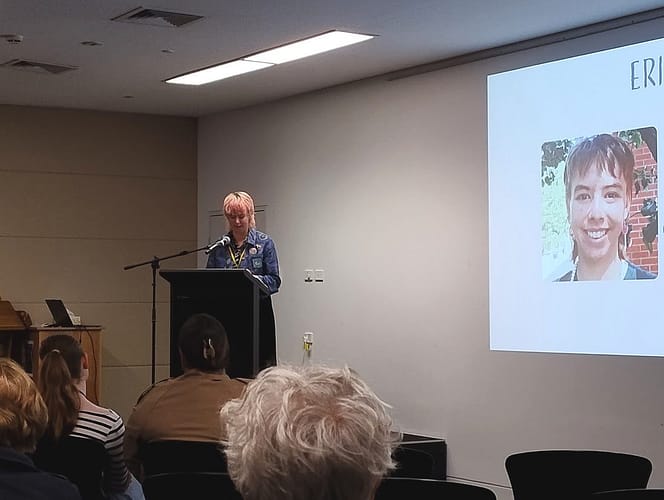
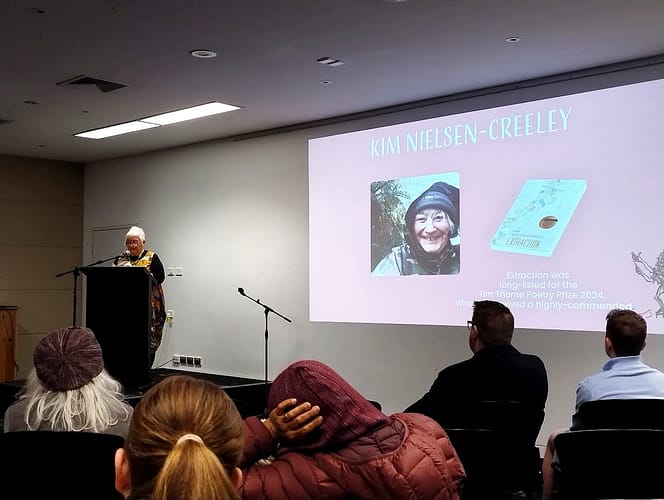
Young Dawkins also introduced the winner of the Highly Commended Section of the Award, Kim Nielsen-Creeley, explaining how as judges they’d ‘continued to push books to the middle of the table, individually, one at a time, over the months, and there was another book we kept bringing back. And it was an interesting thing, because we knew this was a first collection by an author – an emerging voice –and that there was a power here, and something distinctly, deeply Tasmanian about this voice. So for the first time in the history of the Tim Thorne Prize – right, there’s only been two – but this is the first time, and we went to the Tasmanian government with the courage of Tim Slade, and said, we want to create a new designation. We want to create a designation highly commended.’

‘Well, that’s never been done before,’ they said. ‘Well, we’re going to do it this year, because this book deserves it,’ we replied.

‘This is what we as judges wrote:

This collection features intelligent and richly informed observations on how place impacts people. The poems are both reflective and vulnerable, and the reader gains deep insight into the author’s lifelong response to her environment.

And it gives me really great personal pleasure’ Dawkins concluded, ‘that I was the first one to pull this book out from the centre of the table.’

Kathryn Schulz’s ‘Lost & Found’

Have read, then partially listened to, an interview (dated 30th may 2025) in the New York Times recently with Kathryn Schulz, a staff writer with The New Yorker and a winner of the Pulitzer Prize . She’s interviewed by Ezra Klein about her 2022 book, ‘Lost & Found’.

Eighteen months before Kathryn Schulz’s beloved father died, she met the woman she would marry. In Lost & Found, she weaves the stories of those relationships into a brilliant exploration of how all our lives are shaped by loss and discovery-from the maddening disappearance of everyday objects to the sweeping devastations of war, pandemic, and natural disaster; from finding new planets to falling in love.

There are many memorable moments within this interview. Kathryn Schulz is a gifted conversationalist (though not to the same degree as her father, apparently, who ‘could talk me under the table’), and Klein has prepared his questions well. The interview’s behind a paywall I assume, but let me quote just one question and response (and recommend you seek out Kathryn’s work online):

Is there an experience that comes to mind for you recently, where you were looking at something small and you saw something big in it — or big and you saw something small in it?

Sure. I’m going to tell a story that sounds like it can’t possibly be true, and I swear it is.

What you need to know by way of context for this story is that a year or so ago, my partner and I bought the house across the street from the farm where she was born and raised, and where her parents still live. We’ve been gradually renovating it ever since then and were incredibly excited to move in and to be near family and, frankly, near more child care.

We finally move in, and I’m reveling in this beautiful new home as we settle in. Then — this is only a week ago — my daughter, who’s now 3½ — we have these beautiful fields outside of our house, and she wanders off into the field and returns with a stalk of wheat and says: Look, Mama. So I’m thinking: Oh, she found a stalk of wheat — fun! Children pick up everything, right? Clovers, coins, anything muddy, tarantulas — whatever they can find.

So she hands me this stalk of wheat, and I’m thinking: Oh, how sweet, she gets to live in this beautiful setting where the outdoors is full of so many wonderful little things for her to study. Then she looks at me very seriously and says: Mama, we should use this wheat to make bread for people who don’t have any.

It’s just one of those moments as a parent, where, on the one hand, you’re just so in love with your child. You think: Who made this remarkable mind?

I’m sitting there thinking she found a pretty flower or something, and there she is apparently thinking about the poor and privation and need. So right away my sense of the scale of what we were talking about just wildly shifted.

But also, to be honest, right alongside feeling overwhelming awe for her, I felt so morally indicted. I am literally in the middle of reveling in my pretty new kitchen, and then suddenly, I’m confronted with real hunger in the world, and I’m thinking: Why do I have this beautiful backsplash? What have I done here? My 3-year-old has more moral clarity than I do about how we should spend our money and our time and what actually matters in life.

So, yes, in a wonderful way, I feel like my world is full of discoveries that seem small and blossom out into the enormous. Or seem enormous and then have some kind of bearing on small, practical things, like how to be a family and how to raise children. It’s often incredibly humbling. And sometimes it’s very funny, and sometimes it’s very moving. In that case, it was all the above.

The book’s available at Readings Bookshop in Melbourne, costs $34.99.

Sunday 5th Oct, Hobart: Tas Poetry Festival feature reading by six poets

2.30 – 3.45pm, Sunday 5 October

Tasmanian Poetry Festival Feature Reading in Hobart

The Tasmanian Poetry Festival presents a special Hobart feature reading by award-winning poets:

Enjoy this delightful afternoon reading by some of Tasmania’s finest poets addressing themes of nature, family, attention, and joy.

Hosted by Fullers Bookshop, 131 Collins Street, Hobart.


About the poets:

Erin Coull is an editor and contributor for WhyNot and is a past winner of the Andrew Hardy Poetry Prize, and has been published in FortySouth, Togatus, The Trailblazer and WritetheWorld Review. Her writing explores quiet anxieties, uncertain futures and complex connections.

Susan Austin is an award-winning poet, mental health occupational therapist, eco-socialist activist and mother, who has two poetry collections and a verse novel. She will read poems about times when we feel lost – with parenting, relationships and work – and ways we re-establish connection with nature and each other.

Young Dawkins has been published in two collections and numerous literary journals, and has performed his work internationally at major festivals, main stages, competitions and countless questionable bars. His poems draw on autobiography.

Ben Walter is a Walkley award-winning essayist, and the author of a book of short stories, What Fear Was, and the new poetry collection, Lithosphere. His poems explore the Tasmanian natural world in surprising ways.

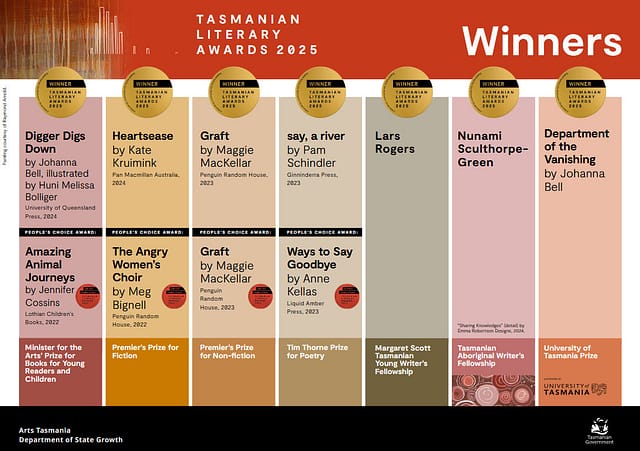
Esther Ottaway is the winner of the $25,000 Tim Thorne Prize for Poetry in the Tasmanian Literary Awards, and holds multiple national and international shortlistings. Her poems are about family bonds, Tasmanian life, experiences of joy, and winter swimming!

Louise Oxley‘s three collections include poems that have won major awards, attracted state and federal grants and earned residencies at Varuna the Writers House and the University of Prince Edward Island, Canada. She will read poems on the theme of mother and child.

Free event! Book here, or just attend on the day: https://www.fullersbookshop.com.au/event/tasmanian-poetry-festival-feature-reading-in-hobart/

This special event is a preview event leading up to the Tasmanian Poetry Festival full days of readings, held in Launceston from 10-12 October, and featuring Erin Coull, Liz Winfield, Les Wicks, Kim Nielsen-Creeley, Kit Kelen, Alex McKeown, and guest, Pam Schindler. Workshops include Constraint-Based Writing, Writing an Interior Monologue, Taking Your Words for a Walk, and Plan to be Published. You can view the program and book tickets at www.taspoetryfest.org

DIY Publishing Toolkit

DIY Publishing Toolkit is a project of the Community Publishing in Regional Australia Research Group.

The group puts out a Community Publishing Newsletter, and online effort – the most recent, no 8 – 11th September 2025.

The DIY Publishing Toolkit is a practical guide for anyone wanting to write and publish a book—whether it’s a memoir, poetry collection, children’s title, or another genre. Leveraging modern digital tools, the toolkit shows how to streamline production, outsource selectively, and retain creative control. It covers everything from selecting printers and designing covers to marketing, sales, and crafting cherished physical copies. Readers can navigate the sections in any order to suit their goals.

Authored by four university scholars—Beth Driscoll, Kim Wilkins, Alexandra Dane, and Sandra Phillips—the guide draws on extensive publishing experience. Together they have authored 85 academic articles, 10 books, and taught thousands of students. Their collaboration began in 2023 as part of the “Community Publishing in Regional Australia” research project, which highlighted DIY publishing beyond metropolitan hubs. Partnering with industry groups (Booktopia, Busybird Publishing, Small Press Network) and councils in Alice Springs, Broken Hill, Winton, and Ayr, they gathered local writers’ stories that enrich this resource.

Vanessa Page in conversation

Vanessa Page hails from Toowoomba but feels most at peace in the outback. A seventh‑generation Australian with First Fleet ancestry, she fell in love with books while spending lonely holidays with her grandmother. She’s the only university graduate in her family—BA in Journalism (USQ), PR diploma (RMIT), and a Master’s in Professional Communication (USQ)—earned while raising a baby and battling doubters. A lifelong footy fan, she turned that passion into a master’s thesis on sport as news. Publishing her first poem at twelve, she revived her writing in her thirties, joined Brisbane’s Speedpoets scene, and now thrives within the supportive Calanthe Press community.

Rosanna E Licari interviewed Vanessa for the current issue of Stylus Lit, launched September 1st, 2025.

Martyn Crucefix | Can AI Write an Original ‘Poem’ By ‘Me’?

UK blogger Martyn Crucefix discusses his experiments with AI poem creation in his blog post ‘Can AI Write an Original ‘Poem’ By ‘Me’?’

On a personal note, I too (like Martyn) have been fiddling around with AI of late, seeking to create a small picture book as a family gift. It’s set in Spain in 1936 during the Spanish Civil War, & I’d been searching for images of 1930’s vintage trucks … tried google searches of well-known automotive brands for the era, but nothing popped up and figured, maybe AI can do the trick. Which it did, with ease. I’m not fussed it’s an AI generated image, the picture book – if it happens — will be a gift, a bit of fun, paying more attention to the act of gift-giving than to other considerations…. AI has its uses, in my experience.

But it has its downsides too, particularly in attempting to imitate the human – as Crucefix discovers….

Having written this I have convinced myself – even more than I had been before – that what AI has written is a ‘hide’, a cover for a poem, making use of words and ideas that it has found associated with poems (perhaps even my own poems) but which it doesn’t itself ‘get’ (how could it?). On the other side of the desk sits the reader. The question for the reader is: how well do we read any poem that comes before us? Do we accept its (often) feeble gestures towards significance as the real thing? Out of a hundred poems we read in magazines and on-line, how many of them ARE the real thing? I’d bet my AI generated poem would find its way into a UK magazine (eventually). It has the aura of a poem, it has many of the familiar gestures of a poem, it doesn’t really make proper sense (which some think is the mark of a real poem), it doesn’t have the heart of a true poem (but lots of poems I read don’t either because they too are copying, mimicking tropes and phrases from other poems).

Read more.

Postscript … a podcast chat with Jamie Freestone (substack ‘The Stark Way‘) on Sarah Wilson’s site ‘This is precious‘ a couple of days ago is well worth a listen (though I assume it’s behind a paywall), discussing the projected scenario of AI in 2027 being so advanced that (in Freestone’s words), ‘you’ve got this sort of self-improving feedback loop where maybe one [AI] company finds almost to their own surprise that they’ve got something that is now much closer to an artificial general intelligence, or an artificial super intelligence, perhaps. And then you’re worried that it will break free of its constraints or start using deception to do things that you don’t want it to do and it becomes very hard to handle … I think that’s probably the kernel of the AI 2027 scenario….’

PPS not to mention the significant water concerns due to the substantial water requirements of data centres that power AI systems….


Andrew Blackman – No, RSS isn’t dead!

(from Andrew Blackman’s blog, 7th May 2025)

‘When I mention RSS these days, I often get either a complete lack of recognition or a kind of amused astonishment, as if I’ve just suggested sending them a fax.

It’s true that big tech companies, notably Google, have killed many of the RSS readers and other technology that used to be common ten or more years ago. It’s true that social media basically took over from RSS as a way of getting updates. It’s true that nobody even tracks RSS usage any more, as far as I can see. I’ve done editing work for tech companies that don’t even bother creating RSS feeds for their blogs because they think nobody uses it. But that doesn’t mean RSS is dead.’

More at Andrew Blackman


Louise Akers | 12 to 20 questions (from rob mclennan’s blog)

(from ‘rob mclennan’s blog’, 17 April 2025)

5 – Are public readings part of or counter to your creative process? Are you the sort of writer who enjoys doing readings?

I love doing readings–because they are fun and social and ephemeral experiences, but also it is a hell of a way to edit a poem. When I know I am reading something out loud in front of strangers, I will be totally ruthless in a way that only vanity can inspire. Also sometimes while I’m reading it, and really hearing and feeling its living reception I will change little things to allow for clarity or rhythm or some other immediate and interpersonal effect.

7 – What do you see the current role of the writer being in larger culture? Do they even have one? What do you think the role of the writer should be?

Oh, it’s hard not to just quote Walter Benjamin on this one. I think critique is important; I think it is important to register the fact that throwing language at a problem (“problem” standing in here very broadly and clumsily for any of the myriad social-political-environmental-economic cataclysms we are enmeshed in currently), policing the language around a problem, or even diagnosing a problem discursively are all deeply incomplete projects, while also realizing that that is not an excuse or a reason not to do those things. Very clunky sentence, but hopefully you get the drift.

(More at rob mclennan’s blog)

Louise Akers is a poet living in Brooklyn, NY. She is a PhD student in English at NYU and is the co-organizer of the small press and working group, the Organism for Poetic Research. Akers is the author of two books of poetry, Alien Year (Oversound, 2020) and Elizabeth/The story of Drone (Propeller Books, 2022).

Dulcetly (Kristy Bowen): Adventures in self-publishing

(from a post on Kristy Bowen’s blog Dulcetly | notes on a bookish life – 03 March 2025))

I was moving some books around on my shelf and realized I have now published just as many books via self-publishing as I did traditional publishing….

After 2020, I felt a shift in my relationship toward po-biz and publishing, as well as a general backlog and build-up of unpublished work. In those intervening years, I’ve had fairly long routines of writing poems daily (or at least fragments)  By the time 2021 had rolled around,  was sitting on three full-length manuscripts that I genuinely had no idea what to do with. I submitted at least two of them during reading periods for my current press, but nothing was picked up those go-rounds. I am not really a contest person, especially if they have high entrance fees and the idea of finding an forging another relationship with an indie seemed an up-hill climb.  And no one publisher could possibly take on as many books as I had stuffed away in my hard drive.

(More at Dulcetly)

Rae Armantrout | ‘The absence of certainty’, a conversation with Kate Lilley

(Cordite Poetry Review, 4th February 2025)

Kate Lilley: … One of the things you said when we were having a bit of back and forth about how we might do this was when I asked you what often gets left out, because everybody writes about (for good reason) the markedly intelligent, propositional, ‘thinky’ character of your work, it’s markedly ‘intellectual.’ You said emotion and affect tend to get left out. Why don’t we start there with some of these poems?

Rae Armantrout: Ok, I like that question. It’s true. People often talk about the ambiguity of my work and how to make meaning out of it – how meaning might be problematised, which are all intellectual problems that are very interesting to me. I like your word ‘proposition,’ Kate. One thing I like to do is to throw out a proposition that may or may not be true, it could conceivably be true, and then pose examples of what it might mean and look like for it to actually be true. Often, the examples are problematic, somehow. It’s like they’re chunky, unwieldy pieces of the world, and how do they line up with these propositions that I’m trying to use to describe it?

So, having said that I want to get around to emotion since I don’t talk about it much. I may not be good at talking about it, but I can tell you that every poem of mine starts with a feeling. And usually with a feeling I can’t identify, maybe because it’s complicated, kind of a compound feeling of ironic yet wistful or a sad yet angry combination of feelings. But also, sometimes, I need help understanding the source of the feeling, and that’s where a poem starts – when I try to identify the source of a feeling.

(Edited transcript of the conversation at Cordite Poetry Review)

(Complete interview online on the Australian National University’s Art and Social Sciences YouTube channel)

Five Islands Poetry Prize ~ for a First Book of Poetry

Terms & Conditions

  • This is an annual prize for a first already-published book-length collection of poetry by an Australian poet or a poet living and writing in Australia.
  • The author of the prize-winning book will receive $2750 and the publisher will receive $1100.
  • A book can be entered by the author or publisher.
  • The book must contain at least thirty pages of poetry, have an ISBN, and be available through retail sales outlets.
  • Self-published books are eligible as long as they meet the above criteria.
  • For the 2024-2025 Prize, books published between 1 July 2024 and 30 June 2025 are eligible.
  • Note: the prize aims to support professional publishers, in particular small-press, independent publishers.
  • Submissions are open until 15 July 2025.
  • There will be three judges, whose decision will be final.
  • The Prize will be announced in late November, and presented shortly afterwards.
  • Four copies of the submitted book are to be posted to PO Box 68 Brunswick Victoria 3056.
  • Books submitted will not be returned.
  • An email must be sent to Kevin Brophy at: kevinjb@unimelb.edu.au attesting that this is the poet’s first published book of poetry, and providing the book’s publishing date, and contact details for the poet and the publisher.

Step 1

Post four copies of the submitted poetry book to the address below. Please note, posted books should be received on or before 15 July 2025.

Five Islands Poetry Prize
PO Box 68
Brunswick Victoria 3056

Step 2

Email Kevin Brophy, attesting that this is the poet’s first published book of poetry, and provide contact details for the poet and the publisher. Please subject your email as “Five Islands Prize Entry”.


Five Islands Press Poetry Prize 2025

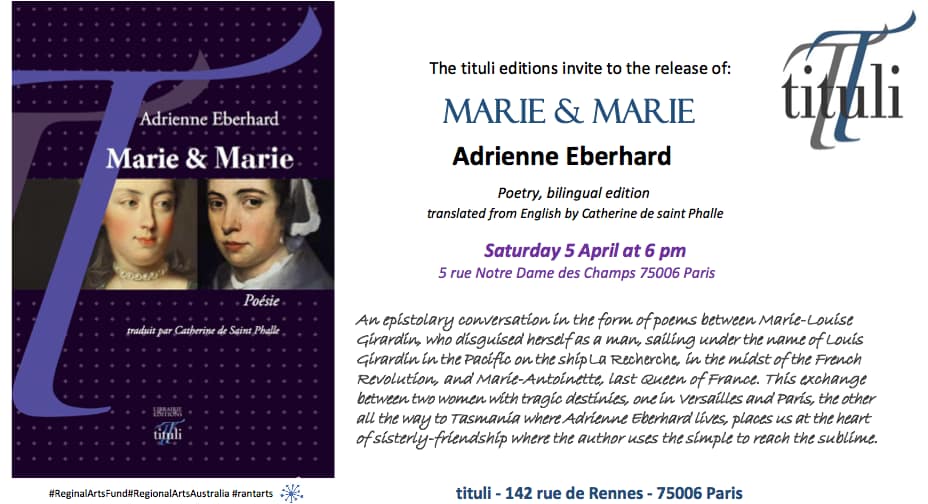
Adrienne Eberhard | ‘Marie & Marie’, Paris launch

Lovely to learn of the launch in Paris last week of Adrienne Eberhard’s new collection of poems, ‘Marie & Marie’, on Saturday 5th April.

Thirteen years in the making, Adrienne’s bi-lingual collection ‘Marie & Marie’ imagines the correspondence between Marie-Antoinette and Marie-Louise Girardin. Adrienne, who’s been in France overseeing the book’s publication the past month, returns to Tasmania soon where she’ll (no doubt) be planning and looking forward to a local launch. Congrats!


Alison J Barton – on 3CR’s Spoken Word, interviewed by Indrani Perera

Enjoyed a thoughtful interview with Wurundjeri poet Alison J Barton recently, aired on 3CR’s Spoken Word program (08 August 2024)…. Indrani Perera spoke to Alison about her collection, ‘Not Telling’, Alison’s debut full-length poetry collection published by Puncher and Wattman.

Perera began by asking about the book’s ‘intriguing’ title…

The title came to me because the unifying theme of the collection is language and speech and in fact silence and not speaking. It’s also a bit of a play on a line in one of the poems in the collection. That’s the unifying theme, but the book is also broken into three sections and they’re quite distinct, the sections. I have one about colonisation and Aboriginal Australian history, one that’s really about family relationships and just indeed human relationships, and another section that has poems that are written around psychoanalytic theory. But yes, the unifying theme is language, speech and silence. You see that coming up in most of the poems, I think.

I know people don’t talk about favourite children, but do you have a favourite section in the book?

Ah, that’s a good question. I haven’t thought about that, actually. Yeah, maybe I do, but I don’t want to say. But no, look, there are poems in each section that I’m quite fond of. I think the sections are so distinct that it’s pretty hard to pick a favourite.

Fair enough.

’Buried Light’ is the first of the poems Alison read throughout the half-hour program, introducing the topic of colonisation in Australia – something that, growing up in the 80’s, ‘ just wasn’t a thing. The history that I learnt was so revisionist it was ridiculous’, says Barton. Perera wondered what it was like as a First Nations poet to have a residency at Oxford University. (In the past, Aboriginal human remains were often obtained by researchers – some associated with Cambridge – and frequently without consent. Aboriginal groups have long demanded the repatriation of remains – and some have been returned – but the process has invariably been slow, and often obstructive)

Yeah, look, it was a great experience but, of course, I was very aware of that contradiction in being there and also I’ve reflected on it a lot since the fellowship.

and there’s a great deal left unsaid here in an interview packed within a half hour program, though Puncher & Wattman’s website offers more of the book’s detail and its depiction of the

ongoing legacy of colonial dispossession and the strength of its survivors through representations of the wretched damage caused by the invasion of Australia, as well as musings on sacred land and celebration of continued culture. It testifies to the systemic oppression of Aboriginal people, connecting present-day black trauma with its origins. Jolted by the life realities of who we were, and are, alongside exacting accounts of genocide, the reader is immersed in a rich and harrowing world.’

…………………………………….

It was about five years ago that Barton took up poetry.

I sort of thought that I couldn’t write poetry so it was something that I didn’t explore until it suddenly came to me about five years ago and I just haven’t been able to stop ever since.

‘Do you know what it was that prompted that shift from prose into poetry?’

What actually happened is a poem just came to me and it’s very rare for that to happen now but it just spontaneously came to me and I wrote it down and I realised it was a poem and I literally have not stopped writing poetry since then.

So it basically snuck up on you and ambushed you?

Exactly. Yeah, that’s a good way of putting it. And there’s something sort of mystical I think about the creative process.

Alison I’m wondering what inspires you to write?

That’s such a big question. Basically everything.

I am in a daily writing practice, so I’m putting something on paper every day and, yeah, anything and everything, I would say.

So everything’s sort of grist for the mill?

I think so, yes. And while I write every day, it’s usually stream of consciousness writing that I then read over later and turn into poetry.

So when you write, is it in paragraph form or are you using dot points?

No, neither, I very much am writing in an endless stream. I have a journal, I use paper and pen and I use grammar sparingly, but there are no paragraph breaks. It’s a very continuous line of thought.

And how long do you do that for each day?

Ideally I would do it for an hour, at least an hour each day, but of course I don’t always get to do an hour. For me, even if I write for a few minutes, I’m happy that I’ve written something each day. Sometimes it’s much longer.

Do you find that doing it daily helps you to then form poems?

Yes. Well, it gives me a lot of material to go over later and turn into poetry, I think if I didn’t do that, I would produce much less poetry. There have only been a couple of times in my career where I’ve sat down with the intention of writing a poem and not using any material, any sort of written material that I’ve produced prior and a poem has just come to me spontaneously.

Usually it’s through great effort.

So is it like your shortcut or your secret hack to writing poetry, doing that daily practice?

Yes, I think that’s right, yeah.

I really envy you writing every day.

Thank you … for some people they need to write, they must write, but they have to force themselves and for me for some reason it’s actually a pleasure.

That’s fabulous.

That’s a great place to be in as a writer. I feel very lucky.

…………………………………….

Writing can be isolating, but a good writing group offers encouragement, honest feedback, and shared understanding. Being part of a writing group means you’ve people to push you to improve, keep you on track. Alison was questioned about whether she belonged to a writer’s group, ‘or do you have somebody that you share your work with and get feedback as you’re going?’

Yeah, I am in a writer’s group with three other poets, it’s only something that we’ve started recently, probably in the last year, I would say, and it’s incredibly useful for refining poems, sometimes I’ll take a poem to that group and I’ll think this poem needs a lot of work. This is in its very early stages. And then the group will surprise me and say, Alison, this poem’s ready.

I think what’s great about that group as well is that we’re all writers, we’re all poets, so we are honest with each other. If something needs work, you know, we want to get better and we want to help each other.

So yeah,  there’s real trust in that group and I value that perspective. I feel like trust is be very important if you’re sharing work, especially poetry, which feels very personal.

I’m curious about your writing and if there are particular topics that you’re writing about.

In general, you mean?

Yeah.

No, I don’t, I really don’t restrict myself and I don’t want to force a poem about something. I have done that at times, but it’s kind of rare.

I think one of my early poetry mentors said to me something along the lines of, you have to let the poem be what it wants to be. And I think it’s very true. I think when I write a poem, it surprises me sometimes, you know, in subject matter sometimes or where it goes.

………………………………………………………………………………………………………………………………………………..

(To listen to the full recording, visit 3CR’s Spoken Word program).

Alison J Barton’s work has appeared in Australian and international journals and anthologies such as Meanjin, Cordite, Westerly, Mascara Literary Review, Australian Poetry Journal, Black Box Manifold and many more. In 2023 she was the inaugural winner of the University of Cambridge First Nations Writing Residence Fellowship. She has been the recipient of several fellowships with Varuna House and the winner of a number of international writing residencies. Alison’s poetry appeared in the Best of Australian Poems 2022 and 2023 and has been recognised in numerous prizes. She’s appeared in podcasts for the Guilty Feminist and Poetry Says.

Alison J Barton’s collection ‘Not Telling’ is available from Puncher & Wattmann retailing for $27.


Ron Riekki | WE’RE SITTING AROUND A TABLE NOT FAR FROM THE RUSSIAN BORDER

US author Ron Riekki’s writing takes the measure of topics some might prefer not be discussed – protest, authoritarianism, immigration – as well as issues of which there’s too little discussion – prisons, overpopulation…. Below, references to some recent work …

                                                                      and
the Chinese artist talks about holding up signs in Hong
Kong that were all white, not allowed to have signs with
actual words, so this haunting image, this effective image
of hundreds of artists and writers and protestors and students
holding up these white signs, ghost signs meant to haunt
politicians …


(from Riekki’s poem ‘WE’RE SITTING AROUND A TABLE NOT FAR FROM THE RUSSIAN BORDER’, published 29th March 2025 in ‘Verse News‘)


And in an unrelated interview, published in ‘The Adirondack Review‘ of Winter 2021, Riekki’s queried about the effect of the pandemic on his work. He replies that he’d been interested in writing a pandemic book previous to covid, but ‘Then the pandemic happened and I realized it was too late.’

These days, ‘if you pitch a pandemic-related book, you have to jump into the monstrous slush pile.  But it’s been making me think about other issues that are right in our face that people are ignoring right now, but that we better put a light on early before things explode.  I wonder what it is that we’re missing that’s right in front of us now.  Maybe overpopulation?  The prison system?  I kind of feel that the next thing that’s going to be a massive concern for us is going to be those two things.  It’s probably a reason why I try to write about both….’


(Ron Riekki wrote U.P.: a novel (Great Michigan Read nominated) and edited The Way North: Collected Upper Peninsula New Works (2014 Michigan Notable Book), Here: Women Writing on Michigan’s Upper Peninsula (2016 Independent Publisher Book Award), and And Here: 100 Years of Upper Peninsula Writing, 1917-2017 (Michigan State University Press, 2017.)

RIP David Bircumshaw

Sorry to learn of the loss of English poet David Bircumshaw recently. Had thought I might get to catch up with him on a visit to England mid last year, but it didn’t eventuate. We published a couple of issues together (British and Australian versions) of a short-lived poetry journal (‘The Chide’s Alphabet’) years back; can’t recall whether the British original was print or online (or both), the Australian issues were modest print versions. RIP


Olga Tokarczuk: ‘It’s autumn in our countries now, the foggiest, darkest and most rainy season. A time of year when it’s easy to lose hope and to give in to negative thoughts.’

In one of your poems you write about the spring that will come. On our geographical latitudes,
where for a long time the winter covers the world in darkness and cold, that’s a powerful
metaphor. I understand it well. The spring always comes.

(Olga Tokarczuk ~ from a letter to Kaciaryna Andrejeva, imprisoned in Belarus | more at Pen International)


‘The Clinking’ by Susie Greenhill review – a stunning, devastating debut

(By Bec Kavanagh … ‘The Guardian’, Friday 21st March 2025)

The Richell prize-winner’s novel, set in a near-future lutruwita/Tasmania, asks what does it mean to have hope in the face of climate crisis?

When Susie Greenhill won the 2016 Richell prize for emerging writers, her writing was described by one of the judges, Michaela McGuire, as “electric, and profoundly affecting”. Her resulting novel’s release into the landscape of 2025 only makes it more so.

This stunning, devastating debut starts slowly, easing us into the future where the novel takes place, a future marked by global heating and mass extinction. Tom, a scientist working to find and preserve the fading vestiges of plant and wildlife, brings home specimens and treasures to share with his daughter, Orla, and his wife, Elena, at their home in the foothills of Lutruwita/Tasmania. Feathers, skeletons and fins, “eggshells of the palest blue, a tiger snake’s translucent, papery skin”. But this poetic whimsy belies loss, as Tom is forced to reckon daily with the disappearance of the plants and animals he loves.

(Read the full article at ‘The Guardian’)

(PS I’ve changed the capitalisation of ‘Lutruwita’, from a small ‘l’, above.

I had occasion a couple of times last year to question the word’s capitalisation – on the back cover of Thomas Forest Bailey’s new poetry collection, ‘Lashings of Whipped Dream: spoken words ~ ink on paper’ for one, where Thomas had originally spelt it as ‘lutruwita’. The Tasmanian Aboriginal Centre offers a map on its website listing the Aboriginal names of over 200 places in palawa kani, the language of Tasmanian Aborigines so I was comfortable at making the change, nevertheless rang the Tasmanian Aboriginal Centre in Hobart to confirm.  Since then, I note that initial capital letters for place names in palawa kani have become standard practice.                                            Ralph)

2024 Anne Elder Award judges panel announced

Australian Poetry has announced the three judges for the Anne Elder Award 2024 panel. They are Jeanine LeaneTheodore Ell, and Ella Skibeck-Porter. Theodore was the 2022 Anne Elder Award co-winner with Harry Reid (a judge last year) and Ella was Highly Commended in the 2023 Award.

2024 Anne Elder Award panel:

Jeanine Leane is a Wiradjuri writer, poet and teacher from the Murrumbidgee River near Gundagai. Her poetry has won numerous awards and prizes, including the David Harold Tribe Prize 2023. Jeanine is widely published in the areas of Aboriginal literature,  literary critique, and writing identity and difference. She is currently a First Nations Writer in Residence at the University of Melbourne where she previously taught Creative Writing and Aboriginal Literature. Jeanine’s current poetry collection, Gawimarra: Gathering  (University of Queensland Press), is short-listed for the VPLA 2024 Poetry Prize.


Theodore Ell is a writer and honorary lecturer in literature at the Australian National University. His poetry collection Beginning in Sight shared the 2022 Anne Elder Award. From 2018 to 2021 he lived in Lebanon, accompanying his wife on a diplomatic posting. Ell’s essay ‘Façades of Lebanon’, about witnessing the 2019 Lebanese revolution and surviving the 2020 Beirut port explosion, won the 2021 Calibre Essay Prize, and his memoir Lebanon Days was published in 2024. Ell’s poetry, essays, translations and non-fiction have been published in Australia, Italy, the United Kingdom and Lebanon.


Ella Skilbeck-Porter is a poet living in Naarm/Melbourne. Her debut collection These are Different Waters (Vagabond 2023) was shortlisted for the Helen Anne Bell Poetry Bequest and the Mary Gilmore Award and was Highly Commended in the Anne Elder Award. Her work has been widely published in journals and anthologies including Best of Australian Poems 2024, Living Systems: Poetry from Asia Pacific, HEAT, Otoliths, Rabbit and Cordite Poetry Review.

US politics — The client’s the voter…

There’s a thoughtful interview on the New York Times web site … ‘The Interview’ Feb 15, 2025, Lulu Garcia-Navarro in conversation with Senator Ruben Gallego of Arizona …

Senator Gallego:

“The base Democratic voter wants to be rich. And there’s nothing wrong with that. And so our job is to expose when there are abuses by, quote-unquote, the rich, the wealthy, the powerful. Then that’s how we get those people that want to aspire to that to vote for Democrats.”

Lulu Garcia-Navarro:

“So Elon Musk, Donald Trump, are these the people who have actually figured out how to connect with the working class?”

Senator Gallego:

“Yes. Yeah. We just had an election that proved that. I mean — ”

Lulu Garcia-Navarro:

“Why?”

Senator Gallego:

“Well, I think because they both are two things that I think a lot of Democratic politicians are. No. 1, they actually understand, quote-unquote, the consumer. Right? And because they are engaged in, every day, one way or the other, trying to talk to the consumer. And in this case, it’s the voter, right?”

Lulu Garcia-Navarro:

“That’s so interesting. They’re salesmen, essentially.”

Senator Gallego:

“Yeah, exactly.”

Lulu Garcia-Navarro

“And they understand who the client is.”

Senator Gallego:

“Mm-hmm. The client’s the voter. And they don’t care. By the way, that’s the other thing that’s — they don’t care how they get the sale done. Right? This is why you saw during the campaign, Trump said, You know what? No tax on tips. We’re not going to tax your security, all this kind of stuff. And on the other side, people were like, Well, that’s really going to do something and do an imbalance to the budget deficit. What did Donald Trump care? He just wanted to win, right? What does Elon Musk want to do? He just wants to win, right? He knows where the voter is, and he’ll get there however he can get there. But they’re closer to the ground, to where the base voter is, than to some of us Democrats.”


Tim Winton on the lack of effective nature laws

(Tim winton, ‘The Guardian’, 22nd Feb 2025)

Having acknowledged our extinction crisis and the climate emergency, Anthony Albanese promised to introduce more effective nature laws. His government hasn’t delivered on that promise. A policy failure this monumental isn’t just politically embarrassing – in the real world of blood and fur and feathers, it’s calamitous. Because without positive action, precious things and places will die. That’s not tragic – it’s shameful.

Sad to say, part of that shame can be sheeted home to my home state of Western Australia. The last-minute intervention of our premier, Roger Cook, ensured the extinction of those new nature laws.

WA, of course, is the only Australian state without a 2030 emissions target – here, carbon pollution is increasing. So, no surprise that temperatures are already dangerous, fires and floods are intensifying, and homes and properties are becoming uninsurable.

Polling shows that most Western Australians want climate addressed properly as a matter of urgency. But the Cook government’s fealty to the fossil fuel industry, backed by local press barons, is almost tribal. Despite the science, they want to back the likes of Woodside to drill and pollute for another 50 years. That’s a death warrant for Australia’s corals.

After this week, our shock will turn to sorrow. But while we must own that grief, we should be sure to identify its sources and use that knowledge to bring about change. Elections aren’t our only opportunity to disrupt and destroy business at usual, but they’re a good place to begin.

Read Tim Winton’s full report here.

Anne Elder Award 2024

  1. Open call for entries – Monday, 27 January 2025.
  2. Close of entries – Monday, 17 March 2025, 5pm (Books must be postmarked no later than Monday, 17 March 2025.)
  3. The announcement of Judges takes place in February, after the award opens. There is a separate announcement on this.
  4. Winner announcement – May 2025.


Information and enquiries
Jacinta Le Plastrier
Email: ceo@australianpoetry.org
Note: Responses to enquiries will not be sent until after 15 January. Please note the new AP address is now: AP, Anne Elder Award, GPO Box 1753, Naarm/Melbourne, VIC 3000. The GPO box number is essential.


The award is named after Anne Elder (1918-1976), a dancer with the Borovansky Ballet in the 1940s who later in life became a notable poet. Her poetry attracted praise from many critics for its vigour, depth of reference and distinctive artistry.  Sponsored by the Australian Communities Foundation, this prestigious, national, annual award is for a sole-authored first book of poetry of 20-minimum pages in length, published in Australia.

Established in 1977, the prize has offered important recognition to poets at a critical point in their writing lives, and its alumni represent some of Australia’s best-known and highly respected poets. The winner is awarded $1,000, and there is also the opportunity for the judging panel, which for the 2024 Award will be announced in February, to award other books a commendation or special mention.

Books published between 1 January 2024 and 31 December 2024 are eligible for entry into the 2024 Anne Elder Award.


Submission Guidelines & Eligibility

  1. Open to Australian residents only.
  2. Entries must be in English. Bilingual volumes are acceptable as long as one of the languages in which the poems are written/translated is English.
  3. Book should be a sole-authored first collection of poetry published in 2024. Pub-dates will be checked.
  4. Book must be 20+ pages in length and have been legally deposited with the National Library of Australia.
  5. A book can only be considered a first volume if the author has not had previous volumes of poetry of 20+ pages published either in Australia or elsewhere.
  6. Chapbooks are also eligible if they meet the above guidelines—please note, if a poet has entered a chapbook previously, they cannot re-submit a longer collection.
  7. Entrants who have previously published in another genre are eligible as long as the entry submitted for this award is the first volume of poetry published by the author.
  8. Co-authored entries are not eligible for the award.
  9. First prize $1,000. Winners and commended entrants will receive a copy of Selected Poems of Anne Elder (Lauranton Press).
  10. The judges reserve the right not to award a prize.
  11. The judges’ decision is final and no correspondence will be entered into.

How to Enter

  1. Send 3 copies of the book to: Anne Elder Award Nominations, c/o Australian Poetry, GPO Box 1753, Melbourne/Naarm Vic 3000.
  2. Entry fee $35 (including GST) is payable at the time of entry. Payment is via an invoice generated by AP. Please contact ceo@australianpoetry.org so we can organise an invoice, to be paid via EFT. Please email ceo@australianpoetry.org also when you have mailed your copies so we can be in contact if they do not arrive.

Annie March’s ‘Eirenikon: Dictionary of a Reimagined Culture’

Tasmanian author Eleanor Vaughan, has released her fifth book, Eirenikon: Dictionary of a Reimagined Culture, under the name Annie March.

A fledgling glossary exploring the whole, healed, holy, ecozoic culture I dream of bequeathing my grandchildren – all of them – sea-eagle eggs, Huon pine saplings, spawning phytoplankton, clear rivers running free…

Excerpt: Chapter 21. TRANSFORMING

LEXICON

apocatastatistics the study of possibility of salvation/enlightenment for all sentient beings

aptosis a petal transforming even as it falls; programmed cell death

enantiodromia the dynamic tendency of the psyche to divide into opposing energies and personalities which are constantly reversing (Greek)

entelechy the dynamic culmination of purposive flowering; the entelechy of an acorn is an oak tree

eucatastrophe an unexpected, sudden, favourable outcome to a chaotic situation

gwairli a graced failure; crack admitting light (Thalassan)

heretic one whose beliefs do not conform to social or religious norms (haeresis the act of choosing; a set of principles: Greek)

heyoka a holy fool who upturns the accepted order, mocks authority, breaks down the barriers; a sacred opening which allows healing and transformation (Sioux)

kahawaii small stream that can move boulders (Hawaiian)

liminar an edge-dweller (limen threshold: Latin)

mandorla in Western art, the mandorla is the almond-shaped aureola framing Christ or Mary. Jungian Robert Johnson has reinterpreted it as the space between two overlapping circles which binds together something torn apart, enables the reconciling of two irreconcilables. As transformation happens, the overlap shifts from a sliver of new moon to the two circles becoming one. In the Hindu tradition, the mandorla is the yoni (vagina)

maverick one who doesn’t conform, a rebel, a stray

metamorphosis radical change in form, as in acorn to oak tree, tadpole to frog; shamanic ability to shape-change into another form

metanoia a radical change of mind or heart

morphallaxis regeneration in a changed form


…I am done with great things and big things; great institutions and big success, and I am for those tiny, invisible, molecular moral forces that work from individual to individuals, creeping through the crannies of the world like so many soft rootlets, or like the capillary oozing of water.

– William James

Theory of Dissipative Structures – Transformation Theory

According to Ilya Prigogine’s brilliant theory, dissipative structures are open systems, maintained by continuous dissipation and consumption of energy, as water simultaneously flows through and creates a whirlpool: a flowing wholeness, highly organised and always in process. The more complex the structure, the more energy is needed to maintain connections, and the system is very vulnerable to fluctuations. Because the connections are sustained by the flow of energy, the system is always in flux. Paradoxically, the more coherent and intricately connected the structure, the more unstable it is: increased coherence equals increased instability. This very instability is the key to transformation: the dissipation of energy creates the potential for sudden reordering. Movements of energy create fluctuations, which, if they reach a critical size, perturb the system; elements of old patterns connect in new ways. The parts reorganise into a new whole. The system escapes into a higher order.

Peter Levine, in Waking the Tiger, uses a whirlpool as a metaphor for trauma trapped in the body/mind. The psyche responds by generating a counter-vortex. Connecting the two in a figure-of-eight – gently, slowly – enables the trapped energy to dissolve, resolve and the whirlpools to release back into the current.

If I knew how an oak tree gets into an acorn and back out again, perhaps, just perhaps, I’d be approaching wisdom.

What ultimately causes a paradigm to change is the accumulation of anomalies.

– Thomas Kuhn

And when we design ecologically we preserve diversity, work on solar income, live harmoniously within larger patterns, eliminate waste and account for all costs. Designing ecologically requires a recalibration of human intentions with biophysical realities in ways that enhance the regenerative capacities of both human and ecological systems.

– David Orr

Neurofeedback – a tool of personal and cultural transformation? Seventy years of drowning not waving; crippled with unremitting, at times paroxysmal fear; periodic descents into the hell of clinical depression; steady-state exhaustion; no technique nor therapy left unturned. And now, after three years of neurofeedback (which doesn’t make change happen, but enables the brain to harness its innate neuroplasticity), I’m robust, resilient, confident, authentic, spontaneous, energetic; I sleep like a baby; anxiety is vestigial. Reborn (almost) as I embark on my seventy-seventh year? Alleluia…

What causation is involved when the Berlin Wall suddenly falls down, Apartheid comes to an end, peace blooms in Ireland?

I’m fascinated by the ways that in fiction (in the hands of a skilled and ethical writer, another name for truth) it’s invariably a mythic transaction that precedes outer change: in Tolkien’s Middle-Earth, the Ring must be destroyed before peace can take root; in Ursula Le Guin’s Earthsea, the mending of the Ring of Erreth-Akbe underpins and catalyses the healing of the realm; in Susan Cooper’s The Dark is Rising, the Signs must be rejoined and the Grail found in order to restore hope to humankind. Patricia A. McKillip explores this exquisitely in The Tower at Stony Wood: a woman, by embroidering in a tower the images she sees in her mirror, is an unwitting, potent agent of liberation and transformation.

Annie March – 'eirenikon'

Eirenikon: Dictionary of a Reimagined Culture is available through any bookshop.

For more information, see https://www.anniemarch.com/eirenikon

Helen Swain’s poetry collection ‘Calibrating Home’ | launch speech by Gina Mercer (Nov 2024)

Gina Mercer, Hobart | 24th November 2024:

So, here is a book. It’s Helen’s book. It’s a very good book. Filled with – and ‘about the goodness of people’. You, all of you – you are a ‘goodness of people’. Gift yourself this very good book. Gift one to any of your people who love goodness. Who need this brilliant balance of balm and grim. Oh, for goodness’ sake – buy a heap. It’ll make Helen happy. It’ll make Bronwyn, the indefatigable and ever-helpful bookseller, happy. And Helen’s perspicacious publisher, 5 Islands Press. And Suzi – why, even the wee spider will be happy.

So here goes, here, I launch this very good book. Helen’s book. Here – it flies into your delighted arms and hearts. Because we know deeply about the goodness of people. That goodness, and this very good book of Helen’s poetry, are our best protection against the weather or whatever is coming.

Read Gina’s full launch speech at Rochford Street Review.

Vale Judith Mok

Sorry to learn of Judith Mok’s death last month. From The Hot Press Newsdesk – 28th November 2024

“Judith was a remarkable woman, a force of life, a powerhouse, with incredible life experience,” a statement from the Centre Culturel Irlandais in Paris reads.

Tributes are continuing to pour in for Judith Mok, following the sad news of the acclaimed classical singer, vocal coach and writer’s death this week.

Her passing was confirmed by her publisher, Antony Farrell of Lilliput Press, who stated in an online post that Judith “died on the morning of Monday 26th with her husband, writer Michael O’Loughlin, keeping vigil.”

“She was a doughty soul and personality, who bore her cancer fearlessly,” his statement continues.


(Sephardic song Addio Querido performed by Judith Mok and Mani Koshravesh in the Centre Culturel Irlandais in Paris. Filmed by Oisin Byrne, 2020. From Judith Mok’s website).


‘I’D never quite met anyone like Judith before, and I found out afterwards, of course, that there was nobody like her,” says writer and poet Michael O’Loughlin. “We started talking on the first night we met, and we’re having that same conversation 29 years later. We find that we still argue about the same things!”

(from the Irish Independent, September 2011)


As a footnote, I was fortunate enough ten years ago to be introduced to Michael O’Loughlin at a Dedalus Press launch in Dublin. In retrospect, I wish I’d known more about his poetry at the time, might have enquired about his career as  ‘one of the few genuine, intellectual, working-class voices in Irish poetry’ (Poetry International). ‘Pleasure to meet you,’ I said, ‘I thought you played a great game against Collingwood last weekend.’ (Where’d that spring from? Regretted the words immediately.) Quick as a flash he shot back, very generously, with ‘Yes, I was quite pleased with my performance myself.’

The ubiquitous becomes sublime: Adrienne Eberhard launches ‘undercurrents’ by Jane Williams

undercurrents by Jane Williams’, Ginninderra Press 2023, was launched by Adrienne Eberhard at The Hobart Bookshop on Thursday 29 June 2023.

Thank you for joining us tonight for the launch of Jane Williams’ latest collection, undercurrents, published by Ginninderra Press. Like most of you, I imagine, I have been a fan of Jane’s work for a very long time, over two decades now, lured by its seeming-simplicity that masks the undercurrents beneath.

I first met Jane at a Tasmanian Poetry Festival, organised by Tim Thorne, when my second son was a baby in his pram. Jane, who is the same age as me, was attending one of the sessions with one of her daughters who was in her late teens, and it both amazed and gladdened me to meet this poet who had already published a number of books and raised two daughters. It gave me hope that both were possible, that anything was possible! Jane’s poetry, as I came to read it and seek it out, confirmed this; in her poetry, anything is possible. The ordinary becomes the extraordinary, the ubiquitous becomes sublime. Humans are angels, and the holy is found in our everyday lives. Jane’s poetry works a quiet magic – from seemingly simple ideas the extraordinary bursts.

Read the launch speech at Rochford Street Review.

Jane Williams reading from her 2023 collection undercurrent.

‘I fly, I drive. We’re all complicit’: Richard Flanagan on vanishing species and refusing the Baillie Gifford prize money

Richard Flanagan has won the Baillie Gifford prize for nonfiction with his book ‘Question 7’.

“This book is about my father and my mother,” he says, “their love for each other and the way they used love to find meaning in a world they knew to otherwise be meaningless. I think everyone is confronted at a certain point with the knowledge that the universe is empty of meaning. So the question is: how do we go on? They found meaning through kindness and goodness to each other and to others. They practised that love and they fought for that love for decades. It ceased to be what I thought was an illusion, and became their hard-fought-for reality. It became a truth – it was really a form of magic, and they the magicians. I realised it was an immense achievement. They came from very poor backgrounds: they understood the hardness and harshness of this life, yet they found wonder within it everywhere.”

Flanagan has delayed accepting the fifty thousand pounds prize until he is able to sit down with Ballie Giffard to discuss his climate crisis concerns over the company’s involvement in fossil fuels.

Read Alex Clark’s full article at The Guardian (21st November 2024).

Australian authors group give every federal politician five books to encourage nuance in Middle East debate

More than 90 Australian authors including writers Tim Winton and Charlotte Wood have paid for every federal senator and MP to receive curated package.

Writers including Tim Winton, Charlotte Wood, Michelle de Kretser and JM Coetzee have backed the Summer Reading for MPs campaign which is appealing directly to parliamentarians to deepen their understanding of the complexity of relations in the region.

The selection has been endorsed by the Jewish Council of Australia and the Australian Palestine Advocacy Network.

(Read more, from Karen Middleton, The Guardian, 19th November 2024).

‘Class’: new (free) downloadable anthology of poems (Meuse Press, Aust)

Maybe of interest? New (free) downloadable pdf anthology of poems entitled ‘Class’ (Meuse Press, NSW Australia, edited by Les Wicks) featuring 74 contributors (45 Australiana along with international contributors published in 14 languages) — at https://meusepress.tripod.com/Meuse.htm (scroll down the right hand side of the page and click on Class.pdf) with contributors including Margaret Bradstock, Kit Kelen, Jennifer Compton, Philip Hammial, Richard James Allen, Jennifer Maiden, Beth Spencer, Louise Wakeling, Margaret Ruckert, Martin Longford, Lesley Synge, Ross Donlon, Kathryn Hummel and many more….

Farhad Bandesh

Back in 2017, the Youtube video of a song — ‘Mey’ — performed by Farhad Bandesh and Mostafa Azimitabar,  (Kurdish asylum seekers held in detention on Manus Island, Papua New Guinea), caught my eye.

The following year, I managed to get in touch with Farhad who shared a little of his experience of detention on Manus Island.

Both men have since been released into Australian society, but not without continuing issues, as a a couple of recent news articles demonstrate:

Australia’s use of hotels as detention centres was unlawful, refugee’s lawyer argues in appeal (The Guardian, 26th Feb 2024)

After a decade in detention I call Australia home. Labor’s deportation bill is horrific (The Guardian, 25th June 2024)

Elanna Herbert ~ ACT Literary Awards 2024

Lovely to see Elanna Herbert’s 2023 poetry collection ‘sifting fire writing coast’ has been shortlisted in the ACT Literary Awards, along with Sandra Renew’s ‘Apostles of Anarchy’, K. A. Nelson’s ‘Meaty Bones’, Tim Metcalf’s ‘The Moon the Bone’, and Paul Hetherington’s ‘Sleeplessness’. Good luck to all.


‘He made every sentence electric’: Martin Amis remembered by Tina Brown, his old friend and devoted editor

Tina Brown, ‘The Guardian’ 11th June 2024

He was cocky, beguiling and witheringly funny. Martin’s most seductive appeal was in his voice. Off the page, a rich, iconoclastic croak. On the page, a combination of curated American junkyard and British irony that hit the low notes so hard against the high that sparks flew and made every sentence electric. In a way, it matched his reading habits: if readers of the future want to know how an abiding faith in classic literature could survive, and even thrive, in a world of redtops, porn mags and trash TV, they will surely turn to Martin before anyone else.

More…


Stuart Barnes – new poem and interview in Welsh journal ‘Modron Magazine’

(from an interview with Glyn F. Edwards, published in the Welsh journal Modron Magazine (Writing on Nature & the Ecological Crisis), April 14th 2024.

Q4. Sexuality and ecology are central themes in your poetic voice – do you consider them disparate or allied?

I’ve always felt very comfortable writing about ecology and the sexuality of the more-than-human world (some of the poems I wrote during childhood were about the love between rhododendrons and eucalyptuses, tiger quolls and Tasmanian devils, and the Derwent estuary’s freshwater and saltwater), but, until a few years ago, very uncomfortable writing about my (and other human beings’) sexuality.

Growing up among the kaleidoscopic foothills of kunanyi / Mount Wellington was astounding, but growing up gay/queer in lutruwita / Tasmania (the last Australian state to decriminalise sex between consenting adult men—the maximum penalty was 21 years in jail, the harshest in the Western world) was terrifying. The homophobia I experienced from five to 18 that manifested itself in psychological and physical violence contorted my perception of my sexuality—writing about it was torturous, then impossible. As a teenager I found solace in walking solo along the fern-edged trails near my home and with friends at beautiful Cradle Mountain–Lake St Clair National Park, Walls of Jerusalem National Park and Mount Field National Park (which, with other national parks and reserves, comprise the Tasmanian Wilderness World Heritage Area).

(Read more)

Martin Flanagan and Cameron Hindrum in conversation

Thursday 21st March 2023 — 18:00 to 20:00

UTAS Inveresk Library celebrates Tasmanian Reads Week with ‘The Place that Made Us: Martin Flanagan in conversation with Cameron Hindrum’.
Martin Flanagan explores what it is about Tasmania – its places. its stories, its people and its ghosts – that seep into the bones and the imagination of a creative soul such as Cameron Hindrum, who has called the island home all his life.
What are the defining cultural moments and narratives that both define Tasmania and are reflected in the art that is produced here?
How is this reflected in the seminal reading, writing and creativity that has occupied Martin and Cameron in their various literary endeavours?
All welcome.
Ticket provides general admission to the talk.
Book sales will be available at the event.

Research journals and gatekeeping

Caitlin Cassidy, The Guardian, 10th March 2024

“We’ve set up a crazy system where publishers own and control knowledge and we’ve let them do that,” Foley says. “Researchers give content for free, sign over copyright, and publishers make a lot of money.

“You can get rubbish, nonsense and misinformation online for free but you have to pay for the good stuff. We need to make sure we’re getting the right information out there.”

Journal publishers have one of the highest profit margins of any industry, taking in an estimated $20bn US a year.

More …

Omar Sakr, Jinghua Qian and Alison Evans — writers’ workshops cancelled

(Kelly Burke, The Guardian, 6th March 2024)

Omar Sakr, Jinghua Qian and Alison Evans have been left to speculate on whether cancellations relate to their pro-Palestinian stances.

State Library Victoria has cancelled a series of writing events out of concerns over “child and cultural safety”, leaving some of the participants demanding an explanation.

More

Anne Elder Award —Australian Poetry announces Call-Out

  1. Open call for entries – Monday, 15 January 2024
  2. Close of entries – Tuesday, 12 March 2024, 5pm (AEST). Books must be postmarked no later than Tuesday, 12 March 2024.
  3. Winner announcement – May 2024


Information and enquiries
Jacinta Le Plastrier
Email: ceo@australianpoetry.org
Note: Responses to enquiries will not be sent until after 15 January. Please note the new AP address is now: AP, Anne Elder Award, GPO Box 1753, Naarm/Melbourne, VIC 3000. The GPO box number is essential.


The award is named after Anne Elder (1918-1976), a dancer with the Borovansky Ballet in the 1940s who later in life became a notable poet. Her poetry attracted praise from many critics for its vigour, depth of reference and distinctive artistry.  Sponsored by the Australian Communities Foundation, this prestigious, national, annual award is for a sole-authored first book of poetry of 20-minimum pages in length, published in Australia.


Established in 1977, the prize has offered important recognition to poets at a critical point in their writing lives, and its alumni represent some of Australia’s best-known and highly respected poets. The winner is awarded $1,000, and there is also the opportunity for the judging panel, which for the 2023 Award will be announced in late January, to award other books a commendation or special mention.


Books published between 1 January 2023 and 31 December 2023 are eligible for entry into the 2023 Anne Elder Award.


Submission Guidelines & Eligibility

  1. Open to Australian residents only
  2. Entries must be in English. Bilingual volumes are acceptable as long as one of the languages in which the poems are written/translated is English
  3. Book should be a sole-authored first collection of poetry published in 2023
  4. Book must be 20+ pages in length and have been legally deposited with the National Library of Australia
  5. A book can only be considered a first volume if the author has not had previous volumes of poetry of 20+ pages published either in Australia or elsewhere
  6. Chapbooks are also eligible if they meet the above guidelines—please note, if a poet has entered a chapbook previously, they cannot re-submit a longer collection
  7. Entrants who have previously published in another genre are eligible as long as the entry submitted for this award is the first volume of poetry published by the author
  8. Co-authored entries are not eligible for the award
  9. First prize $1,000. Winners and commended entrants will receive a copy of Selected Poems of Anne Elder (Lauranton Press)
  10. The judges reserve the right not to award a prize
  11. The judges’ decision is final and no correspondence will be entered into.


How to Enter

  1. Send 3 copies of the book to: Anne Elder Award Nominations, c/o Australian Poetry, GPO Box 1753, Naarm/ Melbourne Vic 3000.
  2. Entry fee $35 (including GST) is payable at the time of entry. Payment is via an invoice generated by AP. Please contact Jacinta at ceo@australianpoetry.orgso she can organise an invoice, to be paid via EFT. Please also let her know when you have mailed your copies so she can be in contact if they do not arrive.

The magazine Overland has been targeted for its solidarity with the Palestinian cause.

A discussion group that includes Australian writers, teachers and academics is campaigning to get an editor and academic sacked and funding withdrawn, in response to a literary journal’s publication of pro-Palestinian and anti-Israel articles.

Messages from a WhatsApp group, which were posted to X/Twitter by Evelyn Araluen, appear to show an “urgent call to action” against Jonathan Dunk, who co-edits Overland with Araluen.

The requests in the group appear to include asking for screenshots to use as evidence to support taking legal action against Dunk and the journal. Other comments posted by Araluen call for complaints to be made to Deakin University, where Araluen and Dunk are employed as academics, and also to Creative Victoria, which funds Overland.

(Rosemary Sorensen, ‘Independent Australia’, 4th Feb 2023—more)

Seasonal Poets – The Summer Reading | Monday February 26th (Hobart)

Seasonal Poets returns to Hobart on Monday 26th February for the Summer Reading with poets Pamela Leach, Irene McGuire and Peter Jerrim.

Seasonal Poets’ new venue is Fullers Bookshop 131 Collins Street and tickets are $10.00 at the door or via the Fullers website: www.fullersbookshop.com.au./events

The $10.00 which no longer needs to be cash includes a glass of wine or non-alcoholic beverage.

Please note the new start time of 5:30.

For further details contact: seasonalpoets@gmail.com.

(Forwarded by Anne Collins, Gina Mercer, Irene McGuire
co-curators: Seasonal Poets)

Koraly Dimitriadis — book launch, Launceston 29th February 2024

The TPF 2024 kicks off its first pre-festival event with a book launch by Koraly Dimitriadis – a Melbourne poet, performance artist, film maker and short story writer.

Join us upstairs at 6 pm on the 29th February at the Plough Inn (lift available) 170 Brisbane St., Launceston to hear this wonderful and multi-talented woman.

Koraly is on her book tour and will also be performing at Silver Words in Hobart on 28th February.

Ticket link:- https://www.trybooking.com/COZAU

Arts Tasmania is a major sponsor of the Tasmanian Poetry Festival in 2024.


Julie Fowlis & Muireann Nic Amhlaoibh (2009)

Julie Fowlis

The Hollywood Inn, Co. Wicklow: “Scottish Hebrides singer Julie Fowlis & Kerry singer Muireann Nic Amhlaoibh singing ‘Dá bhFaighfinn Mo Rogha de Thriúr Acu’ (0:00), Dhannsamaid Le Ailean (1:24) & Cairistion’ Nigh’n Eoghainn (2:16) with accompaniment from Éamon Doorley (Bouzouki) and Martin Ross (Guitar). This clip was recorded for the Geantraí music series on TG4 in 2009.

Carol Patterson — short story collection launch, Hobart, 8th Feb 2024

Carol Patterson third collection of stories (22), Vanishing Point will be launched by the Hobart Bookshop at Irish Murphy’s, Salamanca, Thursday 8 February, 5.30pm. The band Sanctuary will accompany the event: all are welcome.

‘Carol Patterson deserves much wider recognition for her brilliant mastery of the short story form. Each story immerses the reader in an entirely different, vividly depicted setting with complex and contrasting characters. Patterson brings these characters to life as they confront a range of human dilemmas and emotional challenges. Her work is superbly crafted with control of syntax, voice and style.’ – Janet Upcher

‘In these stories, there is a voice of wisdom, a voice of experience, a voice of clarity. The author has tremendous sensitivity to the characters, which allows her to breathe true insight into every scenario. They are the kind of people one may meet in day-to-day life and often encourage us to pause and reflect on our own experiences in comparable scenarios. There is a dynamic interplay between the physical surroundings and history of each narrative with the impact on the characters’ thoughts and reflections. Above all, the writing has grace and elegance.’ – Dr Paul Goodey-Adevisyan


Update from Liquid Amber Press – 2024 publications, and beyond

(from Liquid Amber’s newsletter | 19th January 2024)

Publications for 2024 – and beyond

What an amazing round of submissions we had for the Liquid Amber Publication Call! Thank you to everyone who submitted – for your willingness to share your wonderful work with us. We would certainly love to have been able to publish more titles – but are thrilled to announce our list for 2024.

  • Jenny Pollak Clarion
  • Dominique Hecq Volte Face
  • Nathan Curnow Canaan
  • Stephanie Powell Small Acts
  • Rose Lucas Remarkable as Breathing

And in 2025, we look forward to publishing:

  • Anne Elvey Intents
  • Angela Costi The Heart of the Advocate
  • E Anne Gleeson The Deepest Thing

Seasonal Poets Summer Reading — 26th February, Hobart

2024 is bringing changes to Seasonal Poets. Seasonal Poets will be partnering with Fullers Bookshop for each of its Seasons. The format will continue as it has always been, with three poets each reading for 20 minutes.

The biggest change is the venue. After seven years at Hadley’s Hotel, Seasonal Poets will now be meeting at Fullers Bookshop. And, tickets will be available through the Fullers ticketing link or at the door. This means not having to remember to have cash. The tickets will remain at $10.00. And the sessions will begin at 5:30 and run to 7:00. Wine will be available for purchase in the café.

More from the Co-curators of Seasonal Poets (Gina Mercer, Anne Collins and Irene McGuire):

‘We would like to thank Taswriters for all their help in making Seasonal Poets a reality. We could not have survived for seven years without their support. Unfortunately, they are no longer in a position to continue to subsidise our readings at Hadley’s.

‘We would also like to thank Hadley’s Hotel for their support over these same years.

And, we would like to thank Fullers Bookshop for giving us a new home to continue to present Tasmanian poets to an appreciative audience.

‘Thank you for supporting Seasonal Poets.

‘More details will follow closer to the February readings.’


Simon Grove’s ‘Seasons in the South’ (launched Hobart, 23rd Nov 2023)

Author Simon Grove, illustrator Keith Davis and Dr Sally Bryant AM joined in conversation to mark the launch of Simon’s new book ‘Seasons in the South’, at Fullers Bookshop in Hobart on 23rd November 2023.


Simon Grove is Senior Curator of Invertebrate Zoology at the Tasmanian Museum and Art Gallery in Hobart. He hails from England. Following doctoral research in the Daintree rainforests of tropical North Queensland, he moved to Tasmania with his young family in 2001, to work as a Conservation Biologist. A lifelong naturalist, he is author of The Seashells of Tasmania: A Comprehensive Guide, and has also published widely on Tasmanian natural history and ecology. Simon regularly chats about Tasmanian invertebrates on local radio, and in 2019 was awarded the Australian Natural History Medallion—the ‘Nobel Prize for Australian naturalists’.


For book details, visit Seasons in the South. As well, visit Simon Grove.

Booranga Writer’s Centre, publisher of literary journal ‘fourW’, loses Create NSW funding for 2024

The Booranga Writers’ Centre has been unsuccessful in it’s bid for annual funding from Create NSW under Chris Minn’s Labor government.

This came as a real shock to the Booranga Committee as Wagga Wagga Writers Writers, to give Booranga its full legal title, has been operating for 30 years.

Booranga serves its members and the local community through hosting Writers-in-Residence at their facility located on the Charles Sturt University Campus in Wagga Wagga, and through the publication of its annual anthology fourW. It also supports local and visiting writers with venues, book launches and reading events.

Business Manager Dr Greg Pritchard said ‘this is a real blow to the writers of the region and may mean the Centre has to close. At the very least we will have to severely curtail our activities’
‘It’s very disappointing’ he said, 'as Booranga had a great year with many events, a book sale, open day, writing film night, 10 open mic events and associated workshops and I have just been distributing copies of fourW thirty-four the centre’s anthology of new poetry and prose from all around the Riverina, Australia and internationally.’
‘We participated in the public meetings in 2023 about the new cultural policy, and the call from creatives in the Region was for more funding for regional areas, not to defund one of the Riverina’s key cultural organisations.’

Booranga President David Gilbey said he was very disappointed, ‘I've often said that so long as there was ongoing funding (from the NSW
Government) Booranga could continue - this was the genius of the original funding from Arts NSW back in the 1990s. Its cessation is certainly a mortal blow to Booranga as we know it.’ 

Alison Flett, published in ‘Saltbush Review’

Lucky. You have been so lucky with the chemo. Hardly any side effects until now. But this
week, there’s not just the muscle-pain to deal with, the nausea has also been furious. Waves
and waves, all through the day. And the fatigue! You’re hardly capable of looking after
yourself. Making a cup of tea is a major effort. You make it and carry it carefully through to
the bedroom. You put it down on the bedside table and collapse exhausted onto the bed,
crawl between the covers, gasping at the pain in your side. Just a couple of weeks ago you
felt strong, optimistic, as if you could go on forever. Now death is walking beside you,
holding your arm when you stumble, whispering “I’m here, I’m here”.

***

“The most painful state of being is remembering the future. Particularly the one you’ll never
have.”

Søren Kierkegaard


[Extract from Alison Flett’s ‘What It Feels Like To Die’ (Fragments from a memoir) ]

published in ‘Saltbush Review’, issue 4 — 15th December 2023

Bruny Island Bird Festival — March 15th-17th 2024

The Bruny Island Bird Festival:  Bringing together Science, Conservation, Community and Creativity to create three days of enjoyment and education about the birdlife of this wonderful island.

Packed with new features as well as old favourites, there will be Expert Speakers, Birdwatching Tours & Walks, a Market Day, Art Exhibition and evening events to celebrate birds.

Everyone is most welcome, birders and non-birders alike. 

For more information, visit Bruny island Bird Festival 2024

Bruny Island Bird Festival 2024

Andy Jackson, interview with Advocacy for Inclusion (28th Nov 2023)

Thoughtful responses from poet Andy Jackson, interviewed by Rob from Advocacy for Inclusion (28th Nov 2023), online at Buzzsprout.

Rob, discussing Andy’s poetry collection Human Looking

The poem that really struck me that I sat with for quite a bit was separation, and for me it spoke of the violence of surgical intervention and a very deep and intimate sense of loss that followed from that. In the poem, you speak of those philosophers with scalpels, and I love that line, the kind of philosophy of cutting, those philosophers with scalpels who make a life normal by breaking it in two. So, and I guess this is really flying from what you’ve said so far, is the current health system enthralled to this pursuit of this idea of normal at all costs? And how much does the system operate with the presumption that health is really defined by that particular way of looking and functioning in the world? I guess it really is a little bit of a further answer.

Andy Jackson

Yeah, look, that poem came out of a very particular interest that I had at the time in looking at conjoined twins and this really intriguing sense that for the two, you know, you’re sharing skin, which is, I guess, a very extreme version of our interconnectedness anyway. And that’s where that line comes from, you know, making life normal by breaking it in two, because the assumption in that context is, well, you can’t have a normal life. It’s not normal, to be conjoined. You actually, often it’s thought of as you have to sacrifice one in order to have a singular child. And of course, you know, in general and in that particular situation, there’s no way of being purist about this. I, for my own sake, I’ve had surgical interventions that have quote – unquote normalised me slightly, and they were necessary, you know, they were useful. But it’s interesting, I find it very interesting to explore what the motivations are and where that border is between something that is necessary and something that seems necessary. So in many other cases, we think about intervening in a child’s life. I mean, we see this in people who are intersex, for example. They’re forced to, you know, oh, we’ve got to make this child either, or recognize them being male or female. We’ve got to, in other situations, you know, we even see it with kids who are bullied. We think, all right, we’ll move the child who’s being bullied, rather than addressing the behavior. So, yeah, I think it’s understandable on some level to go for the individualist, easier option of, let’s fix this person so that they blend in, or let’s move them to another space so that the bullying or the staring doesn’t happen. The harder option is to really start unpacking and addressing and yeah, tackling the prejudice that happens. It’s not easy, but it’s the only thing that is actually going to make a society more coherent and more fair and more just and compassionate. That’s the challenge and we all suffer from this idea of the normal. It’s something that I think plenty of us, you know, it affects more deeply but I think all of us have this feeling that we don’t quite match up. So it’s not just a question of disabled people, it’s really a question for all of us. How do we have a different model? How do we have a model that’s more about the broader human health and human flourishing and human connection, and belonging on the land and being able to be here with each other.

… the Aran jumper crowd

… the Aran jumper crowd
 
(Pat Carty, ‘The Sunday Times, 3rd December 2023)
https://www.thetimes.co.uk/article/shane-macgowan-the-man-who-made-irish-music-cool-gj0fvk505
(apologies, it’s probably behind a firewall)
 

Rum Sodomy & the Lash made it into the UK Top 20 in 1985 and it was likely the first time most of us heard of them. MacGowan’s songwriting had taken a quantum leap and the band were also able to run at an old standard like Dirty Old Town and make it their own. It’s no exaggeration to say the album made Irish music acceptable to many ears and rescued it from the Aran jumper crowd.

2 paragraphs from Doris Lessing’s ‘Under My Skin’

2 paragraphs from Doris Lessing’s ‘Under My Skin’ (vol one, autobiography to 1949)

Something else happened, which I have had to think about ever since. At a Mission in Old Umtali there was an afternoon’s fete, and black people as well as white wandered about under the trees drinking tea and eating cake. I had never been with black people as an equal, in a social situation. I was delighted. I was curious. I was threatened, and did not know how to behave. I went up to two old black men standing each with a teacup in his hand and began chatting, social stuff, of the kind my mother was so good at. I chattered and they listened, looking gravely down at me. Then one said gently, ‘You see, I am very old and you are very young.’

Nothing very much, you’d think. I had been given the mildest of snubs, with a smile that forgave. But that was not it. There was something about the occasion, the old men, the words, that ‘got to me’. I knew they had. But what? What happened? Yet not for years did anyone say anything as powerful, making me think, forcing me to use words, incident, old men, as if hidden there was some kind of original excellence, which I must refer to. But nothing had been said, judged in terms of simple sense. And yet everything had. Long after, when something of the same kind happened, and then again, and again – I understood it doesn’t matter what words are used, if a person waits, unconsciously, not even knowing it herself – himself — wanting to hear something, be struck by something, needing it, then words as apparently empty as ‘It’s a fine day’ can have the same effect. But time was needed for that little incident to lodge itself in my mind as a paradigm, and ….


Liz Lefroy and Jonty Watt, a Tasmanian Poetry Festival event – 16th Nov 2023

Liz Lefroy and Jonty Watt – Launceston, November 16th 2023.


Liz Lefroy

Visiting UK poet Liz Lefroy

Liz’s opening poems of the evening involved “that very British sport of queuing,” the first of which – “In the Queue in the Waitrose Cafe, I Meet My Love” – can be read online at Liz’s website, at Liz Lefroy – Poet.

Liz and Jonty Lefroy

Liz: “I love noticing the small things that happen in life. And that’s kind of what happens in the next poem in which my son Jonty, who I’m absolutely delighted has been travelling with me for half the time we’ve been in Australia, features. It’s called ‘Michelangelo’s David'”.

(In a personal blog post back in July of 2016, Liz explained this poem is also set in a queue, but in Florence. ‘… it’s also about love, language, and the fluidity and permeability of borders between people and cultures. It’s about the joy of the taken-for-grantedness of those exchanges: it’s about knowing the words pizza, gelato, cappuccino without having to try. I read the poem with new energy, as an act of poetry.’

I didn’t plan for this, queuing with my son …


Liz Evie and Jonty

Liz, Evie and Jonty


Liz Lefroy, Erin Coull, Sophie Campbell and Zeke Lanham

Liz: “I’ve wanted to come to Australia since I was twelve, when I touched down and we were coming out of the airport in Perth I felt emotional and moved … even caught up with an old schoolfriend in Sydney the other day.”

“So yes to friendship! Yes to poetry! Thank you for having me, really appreciate it. I also want to say: shall we give our young poets another round of applause … Evie had said to me, how would it be having some young local poets read first, and I can’t think of anything better to do. In my other life, I’m a teacher….’


Colin, wrapping up: “Once again, thank you very much Liz and Jonty, this was more than I could have anticipated, a really interesting, amazing experience. I really like the feeling I get from your poem about Western Australia – taking what is the everyday and reminding us that it’s a very different world here physically from the one from where you’ve come. Thanks very much people for turning out, I was really glad that we could get Liz and Jonty into this session and it’s reminded us that we can extend the poetry festival with one-off events such as this throughout the year. I’ll very briefly mention the fact that we’ve been mightily supported this year by the Launceston City Council and by Stella and Harry Kent as well as by other sponsors, and I think it’s important we carry that support over into the fortieth anniversary of the poetry festival next year, making it the longest poetry gig of its kind in Australia. Once again, thank you very much … really impressive.”

Pub to Park – a Bothwell storytelling event, Tasmania, Fri 1st December

A Bothwell storytelling event featuring Kim Nielsen-Creeley, Marilyn Arnold, Tim Hurburgh and Mallika Naguran.

Friday 1 December at the BoHo (Bothwell Hotel) from 3-6 pm.

Listen to stories and poems on highland life and love, over wine, cheese and crackers.

Kim Nielsen-Creeley is a Launceston-based writer and poet. She has released a chap book titled Roughly, and is ready to submit a full length poetry book. Kim is active in the local poetry scene as presenter and emcee. She has been interviewed and read on local and ABC radio. She has assisted to create poetry events in the local poetry scene, and also blogs on-line.

Marilyn Arnold, also from Launceston, has two books of poetry: Capture, written with Carol Easton, and Lies, Lovers and Other Constructions. An award-winning poet, Marilyn is the inaugural president of the Tasmanian Branch of the Society of Women Writers and a committee member of the Tasmanian Poetry Festival. She runs regular poetry open mic and workshop sessions. Marilyn has written about nature in the central highlands, having lived in Hamilton in her previous life!

Tim Hurburgh is an architect, writer and poet who grew up on the Derwent River north of Hobart. The Ouse resident has released his first book of poetry, Disruptions: Tasmania in Poetry. Tim’s second book, Tall Poplars: Tales of Tasmania’s fabled Derwent Valley is a collection of short stories. When not penning poems or weaving tales, Tim sends ping-pong balls whizzing past hot ears in the disused district school uphill.

Mallika Naguran is a short story and children’s stories writer who will soon be published as a novelist. Her debut story collection, She Never Looks Quite Back, has been shortlisted for a book award. She is the founder of Pub to Park Storytelling, which features published authors, poets and new voices live across Tasmania. The city-turned-country girl is now always woken up too early by eager roosters in Ouse.

Cheese platter $10 per head. Wine/whiskey/tea/coffee extra.

RSVP to Mallika Naguran by email: malnag@hotmail.com or text 0459 352 532

Venue: Bothwell Hotel of the Highlands, 15 Alexander Street, Bothwell, Tasmania.

The musical genius of Julie Fowlis – ‘Hùg air a Bhonnaid Mhor’

The musical genius of Julie Fowlis in Concert at ABC Glasgow January 2008

‘Hùg air a Bhonnaid Mhor’


From North Uist in Scotland’s Outer Hebrides, Julie Fowlis is probably the most successful artist ever to work with predominantly Scots Gaelic material and has some high-profile fans, including BjörkRicky Gervais, and Phil Selway of Radiohead. While Runrig and Capercaillie had previously achieved breakthroughs of sorts with isolated outbreaks of Gaelic-language material, Fowlis threw caution to the wind and achieved surprising mainstream acceptance concentrating almost exclusively on the Gaelic tradition.

(From Colin Irwin’s biography of Julie Fowlis at allmusic.com at https://www.allmusic.com/artist/julie-fowlis-mn0000868391#biography)


Australian poetry news — Five Islands Press

Oystercatcher Enterprises Ltd, a not-for-profit company recently founded by Mark Tredinnick and Steve Meyrick, is proud to announce its intention to revive Five Islands Press as a publisher of new poetry and writing about poetry and other lyric works.

Founded in 1986 by Ron Pretty, and named for the five islands off Port Kembla, where Ron lived and wrote, Five Islands has published many of Australia’s finest poets. When Ron stepped back from active involvement with the press in 2007, the fine publishing tradition that he established was continued for over a decade by his successors, with the Press publishing a further 44 books by emerging and established poets before announcing, in 2018, that it would cease publishing new work. Since 2020, the imprint has been managed by Dr Gareth Jenkins, Managing Editor of Apothecary Archive.

Dr Jenkins welcomed the change. “It has been a pleasure connecting with Five Islands readers and writers over the last three years. I always felt like I was just an archivist of the press and its long history so I’m very pleased it will get a new lease of life through Mark and Steve’s initiative.”

Mark Tredinnick, Managing Editor of Five Islands, outlined Oystercatcher’s plans. “It’s our intention to publish at the press an exciting range of new titles, the best lyric work of our best writers, poetry that is timeless and timely, intelligent and intelligible, beautiful and urgent, poetry that is both accomplished and accessible to audiences well beyond the poetry specialists who are most of the readers of new poetry at present.”

“We’re grateful to Gareth for agreeing to transfer the imprint to our new company, and for his vital role in preserving the imprint during a period when its history and tradition of the press could well have been lost.”, Dr Tredinnick said, “I’m really pleased that Gareth has agreed to collaborate with Oystercatcher in rebuilding FIP as we grow it and, with luck, change the shape of Australian poetry, in particular broadening its readership.”

“Our aims are close to those that the founder of Five Islands Press, the late Ron Pretty, spent his life promoting,” explained Mark. “In his own poetry, in his writings on the craft, in his teaching and mentoring and, importantly through Five Islands Press, Ron wanted to make poetry that took people deeper into their daily lives and minds. And he wanted that poetry to reach readers who might not otherwise read it. So, in responding to what we see as the urgent need for more poetry publishing in Australia—especially of lyric poetry, poetry of wisdom and accomplishment and craft—it seemed sensible to carry on what Ron began, to revive a revered press he founded and, with others like Kevin Brophy, built into the most respected poetry press of its day.”

“I owe a debt to Steve Meyrick, too, a fine emerging poet, for seeing in the renewal of Five Islands a way to do some good, of the kind we’re both committed to—for poetry, for the manifold Australian poetries, and the places and lives they witness—while also honouring a press that has already done so much pioneering work in these areas. Steve lives on Wodi Wodi land, within sight of the five islands, and I’m not far inland on Gundungurrah country, so it gives us great joy to rebirth this press where it began. Poetry’s realm, it has been said, is the parish or the watershed, and it is the world. That idea guides our hopes for the press, and the oystercatchers of the shores of the five islands will hold us accountable.”

Steve, who was formerly CEO of a successful economics consultancy, will take on the role of Commercial Director of Five Islands Press. “Much work lies ahead of us, developing the structures and processes that will enable Five Islands Press to become again—and remain—a force in poetry publishing for many years”, Steve said. “We expect it’ll be twelve months before our publishing activity fully hits its stride. But we’re excited to announce that the first publication of the Five Islands Press in its new incarnation is Mark Tredinnick’s Nine Carols, a small book of carols written by Mark, which Alan Holley has set for four voices. The Australian Chamber Choir, which first commissioned Holley to write them some carols, premiered one of the carols (“The Carol of the Two Crows”) in 2022 and will sing that and “Koel Carol” in its 2023 Christmas series; Fiore Ensemble sings three more of them this November in Melbourne, and the book, including a new Advent Overture (a ghazal) written for the occasion, appears in November to catch the Christmas trade to accompany the performances by ACC and Fiore. The book is stunningly designed and illustrated by Gerhard Bachfischer, and printed and stitch-bound by Carbon8 in Marrickville. It perfectly showcases these beautiful contemporary carols, instances of the plainspoken lyricism Five Islands hopes to publish more of in its reincarnation. Other publishing initiatives will be announced early in 2024.”

Small Press Network — Book of the Year Award 2023

News from Small Press Network’s latest newsletter…

BOTY shortlist
We recently announced the six books shortlisted for this year’s SPN Book of the Year Award (plus two titles that received honourable mentions from the judges).

They are:

  • The Branded (Jo Riccioni, Pantera)
  • Our Members Be Unlimited (Sam Wallman, Scribe)
  • Paradise (Point of Transmission) (Andrew Sutherland, Fremantle Press)
  • Against Disappearance: Essays on Memory (ed. by Leah Jing McIntosh & Adolfo Aranjuez, Liminal/Pantera)
  • Mabu Mabu (Nornie Bero, Hardie Grant)
  • Losing Face (George Haddad, UQP).

Honourable mentions go to Lockdown (Chip Le Grand, Monash University Press) and This All Come Back Now: An Anthology of First Nations Speculative Fiction (ed. by Mykaela Saunders, UQP).

The winner will be announced on Friday 24 November. The award event will be hosted by the Wheeler Centre as part of their ‘Next Big Thing’ series

See https://smallpressnetwork.com.au/book-of-the-year-award/book-of-the-year-award-2023-shortlist/ for more details.

Pedlars Poetry Open Mic — Launceston, 14th November 2023

The Pedlars Open Mic Poetry night is on the second Tuesday next month:  the 14th November.

The competition for November will be THE POETRY HANDICAP !

This means that the poets who have won competitions in the past, who have been published and/or are well known poets are handicapped, giving newer poets a greater chance of winning!  So enter the competition if you haven’t done so before, and get all your friends to enter! 

The winner will be decided upon by the MC of the night.  The winner will receive a book prize, a certificate,  a bottle of wine, and a mystery prize.

So get out your pens — or ipads out — and start writing…!

As usual our Pedlars Open Mic will be held at Sports Garden Hotel in a room off the back bar.  Meals at Sports Garden are great, so come early and order a meal if you can to support our venue.

The readings/performances will begin at 7.30 p.m. – we finish at 9.30 p.m

Come a little earlier and put your name down if you wish to read as we like to start promptly at 7.30. 

There are two open mic brackets, and the Poetry Handicap competition.

It’s gold coin donation.  Carol will be collecting on the night.  See you there! 


Marilyn