13 Oct—Graeme Hetherington book launch (Hobart)

The Divided Self: A Tasmanian Odyssey  (Graeme Hetherington)

Hobart Bookshop, 5.30pm, Thursday 13th October

Ralph Spaulding will launch Graeme Hetherington’s new poetry book ‘The Divided Self: A Tasmanian Odyssey.  This is Graeme’s ninth poetry collection and portrays the poet’s troubled journey to escape an “afflicted self” shadowed with loneliness and paranoia.

Tautly crafted short stanzas with references and images connoting blackness, punishment and curse, such as Mount Black’s shadows on Tasmania’s West Coast, the cat-o’-nine-tails, Coleridge’s albatross and the scourge of Christ’s crucifixion, convey the depth of the poet’s despair. Despite the poet’s desire to escape the “darkness of the past”, the reader senses that the power of his personal psychological drama will challenge his search for transcendence. The poet will certainly continue to seek poems that “soar beyond” the theatre of the self, but they will provide perhaps only temporary respite as he continues to experience personal uncertainties and pain.’ – Ralph Spaulding

About the event:

This is a ticketed event ($5.00) being held at The Hobart Bookshop on Thursday the 13th October, where tickets include a complimentary glass of wine.

Click Here to Book your tickets

08 Oct 2022—Thérèse Corfiatus, book launch (Ulverstone)

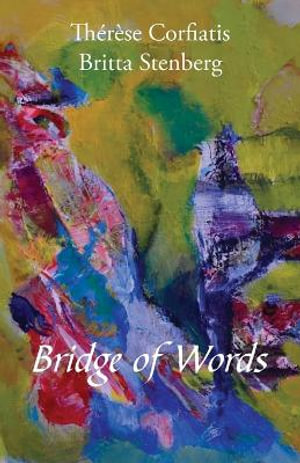
A new poetry collection, Bridge of Words—a collaboration between Thérèse Corfiatis of Ulverstone, and Britta Stenberg of Sweden—will be launched by Fay Forbes at the Red Cross Hall, 49 King Edward Street, Ulverstone, 2-4pm Saturday 8th October, 2022.

Thérèse is a featured guest of this month’s Tasmanian Poetry Festival (Launceston 30th Sept / 2nd Oct), while Britta—if I’ve interpreted google maps correctly—lives in the isolated town of Rentjarn, a community of some 71 souls in Sweden’s north.

I’m reminded of a 2006 writing collaboration between Karen Knight and Scottish poet Delys Rose, imagining the similarities of their experiences with those of Thérèse and Britta. Karen—from her home in Hobart, and Delys, comfortably ensconced in Scotland—were writing a poem a month. ‘Neither of us was particularly keen on formal stipulations and have found that the more open the remit, the better the results,’ wrote Delys at the time. ‘We began very simply with a poem about midsummer/midwinter because it was happening, at the moment we committed ourselves. It’s been a great way to keep up a long distance correspondence, not to mention generating new work.’ 

A key difference is that Karen and Delys had already met in Australia; and some time later, Karen travelled to visit Delys in Scotland.  Britta and Thérèse have never met, though perhaps that will change. In one of the pair’s many online conversations (as reported by the ABC here), Britta suggests that it’s been exciting to get to know Tasmania and Therese. “Bye-bye from Sweden, come and see me some day.”


Two women. Two poets. Two countries. One man. Thérèse Corfiatis lives in Ulverstone, Tasmania; Britta Stenberg lives in Rentjärn, Sweden – two women joined in friendship by Tom Langston, who introduced them to each other long distance, during a trip to Sweden. This collaboration is a tribute to his memory.
 
This evocative collection written over the course of a year, from opposite ends of the earth, holds a fervent hope for readers to discover a moment caught in time.
 
Britta Stenberg is a published writer from Swedish Lapland with a number of novels and poetry to her name. She also writes for the stage. This is Britta’s first publication in Australia.
 
Thérèse Corfiatis lives and writes in Ulverstone on Tasmania’s beautiful north-west coast. She is a cat lover, avid cloud gazer, watcher of oceans and worshipper of the night sky.
 

06 Oct 2022—book launch, Robbie Arnott (Hobart)

Shambles Brewery, 222 Elizabeth Street, Hobart Tas 7000.

Thursday 6th October, starts at 6:00 pm, launched by Senator Peter Whish-Wilson.

Tickets $10 from Fullers Bookshop

In the heat of a long summer Ned hunts rabbits in a river valley, hoping the pelts will earn him enough money to buy a small boat.

His two brothers are away at war, their whereabouts unknown. His father and older sister struggle to hold things together on the family orchard, Limberlost.

Desperate to ignore it all—to avoid the future rushing towards him—Ned dreams of open water.

As his story unfolds over the following decades, we see how Ned’s choices that summer come to shape the course of his life, the fate of his family and the future of the valley, with its seasons of death and rebirth.

The third novel by the award-winning author of Flames and The Rain HeronLimberlost is an extraordinary chronicle of life and land: of carnage and kindness, blood ties and love.

04 Oct 2022—Tamar Valley Writers Festival, Youth Program (Launceston)

TAMAR VALLEY WRITERS FESTIVAL YOUTH PROGRAM✨
 
In the first week of the school holidays, FIVE workshops are spread across Exeter and the Northern Suburbs – with three repeating to make sure that everyone can access the sessions with ease. Sessions are $5 each and can be booked on Eventbrite or at Starting Point Neighbourhood House. There’s First Aid AND Youth Mental Health First Aid at all events, and plans for any anxiety or sensory overload issues. Groups are limited to 15 participants to reduce barriers.

… indiscriminately distributed

‘But Johnny Topo now had other customers and was asking if they wanted the sweet biscuits or the salty ones in exactly the tones he had put those questions to Latika and Gouri. Latika turned away, disappointed that his voice was so indiscriminately distributed. Her discontent returned and she wished again that her tea were coffee.’

Anuradha Roy, ‘Sleeping on Jupiter’ (2015)

Vale Hilary Mantel

British author Hilary Mantel, who won the Booker Prize twice for the first two books of her Wolf Hall trilogy, has died aged 70.

I confess to not being familiar with her work, but her obituary speaks of her capacity for the historical novel—including the Wolf Hall trilogy wherein she writes of the 16th Century during the time of King Henry VIII and Thomas Cromwell. (Hans Holbein the Younger painted the portraits of many characters of English history of this period including both King Henry VIII and Cromwell, hence my interest).

‘The Times’ remarks on her writing….

We hacks, even us literary ones, like to think of ourselves as a hard-bitten bunch, but the news that Hilary Mantel had died aged 70 knocked us back. What a woman, what a writer. Those of us who have read her Wolf Hall trilogy, all 2,000 pages, will feel it
particularly keenly. 

The Wolf Hall trilogy
It feels unlikely that there are many readers out there who haven’t yet been swept up by the bloody brilliance of the Thomas Cromwell trilogy. Across three hefty novels, Mantel conjured up the splendid, tyrannical court of Henry VIII through the shrewd eyes of Thomas Cromwell, the blacksmith’s son from Putney who rose and rose to the King’s right hand. Until Mantel, history remembered Cromwell as a butcher but she made him real — brilliant, humane, ruthless. The trilogy comprises ‘Wolf Hall’ (2009), ‘Bring Up the Bodies’ (2012) and ‘The Mirror & the Light’ (2020).

It’s interesting though, to read—in the comments column accompanying ‘The Times’ article—the varied responses to news of her death. These range from

‘A tragic loss, she was a wonderful writer and not afraid of controversy’, to

‘she failed the basic test of the historical novelist, namely to portray convincingly the interior lives of people who lived a long time ago’, and

‘Patrick O’Brian is a far better master of history’, and

‘Her misrepresentation of St. Thomas More, who died for his beliefs at the hand of the murderous Henry VIII, is a prime example. I wonder how many readers of “Wolf Hall” came away believing More actually was the corrupt villain she created.’

Food for thought…. (Have ordered the first book of the trilogy through the library).

The ABC’s ‘My Garden Path’—Rob Blakers

A new episode of the ABC’s ‘Gardening Australia’ appeared last week, featuring Tasmanian photographer Rob Blakers—

My Garden Path—We head down the garden path with Rob Blakers, a photographer whose love of natural places has inspired the garden he cultivates for his local community.’

Blakers is renowned in Tasmania for his iconic wilderness photography. I recall witnessing him with his camera, many years ago, at a public meeting in Hobart which debated forestry and environmental issues, where various industry and conservation representatives argued their views. When at one stage a particular industry representative addressed the audience, Blakers appeared demonstrably upset at the words he was subjected to listen to.

I picked him up in my taxi once, years later. He’d been filming near Bonorong Wildlife Sanctuary, north of Hobart, and was heading back into the city some thirty kilometres away—a good fare, time enough to talk. I mentioned my time working in the forest industry, how I recalled noticing him with his camera that evening of the forestry / environment debate. He probably figured me for a fence sitter—and why not?—but continued comfortably chatting.

Blakers is a skilled photographer, particularly of the Tasmanian environment; this particular ‘Gardening Australia’ segment reveals that environmental photography isn’t a singular preoccupation but merely one strand of a many-storeyed way of life. ‘Activism is seeing what we’re not doing right, and saying stop—and in advocating, pushing towards, better directions,’ he says. ‘Growing one’s own food engages you with the natural world.’ The garden setup allows neighbours or friends or anyone who’s heard about it, to come along with a box—‘or I can supply a box!’—and pick their own herbs and veggies.’

‘From my side I’m just trying to maintain the diversity in the garden, maintain the level of pickable veggies, so that any time people come they’ll have a seasonal selection. People pay thirty bucks for a box. Essentially it’s just a break-even, there’s cost involved in a garden like this … there’s water, there’s seeds, there’s compost soil, there’s fencing, repairs … there’s always ongoing costs, so if we can break even on that—which we have done—it’s just a win-win all round.’ 

…………………………..

Snuggle Up with Spineless: ‘Ecliptical’—featuring Hazel Smith

A Spineless Wonders Youtube presentention of—readings by Hazel Smith, a presentation by Roger Dean, a conversation between Hazel and Anne Brewster, and  a talk by Joy Wallace. The event took place in June 2022 and was placed online on 25th August and is available for viewing here. It’s 1 hr 28 min in length.


ANNE BREWSTER

I’ve been reading Ecliptical and enjoying it a great deal, and I noticed at the beginning of the book you comment several times that poetry is a kind of archaic literary form, and you question somewhat whimsically about whether people actually read poetry or not. And if this is so, why do you write poetry, and what does it offer for you?

HAZEL SMITH

I think what attracts me a great deal about poetry is the enigmatic and chameleon qualities of language. The fact that a word can mean so many different things—it’s very exciting to explore and exploit that. I also love the interweaving of sound and sense that you get in poetry. But, there is a lot more to it than that, I think that there’s something much more fundamental—which is that I feel that poetry is incredibly flexible, mutable. There is so much that you can do with the form—you can stretch it in so many different ways. This is something that I love to do. I love to hybridize poetry with prose, with writing for performance, with writing for the screen. I love to bring poetry together with visual images, and with music.
It just gives me enormous scope to do what I want. And it really suits me because I like to have a very varied style of writing. I like to write in a very heterogeneous way, rather than a homogenous way. poetry really gives me a space to do that.

AB

And what about the title of the book, ‘Ecliptical’…. this evokes ideas of eclipse and ellipsis. And you seem quite interested in the idea—the act of—not seeing everything. For example, when you talk about personhood—which you do quite a lot—you’re very interested in these concepts of incompleteness and disruption.

HS

Yes, I think we never really do see the whole of everything, we never really have the full story about anything. People often house secrets, or they withhold information—they withhold information in families and sometimes it’s for generations. So we’re not in control of all the facts about something, we’re always wondering a little bit. And I like to present my material like that, I like to present my material in a very enigmatic way. I don’t want to fill in all the details. And I want to raise questions rather than answering them.


Ecliptical addresses contemporary psychological, ethical and philosophical issues including family secrets and tensions, private and public creativity, the enigma of time, surveillance, fake news, environmental damage and homelessness.

Ecliptical includes prose poetry and short prose; texts that are synaesthetic, sonic or linguistic explorations, surreal excursions and ‘bullet point’ adventures in which each line unveils a new observation. Other pieces employ non-literary forms or include documentary or remixed elements. Ecliptical also flirts with the posthuman in some collaborative computer-assisted poems.


Anuradha Roy interview, ‘The Rumpus’ (Aug 2022)


Roy’s fifth novel, ‘The Earthspinner’, was published in 2021. She spoke with Janet Rodriguez for an interview published in August 2022 in The Rumpus.

Three questions & responses from the interview—

(on writing poetry)

Rumpus: Your words are so elegant, I am sure you write poetry . . .

Roy: I don’t write poetry, actually! I have never been able to, but I have always read poetry.

(on identity and loss)

Rumpus: Regardless of how you categorize the book, The Earthspinner is a deeply gorgeous work of fiction. I found it to be filled, like your other books, with themes of identity and loss. Why do you think these show up in your writing?

Roy: A poem I used to know almost line for line was Elizabeth Bishop’s witty and wise “One Art” where she goes from the loss of inconsequential objects to the great, irreparable loss, of someone she loves. The fear of loss, the inevitability of loss—it’s a universal theme. As for identity, this has become so politically charged for most of us in the world these last few years that it’s difficult to escape addressing it.

(on relationships across religious divides)

Rumpus: Sara remembers the time of this violent upheaval as the same time she learns how to spin pottery. In her small village, a Hindu man named Elango, the local artisan potter, agrees to mentor her. Elango is in love with a Muslim woman, Zohra, which is another politically charged issue. There’s a Romeo and Juliet quality in Elango and Zohra, isn’t there? They almost don’t understand the danger of their union, do they?

Roy: Everyone who lives in India is aware of the extreme danger of loving across the religious divide, and yet people do it. That’s one thing that hasn’t changed since Shakespearean times. Elango knows the dangers in relation to Zohra but carries on anyway.


Which is simply to say, IMHO, Anuradha Roy is well worth a read. Below, from ‘Sleeping on Jupiter’:

He had idled near the temple for only a little while when Hari, another temple guide, tapped his arm saying, “Bhai, Badal. I need to leave – something urgent – and I’ve two people waiting for me. You take them to the temple, give them a quick round.”

Luck appeared to be on his side. It had to do with his early morning glimpse of shirtless Raghu, he was certain. Or perhaps it was those ten rupees and prayers at the old woman’s shrine. He remained carefully unsmiling and continued chewing his samosa. Between bites he said, “I’ve no time, got another group soon. And in the afternoon I need to get home.” He had no work till evening, but Hari did not need to know that. He looked towards the temple gates. he must not let Hari’s clients escape. He had to slow it down to extract as much as he could from Hari, but not too much.
Eureka Street—Vol 32 No 16 (2022)

Eureka Street, published by Jesuit Publications, was founded in 1991—a print magazine for fifteen years that went online from 2006. It was edited by Morag Fraser from 1991 to 2003, and is currently edited by David Halliday.

In an interview in 1995, Richard Flanagan voiced the opinion that  “Eureka Street has been a huge success story because it uses short thoughtful articles by interesting people on good subjects, and has a bloody fine editor. And Australian Book Review actually debates literary issues in a way that’s readable and intelligible.”

Eureka Street has uploaded in excess of a hundred youtube interviews with individuals including Morag Fraser, Fr. Frank Brennan, Geraldine Doogue, Kristina Keneally, Stephanie Dowrick, Michael Kirby, Robert Adamson and Hugh Mackay. David Halliday’s December 2021 conversation with Morag Fraser delves into the reasons behind, and problems encountered in, setting up the journal in the first place.

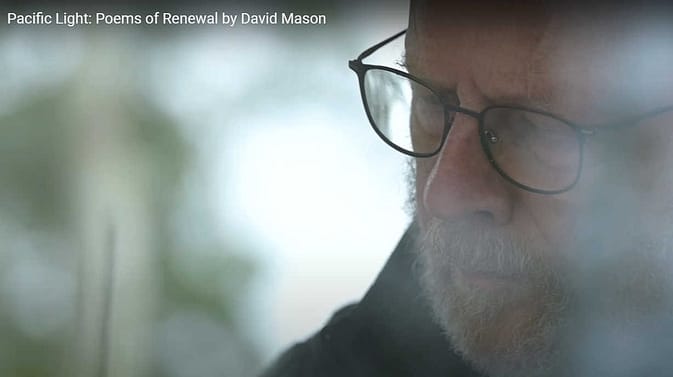
Anna Cadden’s film—’Pacific Light: Poems of Renewal by David Mason’

‘Pacific Light: Poems of Renewal by David Mason’, a film by Anna Cadden with underwater photography by Cally Conan-Davies, is a meditation on life, work, poetry and the soul. Poems are from David’s book Pacific Light (Red Hen Press, 2022), available through https://bookshop.org/books/pacific-li…

David Mason was born in Washington State, forty-odd degrees north latitude, and now lives on the Australian island of Tasmania, forty-odd degrees south latitude. That Pacific crossing is the work of a lifetime of devotion and change. The rich new poems of Pacific Light explore the implications of the light as well as peace and its opposing forces. What does it mean to be an immigrant and face the ultimate borders of our lives? How can we say the word home and mean it? These questions have obsessed Mason in his major narrative works, The Country I Remember and Ludlow, as well as his lyric and dramatic writing. Pacific Light is a culmination and a deepening of that work, a book of transformations, history and love, endurance and unfathomable beauty, by a poet “at the height of his powers.”

The film—23 minutes in length—is a very thoughtful, professionally-designed production, & I particularly enjoyed listening to David’s reminiscences of how he’s configured ways to live a life…. 

[DAVID MASON] ‘I don’t really have ideas so much as I have sensations. Keats said, “Oh for a life of sensations rather than of thoughts”, and I suppose to a very great degree that’s the way that I live as a poet. And what I try to do is define the words that are going to match those sensations and the rhythms I’m feeling, the sounds….’

[INTERVIEWER] ‘So—what is to you, the work of poetry? What is its purpose, in a way—if work gives us purpose, what is the job that poetry does in this world?’

[MASON]: ‘There are several different things. One is what it does for the poet’s life. I think it’s DH Lawrence who said, “I write so that I will not lose my life”. So one feels as if one is trying to live more fully, or relive more fully—you want more life. You want to live more—by observing more, writing more, seeing more, and all that….’

I don’t write just for myself. I write to speak to other people, and to speak across time to people I’ve never met about what it’s like to be alive in the world. I want to make memorable speech out of this, maybe even memorable song out of this. Which means, that to some extent, we write to face our mortality. Or we are always facing our mortality when we write. We’re always thinking about what it means to speak through that death and across that death, into another time, and to other people.’


David will be appearing as a guest of the Tasmanian Poetry Festival in Launceston at the end of the month.


Tasmanian poet Tim Slade, reading ‘Thylacine’

Tim Slade’s been writing poetry for a decade, his work has appeared in publications as diverse as The Weekend Australian, The Koori Mail, Australian Poetry Anthology, Growing Up Disabled In Australia and Cordite Poetry Review. Originally from Hobart, he settled in the tiny Tasmanian town of Pioneer a decade ago where he’s drawn inspiration for much of his poetry. 

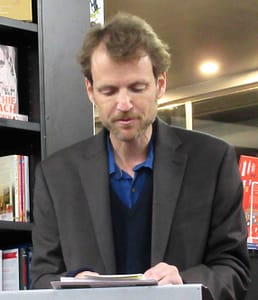
Tim’s poetry collection The Walnut Tree, was published in April 2021 by Daniela Brozek Cordier’s imprint Bright South Publishing, and launched by Pete Hay at Petrarch’s Bookshop, Launceston.

Tim Slade at the launch of The Walnut Tree

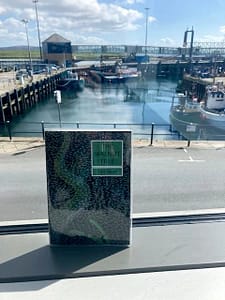
Coincidentally, both Slade and Hay—in their most recent collections—praised the work of a Scottish poet who lived out his life on a far flung island on the opposite side of the globe, Orcadian George Mackay Brown.  Honouring Brown, Tim mailed a copy of his book to the local library in Stromness, Orkney Islands, where the book is now available to borrow.   ‘On the harbour in Stromness, the view from this library is perhaps the most picturesque in the world,’ Tim writes.

Tim recently produced a Youtube video of ‘Thylacine’, one of the poems featured in his collection. As well, Warwick Hadfield read the poem on RN’s Breakfast programme in July this year. ‘Thylacine’ was previously published in Communion 15.


Otoliths # 66

When introducing issue sixty-six of online lit journal ‘Otoliths’ some weeks back, Mark Young noted that following the next issue, ‘there will be another four issues of Otoliths & then the journal will close with issue seventy, the southern winter 2023 issue.’ Which is a blow for writers & readers…. Founded in 2006, ‘Otoliths’ experiments wildly, offering opportunity for exciting writing & artwork, open—as the journal defines itself in ‘Duotrope’—’to all/most styles and topics, including experimental and literary.’

The current issue, no 66, is available online at otoliths.

Uluru Statement from the Heart: Sydney Peace Prize winner 2021—2022

On 3rd August 2022, the Australia Institute posted both a video, and a transcript, of a conversation between Pat Anderson, Professor Megan Davis and Archie Law about the Uluru Statement from the Heart and its three objectives: a Voice to Parliament, Treaty, and Truth.

Beginning of the conversation, host Ebony Bennett  asked about the process that led to the Uluru Statement from the Heart.

In response, Pat Anderson noted that ‘we’ve been doing this since before 1840.’

‘Every generation of us has had a go at getting us to be acknowledged and accepted and
respected as the first peoples of this beautiful continent of ours. We’ve been here. The latest figure, our bridge over 100,000 years. It’s commonly said to be 65,000, but of course, that’s what the scientists say. But for us, we believe we have always been. We didn’t come from anywhere else. This is definitely, absolutely our place over millennia….’

For access to the conversation, visit the Australia Institute.