Review, Jane Williams’ ‘Points of Recognition’

Alison Clifton reviews Points of Recognition, one of two of Jane’s collections to appear in 2021 (the other: Between Breaths, Silver Bow Publishing, Canada).

‘Jane Williams’ Points of Recognition is inherently human poetry. Her concerns are wide-ranging: from empathy to idiosyncrasy, the mundane to the marvellous, compassion to passion, diffidence and restraint to ecstasy and excess. Always she is wondering, inquiring. What does it mean to be human? And what does it mean to be inhumane, even inhuman, in our treatment of others?’

(Read more: Alison Clifton, StylusLit)

War Poetry in Ukraine: Serhiy Zhadan and Lyuba Yakimchuk

An essay by Maria G. Rewakowicz, published in ‘Los Angeles Review of Books’, 22 Feb 2022

Ever since Russia annexed Crimea in 2014 and soon after stirred the conflict in the southeast region of Donbas, the theme of war has figured prominently in Ukrainian prose and poetry. The ongoing war has inspired two poetic anthologies in English translation, Letters from Ukraine: Poetry Anthology (2016) and Words for War: New Poems from Ukraine (2017), as well as, more recently, two volumes in the Contemporary Ukrainian Poetry Series published by Lost Horse Press: Serhiy Zhadan’s A New Orthography (2020) and Lyuba Yakimchuk’s Apricots of Donbas (2021). Both Zhadan and Yakimchuk come from the conflict-ridden Donbas and, even though they no longer live there, have emerged as the region’s trusted spokespersons. Yakimchuk, born in Pervomaisk of the Luhansk Oblast, now occupied by the self-proclaimed Luhansk People’s Republic, resides in Kyiv, and Zhadan, born in Starobilsk, also of the Luhansk Oblast, now under Ukrainian control, lives in Kharkiv.

Read more at ‘Los Angeles Review of Books

Launch — Les Wicks’ poetry collection ‘Time Taken — New & Selected’

Time Taken — New & Selected’, (Puncher & Wattman) is Les Wicks’ fifteenth poetry collection.

2022 will mark the 50th anniversary of Wicks’ first poem publication. His imprint Meuse Press will turn 45. He has been presenting workshops around Australia across 35 years.

Time Taken is a New & Selected collection revisiting his best poems across this time span, the culmination of a lifetime’s work.

Time Taken will be launched by Martin Langford at the Friend in Hand Hotel, 58 Cowper St, Glebe, Sydney, upstairs bar, on Sunday 13th March at 2.30pm

Launceston — ‘A Passion for Poetry’

Monday February 28 at 4pm

City Park Radio, 96.5 FM or 103.7FM or live streaming on the Internet.

1st episode of ‘A Passion for Poetry’, presented by Nancy Corbett.

The first program features Dylan Thomas and Leonard Cohen reading their own poems (thanks You Tube) and an interview with Colin Berry, president of the Tasmanian Poetry Festival Committee and multiple winner of the coveted Launceston Poetry Cup.

Please tune in.

Geoff Goodfellow at Adelaide Festival, 7th March 2022

Geoff Goodfellow returns to Writers’ Week with a reading of his new verse novella, ‘Blight Street, (Walleah Press), featuring Geoff and performers Roslyn Oades and Nic Darrigo.

(From the festival’s notes):
“Set in the northern suburbs of Adelaide, ‘Blight Street’ is written in the language and idiom of the culture it portrays. Harrowing but tender, ‘Blight Street’ draws on the vital themes that characterise Geoff’s writing: the working class struggle, the tragedy of addiction and the celebration of love.”

The reading (a free event, no need to book) is timed for 10.45 am, Monday 7th March, Plane Tree Stage, Pioneer Women’s Memorial Garden. It will followed by a short interview with Geoff, chaired by Rick Sarre.

Forwarded message from Seasonal Poets (Hobart)

Subject: Seasonal Poets – February Reading Cancelled

Date: 15 February 2022 at 9:10:08 am AEDT

Dear Friends of Seasonal Poets,

Next Monday, 21st of February, should have been our first reading for 2022 at Hadley’s Hotel. Given the current restrictions for masks and social distancing, we have reluctantly decided to cancel the reading. We are looking forward to our May Autumn reading and hope you are as well.

We would like to leave you with the poem ‘Window’ by Tim Thorne who died in September.

Window
What is the mind that would invent the lock?
What are the pathways of the brain
that must be followed with no ball of string
to arrive at a device
which excludes? Why would you start?

If this slab of the earth
was where you had always been,
there would be no entry point,
no threshold of distrust, only the base
ab origine home and whole.

Cook and Banks cased the place, reported back.
(This mob didn’t do disorganised crime.)
‘It is a place of curios if it is, at all,
a place.’ The Enlightenment understood
locus in its richest meaning.

Meanwhile need, greed and curiosity
(those drivers of all crime)
were building against a coastline
that bound like straps. Something
(by Hegel!) had to give. Someone

had to go. The blue chasm had to
be bridged, the stormy lanes traversed,
the metaphors of danger maelstrom-mixed.
Easier than wriggling through a window
as it turned out, the landing was made.

ABR, States of Poetry 2016 – TAS – Tim Thorne
Thank you all for supporting poetry and Seasonal Poets.

Regards,
Gina Mercer, Anne Collins and Irene McGuire, co-curators
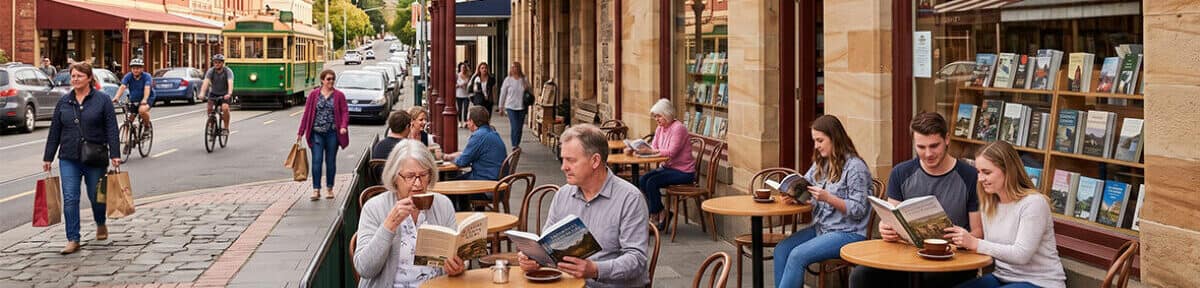
Tasmanian Poetry Festival, September 2022

Noting from the festival’s facebook page … the 2022 festival is now planned for September in several venues over two weekends, with some events on the weekend of the 17th and 18th and the main Festival on the following weekend, from Friday the 23rd to the 25th of September.

The festival also hopes to have some other poetry events in the lead up to the Festival, similar to last year.

Poets (including some musicians) will include people from different parts of Tasmania as well as some from the Mainland and further afield (COVD permitting).

At this point, guest poets include: Therese Corfiatis, Anne Kellas, Dave Mason, Thomas Bailey, Ren Alessandra, Daniel J. Townsend and Fleassy Malay. There will also be open mic opportunities.

The Festival was originally planned for March, but has been moved to September following the influx of COVID infections post border opening.

‘Otoliths’ issue sixty-four, southern summer 2022

A southern summer issue of otoliths’ (issue sixty-four), is online featuring the work of 120—130 writers and artists including Tony Beyer, Les Wicks, Pete Spence, John M. Bennett, Eileen R. Tabios, Sheila E. Murphy, Cameron Morse, Alyssa Gillespie and many more.

Nothing by editor Mark Young in the issue, but you can savour some recent work in the latest issue of Rochford Street Review.

A time of goodbyes

(From Anne Layton-Bennett’s blog)

But the analogy holds given that during the closing weeks of 2021 Tasmania – and particularly Launceston – lost three of its finest people in Tim, Annie and Peter. They were all leaders in their field, and were truly lovely, caring and generous individuals. I feel privileged to have known all of them, albeit not necessarily well, or for lots of years.

So in memory of all these impressive people: renowned poet, writer and environmentalist Tim; dancer and cultural icon Annie; and Peter: writer, horticulturist, gardener extraordinaire, and champion of the environment, this tribute is for you as well as Stuart and Ruth.

Read the post in full at Anne Layton-Bennett.


(Also read Anne’s reflections on her continuing love affair with Tasmania, written at the height of the pulp mill controversy in Tasmania and published in Famous Reporter in 2012).

We all have roots, and after twenty-two years mine are now firmly established in Tasmania. After all, I’ve spent – almost – more of my life here than anywhere else. And despite that initial reluctance to move, my roots – like mature tree roots – are now deep and well dug-in.

As is my love affair with Tasmania. Which is why, like so many others, I’m hopeful those firm handshakes across the forestry roundtable will ultimately succeed in uniting Tasmanians by permanently closing the emotional chasm.

But my affinity is also with the trees, and I’m no longer a wavering, transplanted sapling. Because I live in the Tamar Valley, with the daily uncertainty of Gunns proposed pulp mill a constant and malignant threat, rather like those ancient forest trees I’ve grown steadily stronger, more steadfast and resolute. Determined both to ensure this tentative, fragile peace will last, and that a pulp mill will never threaten the vibrant beauty of this valley.

Read the essay in full at Planted in Tasmania