Category: Hobart
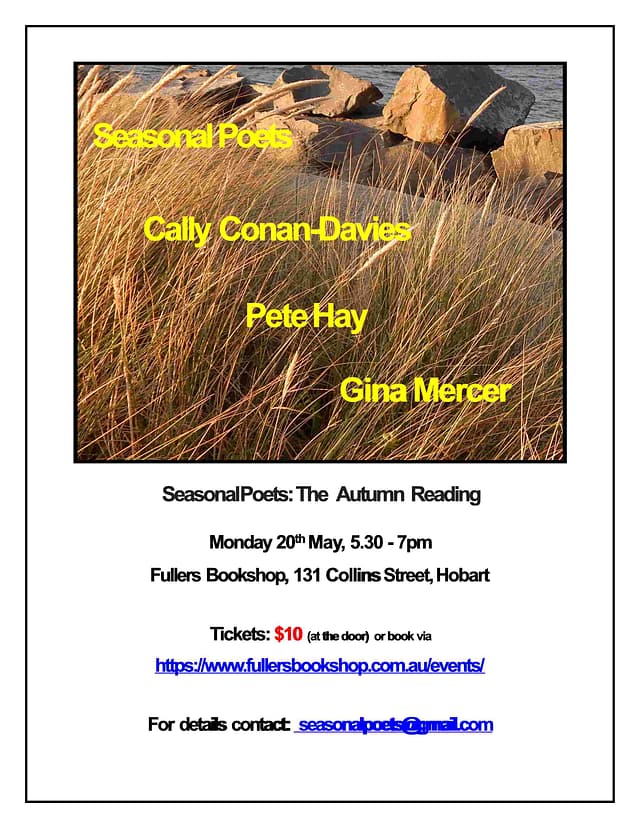
Seasonal Poets – The Summer Reading | Monday February 26th (Hobart)
Seasonal Poets returns to Hobart on Monday 26th February for the Summer Reading with poets Pamela Leach, Irene McGuire and Peter Jerrim.
Seasonal Poets’ new venue is Fullers Bookshop 131 Collins Street and tickets are $10.00 at the door or via the Fullers website: www.fullersbookshop.com.au./events
The $10.00 which no longer needs to be cash includes a glass of wine or non-alcoholic beverage.
Please note the new start time of 5:30.
For further details contact: seasonalpoets@gmail.com.
(Forwarded by Anne Collins, Gina Mercer, Irene McGuire
co-curators: Seasonal Poets)
Simon Grove’s ‘Seasons in the South’ (launched Hobart, 23rd Nov 2023)
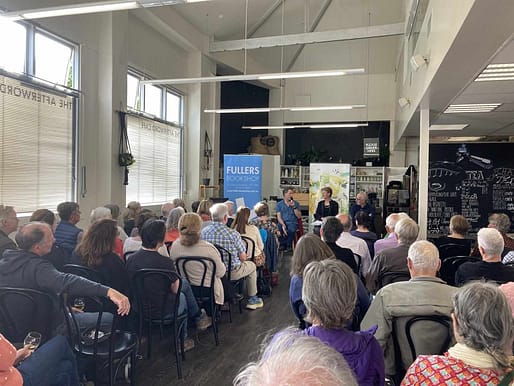
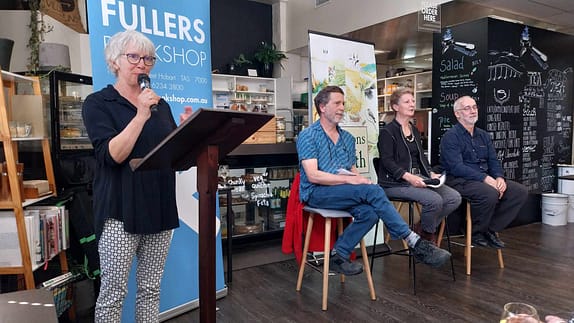
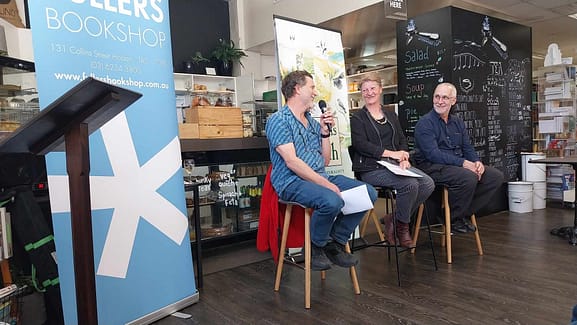
Author Simon Grove, illustrator Keith Davis and Dr Sally Bryant AM joined in conversation to mark the launch of Simon’s new book ‘Seasons in the South’, at Fullers Bookshop in Hobart on 23rd November 2023.
Simon Grove is Senior Curator of Invertebrate Zoology at the Tasmanian Museum and Art Gallery in Hobart. He hails from England. Following doctoral research in the Daintree rainforests of tropical North Queensland, he moved to Tasmania with his young family in 2001, to work as a Conservation Biologist. A lifelong naturalist, he is author of The Seashells of Tasmania: A Comprehensive Guide, and has also published widely on Tasmanian natural history and ecology. Simon regularly chats about Tasmanian invertebrates on local radio, and in 2019 was awarded the Australian Natural History Medallion—the ‘Nobel Prize for Australian naturalists’.
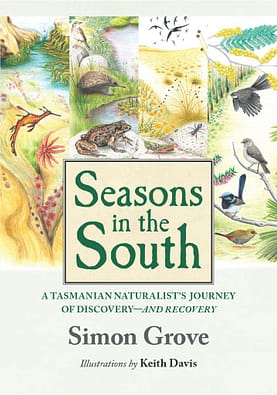
For book details, visit Seasons in the South. As well, visit Simon Grove.
Hobart launch—Jan Colville’s ‘a small universe’
Jan is releasing a new chapbook of her poetry, a small universe! (published by Bright South).
Where: Hobart Bookshop
When: 24th of November, at 5.30pm
Please rsvp: rsvpbrightsouth@gmail.com or call (03) 6223 1803

26th Oct: Robbie Arnott & David Whish-Wilson in conversation—Hobart
Robbie Arnott (author of ‘Limberlost’) and David Whish-Wilson (‘The Sawdust House’) in conversation about their new books.
Hobart Bookshop, 5:30 pm Wednesday 26th October
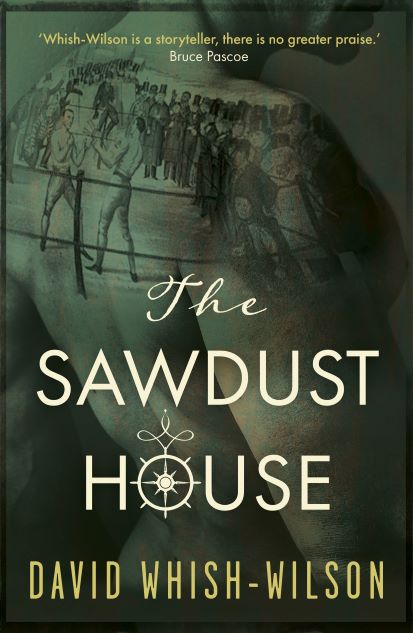
This is a double Author Event with David Whish-Wilson and Robbie Arnott talking to each other about their newly released books The Sawdust House and Limberlost.
The Sawdust House is a historical fiction set in San Francisco, 1856. Based on the true story of Australia’s first major sporting export, Irish-born James ‘Yankee’ Sullivan, a ‘notorious man’ formed in the crucible of the Australian convict system. Incarcerated by the Committee of Vigilance and watching his fellow prisoners being taken away to be hanged the convict tells a story of triumph and tragedy: of his daring escape from penal servitude in Australia; how he became America’s most celebrated boxer; and how he met the true love of his life.
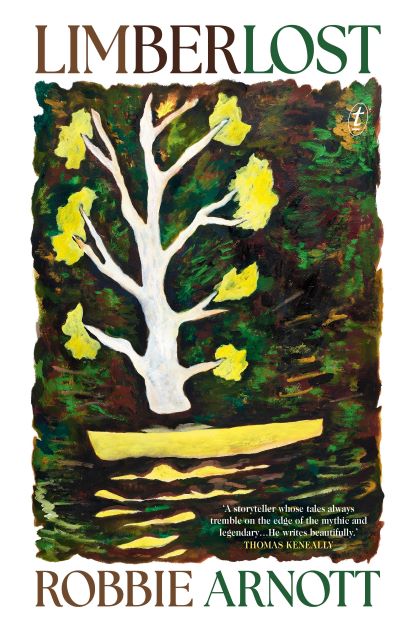
In Tasmania in the heat of a long summer, Ned hunts rabbits in a river valley, hoping the pelts will earn him enough money to buy a small boat. His two brothers are away at war, their whereabouts unknown. His father and older sister struggle to hold things together on the family orchard, Limberlost. Desperate to ignore it all, Ned dreams of open water. Ned’s choices that summer come to shape the course of his life, the fate of his family and the future of the valley, with its seasons of death and rebirth.
David Whish-Wilson is the author of eight novels and three creative non-fiction books. He has been shortlisted for the Ned Kelly Award on multiple occasions and Sawdust House was recently long listed for the 2022 ARA Historical Fiction Prize.
Limberlost is Robbie Arnott’s third novel after his acclaimed debut, Flames (2018), and Miles Franklin shortlisted The Rain Heron (2020). Robbie Lives in Hobart.
About the event:
This is a ticketed event ($5.00) being held at The Hobart Bookshop on Wednesday the 26th October, where tickets include a complimentary glass of wine.
Launch: David Webby’s children’s book (March)
David Webby’s ‘The Misadventures of Harry and Larry: The Chosen Ones’
Launch — Hobart Bookshop (youtube: 3mins 09 secs)
Two bush Mice, Harry and Larry, from the Bunya Mountains become trapped in a 4WD owned by two humans, known as Charlie and Izzy Humbledink, and are thrust into an exciting adventure all the way up the east coast of Australia. On the way, Wilmar, Queen Mother of all Humpback Whales in the vast ocean, reveals to them the Prophecy that they are the Chosen Ones that will save the world.
What does this mean?
How can two simple bush Mice change the way humans think and act?
Find out as Harry and Larry travel with their human friends to explore the lush landscape of the tropical north of Australia; they also survive some often-scary encounters with local inhabitants, and they call on the skills gained in Mouse Scouts to get them out of trouble. This is a pair of Mice who find that there is more to life than they knew, and destiny was not an easy way to discover their worth…come on an adventure and share the fun and learning with Harry and Larry!
AUTHOR BIO
David was born in New Zealand, but during a working holiday in Australia in 1984, he decided Australia was the place for him, and has lived here ever since. In early 2017, he and his wife moved to Tasmania, and settled in the beautiful Huon Valley with their two labradoodles. David is a podiatrist by trade, and enjoys bushwalking, photography, gardening, and bee keeping. His inspiration to write comes from his love for trees and wildlife, and his memories of childhood exploration. He includes a richness of history and culture in his writing that has come from extensive travels, both within Australia and overseas.
ABOUT THE ILLUSTRATOR: M. K. PERRING
After traveling all over the world before moving and living in Australia I’ve always had a passion for the creative arts, going straight into film and television for secondary education. After improving my skills for a few years independently, I came across University to advance my skills in filmmaking and Animation. I started working on a personal project on YouTube accumulating over 2.5 million views collectively with a fan base dedicated to my storytelling and character design. Having finished a Bachelor of Animation, I am constantly exposed to creative environments and learning more programs and methods while working in teams to be ready for industry.
Forwarded message from Seasonal Poets (Hobart)
Subject: Seasonal Poets – February Reading Cancelled
Date: 15 February 2022 at 9:10:08 am AEDT
Dear Friends of Seasonal Poets,
Next Monday, 21st of February, should have been our first reading for 2022 at Hadley’s Hotel. Given the current restrictions for masks and social distancing, we have reluctantly decided to cancel the reading. We are looking forward to our May Autumn reading and hope you are as well.
We would like to leave you with the poem ‘Window’ by Tim Thorne who died in September.
Window
What is the mind that would invent the lock?
What are the pathways of the brain
that must be followed with no ball of string
to arrive at a device
which excludes? Why would you start?
If this slab of the earth
was where you had always been,
there would be no entry point,
no threshold of distrust, only the base
ab origine home and whole.
Cook and Banks cased the place, reported back.
(This mob didn’t do disorganised crime.)
‘It is a place of curios if it is, at all,
a place.’ The Enlightenment understood
locus in its richest meaning.
Meanwhile need, greed and curiosity
(those drivers of all crime)
were building against a coastline
that bound like straps. Something
(by Hegel!) had to give. Someone
had to go. The blue chasm had to
be bridged, the stormy lanes traversed,
the metaphors of danger maelstrom-mixed.
Easier than wriggling through a window
as it turned out, the landing was made.
ABR, States of Poetry 2016 – TAS – Tim Thorne
Thank you all for supporting poetry and Seasonal Poets.
Regards,
Gina Mercer, Anne Collins and Irene McGuire, co-curators
Gwen Harwood Prize 2005
- A small crowd has gathered at Hobart Bookshop for the announcement of the winner of the Gwen Harwood Prize. Island’s editor David Owen welcomes guests, thanks judges Adrienne Eberhard and Kevin Gillam, “two individuals far apart – Kevin in Perth, Western Australia, Adrienne here in Hobart – a distance that could of course cause difficulties, but then again … maybe it’s a positive!”
David introduces Sarah Day, who describes the background to the Gwen Harwood Poetry Prize. Gwen was born in Queensland in 1920, raised and educated in Brisbane and in 1945 moved to Tasmania with her husband William – a move she did not at first appreciate. But her life here became immensely rewarding and productive, not least being mother to four children. And over a thirty-year period she published seven highly acclaimed volumes of poetry including The Lion’s Bride, In Plato’s Cave, Bone Scan and two Selected Poems. “Gwen Harwood is justly considered a major twentieth-century English language poet and it’s therefore all the more rewarding to be able to announce this year’s winners of this prestigious prize established in her name”.
Sarah announces the three Minor Prizes: first runner up Carolyn Fisher for ‘A Life of Birds’. “Carolyn lives in Ulverstone. It’s always very pleasing to have a Tasmanian poet recognised in this prestigious national award. She is here this evening and will shortly red ‘A Life of Birds’.”
“The second runner up is Ray Liversidge for ‘The Divorce Papers’. Ray Liversidge is a Melbourne poet whose first book of poetry, Obeying the Call, was published by Ginninderra Press in 2003. His verse novel The Barrier Range will be published next year by Flat Chat Press.”
“The third runner up is Lucy Holt for ‘The Love-doggedness Sonnets – Part I’. Lucy is a twenty-three year old poet who lives in Brunswick, Victoria. Her collection Stories of Bird was published earlier this year by the Poets Union.”
“I have much pleasure,” Sarah continues, “in announcing that the winner of the Gwen Harwood Poetry Prize for 2005 is Mark Tredinnick for ‘The Child & Time’. Mark is an essayist, poet, critic and writing teacher. He lives both in Katoomba and in Sydney, NSW. His books include The Land’s Wild Music, published this year, and the forthcoming landscape memoir The Blue Plateau. He is also the editor of A Place on Earth: An Anthology of Nature Writing from Australia and North America. Mark teaches creative nonfiction, nature writing, ecology and literature, business writing, composition and grammar in the University of Sydney’s continuing education program and elsewhere. His work will be familiar to readers of Island: his essay ‘Days of Christmas’ won the 2005 Wildcare Tasmania Nature Writing Prize, and he will in fact soon be in residence at Lake St Clair, as part of that prize winner’s package.”
“As we did last year, with the winner not from Tasmania, the winning poem is read out on the winner’s behalf. This evening John Hale, well known stage actor and good friend of Island magazine, will read ‘The Child & Time’.”
John Hale makes his way to the front of the room – “I’m an actor & I need a stage!” – noting how pleased he is to be faced with a small crowd this evening. “I’ve read Mark’s poem, and think it best felt in a room where there’s a sense of intimacy and perhaps a shared bottle of wine. It’s the kind of poem suggestive of whispers in a lover’s ear, a poem of intimacy and of great beauty.”
David Owen rounds off the evening with ‘Thanks John. I only wish we’d had a recorder here to tape your rendition of Mark’s poem’.
North to Garradunga: An afternoon at the Republic
Various things draw me to Hobart’s Republic Hotel this afternoon, not least the fact that Pete Hay is reading today. Compere Liz Winfield opens proceedings with work by Barney Roberts and Magenta Bliss (Jenny Boult), a recital that both renews our appreciation of their respective talents and accentuates our loss. Some of us are making the trip to Launceston for Bliss’ funeral next Thursday. Continuing on a happier note, Liz announces the results of this year’s Bruce Dawe Poetry Prize. ‘Last year as you’ll remember, it was won by Louise Oxley, this year it’s the turn of Jane Williams.’ Both women are among the audience for the afternoon’s readings.
First to the microphone is visitor Shaun Levin – originally South African but now a resident of London – and Hobart City Council’s International Writer in residency. ‘Much of my work is about love, and sex,’ he says, ‘which I’m missing cos I haven’t been home for three weeks…’
‘But you’re open to offers, right?’ calls some wit from the audience.
Levin grins without missing a beat. He’s the editor of Chroma, a queer literary journal publishing work from writers and visual artists based in the UK. This afternoon he reads from his recent novella, Seven Sweet Things – his writing is funny, droll, in-your-face.
Next to read is local writer Kathryn Lomer. She’d missed the last reading at the Republic, she explained, having been hospitalised for a few days with a life-threatening illness. Kathryn mentioned the name of the illness, ‘something to do with the colon’ she said, adding that investigation had led her to realise the poet A.D Hope had suffered from the same affliction. ‘We both underwent life-saving operations … saved his life, saved mine. Hope went on to write about his. “I’ve always been partial to a colon; but a semi-colon is better than a full stop.”
Lomer reads from old and new work, including ‘Heart to heart’ published in the most recent issue of Island (no. 102), and displaying her effortless capacity to write of the trials of the heart – ‘… parts of our hearts already comatose/ from long-ago mishaps in love’. As she offers words to the microphone I wonder again at the sheer quality of her first collection An Extraction of Arrows (UQP), the winner of the Anne Elder Award and short-listed for the 2004 Adelaide Writers’ Festival. (How difficult is that, faced with competition from every decent poetry collection published in the country over the preceding two years?)
The experience of motherhood is never far from Kathryn’s consciousness, it comes out in her writing, in her conversation. ‘I think we could learn from a survey of four-year-olds on their recollections of the experience of birth,’ she says in response to something raised by Shaun Levin, the previous reader. “I asked my son what he remembered about his birth. His immediate response was, “It was too dark, then I slid down a slide and Mummy bit me” ’. (Do our children ever forgive their writer parents for any of this, Kathryn wonders?).
Another poem is dedicated to Anne Morgan, ‘who put me on to kayaking’. It’s a poem from what she hopes will be her second collection ‘by a publisher who’s intimated they may be able to publish it … in 2007’. It’s funny, Lomer adds, ‘people always tell me this is a great poem about relationships but it’s really just a poem about kayaking’.
I can’t help thinking how good an experience it’d be to publish Lomer myself, if only I had the resources. The things that matter most in the relationship between a press and the work it publishes – the things that make a book effortless and natural to promote – is always apparent to me when listening to Kathryn read her work, it’s in her earthiness, in the lack of self-consciousness about her writing, in her lively imagination.
Pete Hay introduces a sombre note to proceedings. Remarking on the passing of Magenta Bliss (Jenny Boult) this week, he mentioned how he’d had the privilege of delivering the eulogy at the funeral of Barney Roberts a little time ago. “Scott, Roberts, Bliss in the past three months … we’re losing too many fine poets, too fast’, he laments.
Hay reads from his recent collection Silently on the Tide, the poetry spilling out from this much loved man of letters. Of the thylacine, he reads:
- The tiger is an absence, and here’s a marvel.
- In the common soul wells a mourning,
- a sense of an essence lost from the land
- and we have made it so.
- We have rendered the land incomplete
- and it is not to be redeemed.
- It is the very land that grieves, perhaps,
- gathering us up.
Hay – generous as ever – makes mention of the presence of Cameron Hindrum in the audience. Cameron, the Director of the annual Tasmanian Poetry Festival, is in Hobart to present Jenny Barnard with the Poetry Cup she’d won at the festival. ‘Cameron’s an extremely good link-man’, Hay says, adding that like a good many other people ‘I got my ass kicked by Jenny in the Cup’. He finishes his set with a wry smile and some welcome new work. ‘The book goes on, becomes part of history … and the poet moves on, to the next.’
Hindrum is welcomed to the microphone. ‘The Launceston Poetry Cup has escaped Launceston,’ he says mournfully, ‘has come to Hobart for the first time since Tony Rayner lifted it in 1997’. The Cup is duly presented – ‘it’s yours for a year Jenny, no wild parties with it’ – and there’s opportunity for Jenny to read her prize-winning piece.
Liz Winfield takes a few moments to launch the latest issue of Poets Republic, the bi-monthly A3 poetry broadsheet she’s faithfully produced for the past two years. It’s a freebie, five hundred copies of it are distributed by literary organisations and bookshops throughout Tasmania. ‘This issue marks its second anniversary,’ she says, ‘the next one will appear early in the new year”.
It’s been a good afternoon.