JOSH STENBERG
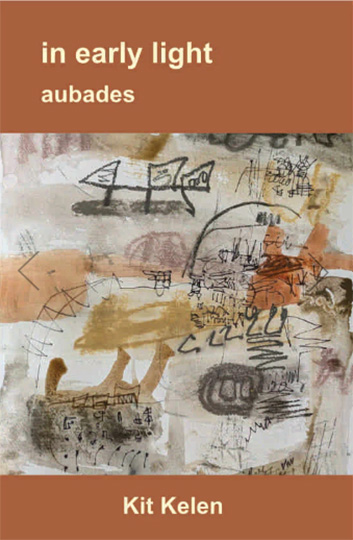
Launch: 'in early light ~ aubades', by Kit Kelen
Newcastle Writers Festival (March 2026)
‚Ez ist nu tac!
daz ich wol mac
mit wârheit
jehen, ich wil niht langer sîn.
diu vinster naht
hât uns nu brâht
ze leide mir den morgenschîn.
sol er von mir scheiden nuo,
mîn vruint, diu sorge ist mir ze vruo:
ich weiz wol, daz ist ouch im,
den ich in mînen ougen gerne burge,
möht ich in alsô behalten.
mîn kumber wil sich breiten:
ôwê des, wie kumt ers hin? der hôhste vride müeze in noch
an mînen arn geleiten.’
[Now it is day!
and well may
with truth
proclaim, no longer will i while.
sombre night
has now led us
to my sorrow the morning bright.
were he to part from me now
my friend, this trouble would too soon be upon me:
i know full well that for him as well,
him, whom i desire to hold safe in my eyes
wishes to keep me too.
my care already swells
alas, how could he leave? when utmost joy ought to
lead him into my arms.]
 You will all have recognised Wolfram von Eschenbach’s immortal Tagelied from his immortal early 13th century Parzival. In the face of vicious claims of
derivativeness from the troubadour tradition, it falls to us regularly to return to the middle high German chivalric romance to reclaim some of the
simplicity and directness that the Teutonic branches of literature can distil, through the alchemy of influence and borrowing, from even the most florid
Romance forms. The simplicity is evident also in the name of the genre itself, the Tagelied, the day-song, honest as a day-loan.
You will all have recognised Wolfram von Eschenbach’s immortal Tagelied from his immortal early 13th century Parzival. In the face of vicious claims of
derivativeness from the troubadour tradition, it falls to us regularly to return to the middle high German chivalric romance to reclaim some of the
simplicity and directness that the Teutonic branches of literature can distil, through the alchemy of influence and borrowing, from even the most florid
Romance forms. The simplicity is evident also in the name of the genre itself, the Tagelied, the day-song, honest as a day-loan.
One of the things to appreciate about in early light—aubades, and of the Kelenic oeuvre in general, is the insistence on both the worldliness and the
locality of poetry, the invitation laterally into geography and horizontally into history. We can peer back to Arthurian legend from the bush turkeys
on the Gore Cove Track, with daytrip excursions to Asia and Eastern Europe. The result is a delight in kaleidoscopic fragmentation but also the
insistence that we are all helplessly and creatively confined “on blue disc,” a condition requiring of us to be “day’s naked” and “our own pyjamas.”
That passage reminded me of Liu Ling, a major 3rd century drunk, who was known to strip naked and stay in his house. To the busybodies who admonished
him he would answer, “Heaven and earth are my house’s columns and roof, while the rooms of my house are my pants. What are you doing in my pants?” Over
and over again, on the sky-breaking trails of this book, we are defenceless and implicated in the planet; and it is as true now and sober as it was
for the tipsy two millennia ago. We are often left gazing with early detachment and the mad necessities that overcome us toward noon, let alone by evening.
This is a book of Kit in conversation with the history of civilisation as much as it is with particular kookaburras (“call it laughter/this warding away”),
a book at play; but the gambolling mind is also distractable, and the rules of the games change frequently. We are not always in the mental maelstrom, there
are languid games here too, cloudwatching games, tops slowly spinning as well as vinyl played at excessive speed. For a universitarian, much persecuted by
genre, the form of the aubades is one way the book moseys in to world literature, but Kit wanders through the forms of poetry as he does through the world.
One moment we are in the meandering puszta of Hungary, all reaches and ellipses, the other in peaceful observance halfway up a Japanese mountain: “the way’s
just these steps.”
Many Kits await us at the next landing. There are ornithological and entomological Kits peering through the pages, but they serve the philosophical and
cosmological personas, the kinetic Kelenic venturing out into the project of the day, orienting himself in space and duty to the planet and to other creatures.
Indeed, one of the reading of these Aubades is as a kind of autofiction of the mind, in which we dip into Kit’s head day after day, at the moment of
self-consciousness and appraisal, called to order by “the firstliness of birds” but also by a persistent disillusionment, a modesty and ongoingness
(“it’s with the gone/all must remain/duty bids us on”). Perhaps this is why the lines in many of the Aubades find their expression in fragments, leading
us in through the woods, given space on the page, sometimes making the eye fill in the blanks, expand the meanings. But many end on an unresolved chord,
the petering, the vein of first poetic moment sliding and transforming into the fact and mundane action of the day, the breath held before the plunge…until
we start again, another day…The perpetual morning hiatus of the clock lending the book a kind of Groundhog Day aspect, the sense that we are going to try
the arts of living again and again until we get it right (and we are not getting it right). Often one gets a sense of the land, even the premises, the
contours of a certain Markwell seigneurie for the arts, green and battered in the crepuscule, and the tramp of possession, both romantic and practical—there
is probably that something needs fixing?
Indeed, everything needs fixing: and here we are in the concerned, ecological side of the Aubades, maybe even grading into the grudgingly apocalyptic, a
sense of the worst in history reanimated (“there’s a fire/they’re coming for us”), with the decays of the natural and political worlds coming alarmingly
together. It comes as no surprise to anyone in touch with the Kelenic oeuvre to find him convinced that the world is aflame and governance the preserve of
unadulterated nitwittery.
Painterly Kit is also on the loose, dabbing the sky in. The poems are interleaved with interruptions from his paintings, that characteristic world of
urban scribble, dense as the cities of Japan or China, with its maps, mazes, and warrens, its arrows and directions to buried treasure, its prisons and
hieroglyphs. Painting for Kit is almost calligraphy, on the canvases writing is sometimes actually but more often nearly occurring, cursives of lost
civilisations, messages that have been painted over and reinterpreted by successor civilisations. Perhaps beneath all the layers are the medievals
themselves, their turrets and damsels, liripipes and caparisons.
I know what you’re thinking. I can hear the restive stirrings of the Romance faction in the audience, dismayed at my heresy of allowing the
Teutonic Tageslied to stand-in for the Occitan fons. In pacification, in the spirit of some antipodean Maastricht, we will end with some lines
of an alba by Cadenet
S'ieu en vil castelh gaitava
Ni fals amors i renhava,
Fals si'ieu si no celava
Lo iorn aitan quan poiria,
Quar volria
Partir falsa drudaria;
Et entre la leial gen
Gait'ieu lialmen
E crit quan vei l'alba.
If I were watching a cursed castle
in which false love reigned,
I would be false myself if I did not conceal
the day’s arrival as long as I could
since it would be my wish
to thus end their false chivalry
Yet among loyal folk
Loyal to is my watch
And I cry out when I see the dawn.
For in the world of the troubadours there is always (once we escape the miserable religious versifying) the courted lady, held by the grim and loveless master, the false gallantry, yet surrendering herself to a beloved knight. The logic of loyalty is repurposed in this rather ribald tradition, and Christianity paid off with some parenthetical Marian devotions—the loyalty to the state and the territory is meaningless, the loyalty to mere connubial vows is meaningless, it is the loyalty to the lustiness of life, to abandon which is praised, and sometimes paid for. Well we post-postmoderns have enough grim masters and wretched castles to whom we are beholden, and we can use the reminder to go among loyal people, and to read their lusty loyal homage to the day. And with this I declare Kit Kelen’s in early light—aubades launched!