John Bartlett's Memoir Launch | love and its penalties
Held on May 17th, 2026, at Armstrong Creek library in Geelong
Good afternoon, everyone. Welcome to Armstrong Creek library. My name is Katie-Anne Clarkman, and on behalf of Geelong Regional
Libraries, I'm delighted to welcome you all to this afternoon's event with John Bartlett, discussing his latest book,
Love and Its Penalties.
I would like to acknowledge the Wadawurrung people of the Kulin Nation, and the Koolijung and Gadigal peoples of the Maa
Nation as the original owners of the lands on which our library services operate. We pay respect to Elders past, present
and emerging. We acknowledge and celebrate First Nations peoples of this land as the custodians of learning, literacy,
knowledge and story.
We're very pleased to be hosting John Bartlett today. John was raised as a devout Catholic, spending seven years training
for the priesthood in Sydney, before working in the southern Philippines during a time of great political unrest. In the
1980s, he left the priesthood and returned to Melbourne, where he came out as gay during the height of the HIV-AIDS pandemic.
John has since turned to writing, going on to publish 12 books across fiction, non-fiction and poetry. Today, John will
be joined in conversation with Gregory Day. Gregory is a writer, poet and musician.
Gregory is the winner of multiple awards and has also been shortlisted for the Miles Franklin Award twice, most
recently, in 2024, for his book, The Bell of the World. His latest poetry collection, Southsightedness, was
published last year.
Please join me in welcoming John Bartlett and Gregory Day.
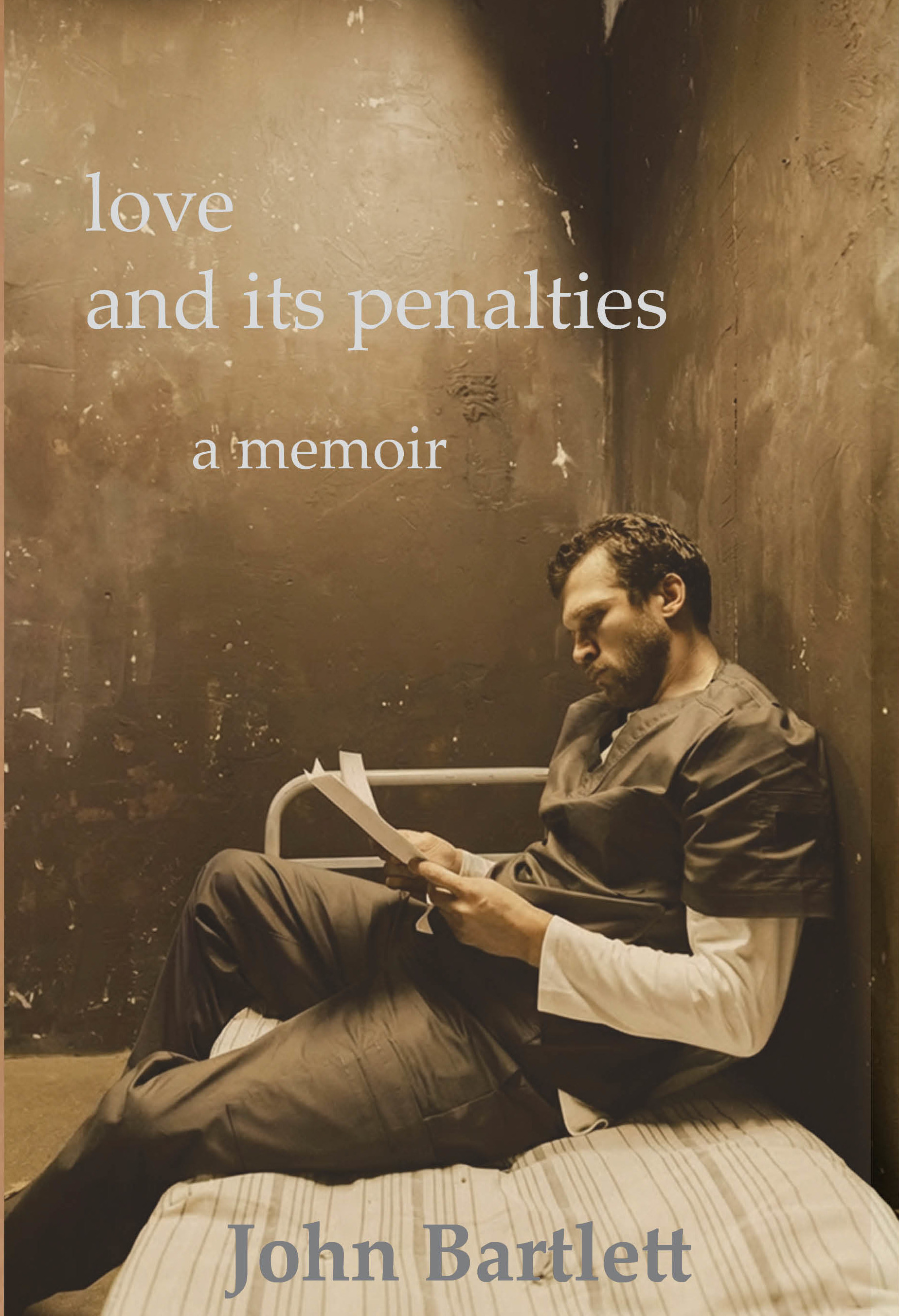
Gregory: Thanks, Katie-Anne, and welcome everybody to what I think is a special occasion. It's not often we get to sit
down and speak with a genuine elder, and I consider John to be that in the most profound sense of the word.
And the journey we'll be on today will illustrate maybe why I think that. A lot of you in the audience might know John
better than I do, but I'm here to talk about the book and what John has put into the book of his amazing life. So it's a
journey, a massive journey, but I think I'd like to, John, start with... The book doesn't start at the beginning of the
story, which is a kind of compositional decision that we might talk about later on.
But for today, I thought I might start the thing at the beginning. So here we are on Wadawurrung Country. But the
beginning of this journey is a long way west of here, in Narrandjeri Country, down near the mouth of the mighty Murray
River.
I think of it as David Unaipon country personally. And your family has deep roots there, around Murray Bridge, Tailem
Bend and so forth. And in the second middle section of the book, you write very beautifully about those connections and
about that sense of place in the land.
And so I thought maybe we could begin by you just describing that connection to that place, what that is, the family,
the quarry, the stone, the church, just to get us rolling.
John: Yes, thanks, Greg, for that question. We were talking before a little bit about connection to place and yes, it's
true, I think, that we feel drawn to particular places, particularly places that we grew up in. And Murray Bridge is a
place for me, although I was born in the Clare valley. But I left there as a baby, long before I'd come to appreciate
wine drinking.
My family had great connections to the lower Murray, to Murray Bridge. I won't bore you with the whole story,
but my great-great-grandfather and his family arrived in that area in the 1840s. And then my great-grandfather
bought up a lot of land around that area and did a lot of logging.
He also bought up a quarry along the River Murray just past Murray Bridge. So knowing all that, you know, talking about
the Ngarrindjeri country, then you think about the disadvantage for the Ngarrindjeri, what was happening for them as a
result. They were losing the land that my great-grandfather took in some way or another even though not violently, I
don't think. He bought the land but of course, you know, they lost all that land, and they lost that connection to the
land. This was a fact I was very aware of when I wrote my novel, Estuary, about that sort of connection and what
happened to the land around the Ngarrindjeri land once my family sort of came in and took over.
A lot of the stone from my great-grandfather’s quarry supplied the stone for many buildings in Adelaide, including
the Adelaide Railway Station, which some of you may have seen. He also donated all the stone for the Catholic church
so for me there has always been this deep Catholic connection to Murray Bridge. So there's been this religious connection,
but something else as well, something deeper even, a sort of a soulful connection. I still feel drawn back to that
area whenever I go there, incredibly connected with that country.
Gregory: Yes well, I'm not surprised. I always love stories that start with the ground. And in this case, when
you say, you know, it's the Catholic connections, but something deeper, literally deeper.
It's in the quarry, you know, it's in the stone. And I think you mentioned in the book that not only did your family
donate the stone, but before that, for the church, before that church was built, you were holding masses in the family
home.
John: Before the church was built, yes, my great-grandfather built a house on the other side of the river from Murray
Bridge township with the stone from that quarry and that was used as the Catholic chapel for quite a few years. My
grandparents were actually married in that home.
And then, speaking of the stone from the quarry, my great-grandfather built another house in Murray Bridge, and that
was the house that I actually grew up in, which unfortunately has been demolished, and there's a Chinese restaurant
there now. So there’s a lesson here about getting too attached to places, because they change too.
Gregory: They don't stay the same. That's right. But suffice to say, they provide, you know, kind of inextricably,
deep roots for you in that part of the world, and that's where that story begins.
But as you say also, these roots are entwined with the culture that was brought by your family from Ireland and the
Irish Catholicism that they came out here with, and which, you know, is such a large part of your book. Therefore,
your book, and a huge part of what makes this book so interesting and what gives us so much to think about is in
relation to how, as you say, our life goes, if we're lucky, there's lots of lives within that life for all of us.
I think actually in terms of biology, we shed cells every seven years, so we physically are shedding ourselves,
and that happens in our life journey and our identity and so forth.
This book is so interesting for what it tells about change, because your life has had these really distinct
revolutionary changes in it which are connected to that Catholicism that your family brought here. So your
childhood, John, as you write in the book, is so immersed in Catholicism, and your brother Michael, who's
seven years older than you, is a big figure in your life, actually entered the Catholic seminary at the age
of 13.
So you're six, your 13-year-old brother leaves home to enter the seminary. So with the church that your family
donated the stone for, then your brother at 13 doing that, this is deep in you. And so can you talk to us a bit
about, for those of us who mightn't understand, like, the extent, breadth and depth and complexity of what it
is to have a childhood like that and where your siblings and then yourself are entering into those institutions,
can you describe some of what that was like back in the 1950s?
John: Well, I think as I described in the book, it was a bit like living in a Catholic bubble, living in Murray
Bridge. Basically, all our friends were Catholic. But then some of you may remember that in the 1950s, there was
a real separation between Catholics and the non-Catholics. And even going to school, it was normal to shout
abuse backwards and forwards to one another. That was the norm. And so we had this little Catholic bubble that
we lived in and then yes, my brother left home at 13 to go to Adelaide to the diocesan seminary.
I also had a first cousin who left home at a young age to study for the priesthood as well as another cousin
who joined the convent and two other cousins who joined the priesthood. So volunteering for the church was all
happening all around me. Plus my Irish grandmother who came to Australia at the age of 14 was very Catholic
and very traditional. So there was that influence too from her side of the family.
Looking back, it was all good. It was a great childhood, even if very restrictive. I went to the St. Joseph's
convent, run by the sister of St. Joseph, and then later to the Christian Brothers in Adelaide. Having that
protective bubble meant there was a separation from the real world, which became more exacerbated, I suppose,
when I went into the seminary. And it was there that we were encouraged to be separate from worldly affairs.
Gregory: So your brother goes into the seminary, and then, you know, as you say, it was a good kind of safe,
protective bubble. But when you entered boarding school, when you left home to go to boarding school, that didn't
feel so great, did it? No. So you left home at what age? 14 ?
John: 13 or 14, yes.
Gregory: So, John when your brother leaves home at 13 to go into seminary, you leave home at 14 to go into
boarding school, and that's a great rupture for you, and something that obviously caused you a lot of pain.
John: Yes, I luckily or unluckily won a scholarship to Christian Brothers College in Adelaide, and off I went.
And, you know, the experience, after coming from a very loving home, and I suppose being cocooned in lots of ways,
you know, from the world, suddenly I'm in a very sporty school, and everything changed, For a boarding student
it was a cold, impersonal place and I wasn't very good at sport, so I didn't feature very highly in the hierarchy of
the school. I was down at the bottom. For example, I was always the last person to be picked for a football team.
That's about the most humiliating thing, I think, that could happen for a child.
So as a result, I did go into myself then, and I can sort of still picture how much I hated that life. I'd go home
sometimes for holidays, and Mum and Dad would bring me back, and in front of the college there was this long road
leading away down the highway, and I could see myself standing at that corner watching dad’s car disappearing down
the road, going back to Murray Bridge, and just feeling terribly lonely and destitute. In many other ways. It was
a very punitive place too. The brothers were, as I experienced it, quite cruel. We had brothers that used the
leather strap quite freely. One brother, (I can laugh at it now, it's a bit of a joke) but, when he came in
every morning, he used to go around and give us all the strap. His excuse was that he'd do it early because
he might not get around to it later during the day. So that was the sort of atmosphere. There was quite a
lot of bullying, too by brothers during classes students being put down in class and called stupid and
hopeless.
It was a horrible atmosphere, and I think as part of that, the only thing that gave me some consolation then
was that I found myself going into the chapel and spending time there. And I felt like, well, OK, God seems
to understand me, he's not judging me, I can be here in the chapel and that was consoling. I guess then it was
a bit of a slippery slope then, leaving secondary school to be going straight into a Catholic seminary.
Gregory: I was also brought up a Catholic too, John, and my uncle was Jesuit and so forth. But my mother was,
you know, she was very much a defiant... ..Germaine Greer-influenced Catholic and she was always marching us
out of church in protest at something that the priest was doing. But her message to us as kids was never let
the church come between you and God. And what you describe there, where you're in this Catholic institution,
it's punitive, it's bullying, it's kind of emotionally arid, potentially, but you're going into the heart of
that community, right into the tabernacle of it, the chapel, and finding solace right in the heart of it. That
God to you, just widened out into a spiritual life, but nevertheless separate from that human institution at
that time.
John: Oh, absolutely, yeah. It was... ..I don't know how else to describe it, but it was...it was the church,
and all that the church taught and spoke about was something else at the time that I could hang on to, which
is probably what I still hang on to today, really. That some sort of inner life, because I still feel drawn
to that sort of inner spiritual life. Everything to do with that.
Gregory: Yeah, well, that strikes me as one of the most important things about your book is this description
of this inner journey, and how it takes different names at different times of life, but perhaps it's the same
thing manifesting in different ways, depending on the cultural context and the circumstances. So you're in
the boarding school, and that's no fun. You find solace in the church, and eventually you start to go well
academically, and you find yourself thinking, by this stage, you know, your brother is progressing towards
being a priest.
John: He was well and truly a priest by then.
Gregory: And then you decide you want to follow that path as well. So how old were you when you decided that
maybe that was for you?
John: I was 16 when I thought about going to the seminary, but I was advised to wait another year because I
was too young. So I was 17 when I actually joined up.
Gregory: Can you give us a bit of an insight into what that's like for a 17-year-old boy to decide to commit
his life to the Catholic Church, and with all the sacrifices involved in that, and how conscious or unconscious
the process was?
John: Quite unconscious in lots of ways, I think. I never really thought about any sacrifice involved. There was
in fact a certain glamour about it. Because what I did do was that I didn't choose to go to the local diocese and
work in the state close to home. Instead I chose what’s called a missionary group, St Columbans Mission whose
priests worked overseas. So as I look back at it, I think, oh, I think all the time you were just thinking about
the adventure of travel and life overseas.
I did see through my own motives only much later but I'm sure that travel was part of the attraction, really. and
in fact, I remember my mother that as happy as she was for me to go to the seminary, she wasn't so happy that I
was joining a congregation that would send me overseas, I remember that. But I don't think that I ever felt
influenced, say, by my brother going to the seminary. As much as I loved him and looked up to him, it all seemed
a separate thing somehow. Nor was I influenced by the cousin who I mentioned earlier even though, he had joined
St Columban's ahead of me. I wasn't influenced by him particularly either. It seemed like a very separate thing.
The other thing, I was thinking about it today, was, you know, at that age, you know, you're idealistic. You want
to, you know, make some difference in the world. You want to do something that's different or exciting and this
seemed to be it. But I wasn’t aware then of all the issues that might come up at all. Like celibacy. I was
innocent, then. Yeah.
I often wonder how I sort of surprised myself really, but that little boy that, you know, was dumped in the boarding
school and hated being there, but come 17, how happily he went off interstate to Melbourne and joined up with this
crowd and never looked back. And then once, in the following years, he went to Sydney, all those trips backwards and
forwards over seven years between Adelaide and Sydney. I went very happily, really.
Gregory: And, of course, you would have been getting a lot of positive affirmation from your parents about it
because they were extremely proud of having a son studying for priesthood.
John: Yes, very. So there's that as well. I mean, that's got to be a factor, I suppose.
Gregory: So you decide to join the seminary and that requires you to once again leave home and travel. Tell us about
arriving in Melbourne and what that was like, entering that new chapter.
John: Oh, look, it was easier than going to boarding school, it was nothing like it, really, no.
I think because it was something I wanted to do and also not yet knowing what it involved, and I was going to another
state and, you know, ultimately perhaps I’d end up going to another country. There was an excitement, I suppose,
really. And then once I met with the people in my class and it was such a fantastic group of people that, that
connection held me over the seven years that I was training too. There was a sort of camaraderie, if that’s the word,
a companionship that was very strong and still is to this day. That closeness with some of the people I studied
with still exists
Gregory: And the interesting thing, one of the interesting things that struck me in the book is that you had entered
seven years of training. Pretty rigorous, you know, philosophical, and theological training for seven years, and you
come out and you actually don't... It's not recognised by the education department as any kind of degree or anything
like that. No. It's just specifically tailored for the role as a priest.
John: That's right. Yes.
Gregory: So that education, we hear a lot about Catholic education, you know, for good and ill, but one of the positive
things we hear about Catholic education is at the intellectual level.
So what do you think about that in terms of that training and how that influenced the way you think and perhaps
what you've become since then?
John: I don't look back on the training as wonderful. It doesn't really jump out at me as being excellent. I don't
think so, not really.
In fact, I must just add, that I was talking to a friend recently who was in the same class as me, who also left and
got married, and he was telling me the other day that when he left and went looking for a job, the first job he went
for, the guy said, OK, so you finished your studies here and now, seven years later, you're looking for a job. Have
you been in jail? Yeah. That's how I sort of feel about it.
And also, I suppose, for those of who left, that study didn't equip us for anything practical at all, really. It
didn't really equip us for living in the Philippines with the state of war and revolution that existed then. So I
didn't feel very well equipped for that life at all
I sort of bounced along this idealistic sort of bubble again, really. The bubble was still operating. Yeah.
Gregory: So at the end of the seven years, when you're kind of graduating, if that's the term, or approaching ordination
or whatever, and you’re getting yourself ready to go overseas, you know, maybe to America. That's positive as a possibility.
And the Philippines or maybe South America. And then they send you to Essendon in Melbourne to help edit the
Columban magazine. And so for some reason or other, they have decided that you have the skills to edit a magazine.
I mean, it's so interesting to me the way these things work. Now you've become a writer. You've written 12 books.
You're a poet, you're a novelist, now you're a memoirist. And somewhere along the line, those Catholic educators
in their own way, have either identified skills in you or nudged you somehow in that direction. Instead of sending
you off to Marquette University in America to study journalism, they send you into an editorial office in Essendon.
And that was very disappointing to you at the time.
John: Well, yes it was because there were eight in our class, and six of the class went to various overseas countries,
and two of us were stuck in Melbourne. My other classmate was stuck in the office. He was an office manager. Well, this
wasn't what we signed up for. But even before that, the other strange thing was when it did come to the end of my
studies, I was told that I was going to Marquette University to study journalism. So it was a bit of a surprise.
But, you know, then in about two weeks after I went to Essendon someone signed me into another college in Melbourne...
What was it? A college that taught typesetting, printing, which I would never use. I mean, I wasn't ever going to print
up the books or anything. The course was all about setting up typesetting and, you know, different typesets. So I just
dropped out of that, you know, pretty quickly.
Gregory: My uncle was a Jesuit, and he was a bit of a, you know, a guns-blazing intellectual in the 1960s as a young
Jesuit. And they sent him to San Francisco and California in the late 1960s to check out the scene over there. There's,
as we know, an enormous amount of stuff going on there in the culture. So he went over there and checked it out and
learnt a lot and brought it back. And when he got back and started making recommendations, they just completely
blanked him. They didn't want to know.
It was far too radical. And he ended up leaving the priesthood three years later. And they were going to send you
to America too, but you mention in the book that perhaps because of that, that kind of revolutionary stuff that was
going on, they decided not to send you.
John: Yes, I think that was part of it. I mean, these were the student demonstrations. I think this was the time when
the students were shot dead on one of the university campuses. Plus, you know, it was the beginning of, other changes,
when feminism was raging and Black and Gay Liberation too. America was in a lot of turmoil. Maybe they just thought,
yeah, it wasn't such a good idea.
With regard to any potential in the area of writing, I recall when I was at primary school in Murray Bridge, I was
constantly reprimanded by Sister Benedict for using big words. LAUGHTER Stop using big words she said.
Gregory: She can talk. She's got a male name. She's Sister Benedict. Too many big words. Just had to, you know, use
small words. Isn't that amazing? I thought it was amazing anyway, how that whole thing... So she probably saw something
likely, didn't she? Nobody else. That's right, and she didn't like the writing. No, she discouraged it. Or maybe she
just followed Hemingway and wanted to keep the sentences short, you know, no adjectives.
John: It was for my own good. Anyway, after this experience in the editorial office in Woodland Street in Essendon,
eventually they decided, yeah, time to go to the Philippines.
Gregory: Amazing. Just an amazing thing. So can you maybe just unpack that a bit for us, what that was like and what
you found when you got there? And, I mean, pretty soon after you got there, you were giving sermons in Philippine dialect.
John: Sort of. But badly I think.
Gregory: If I imagine standing in front of a congregation in a foreign country and you're giving that sermon in their
dialect, I mean, this is an absolute cinch here today, isn't it? So can you just tell us a bit what that was like?
John: Well, we were fortunate in that we were assigned to Mindanao, which is the southernmost island in the Philippines,
which has quite an interesting history, particularly Islamic history, because before the Spaniards took over the Philippines,
in the 16th century, there were lots of Muslim people coming from the Borneo area and they settled in Mindanao. Mindanao
was pretty much all Islamic. So we were sent there and the first thing we did was go to language school for six months.
So, you know, we were taught by two excellent teachers in learning how to speak the language, which, of course, really
only sort of came to the fore when we went out into the parishes and had to rely on that, in places where nobody else
spoke English and you just had to use it and get on with it.
The process of learning the language was interesting and of course we made lots of mistakes. The good thing was that
kids would laugh at your mistakes, and they'd tell you what you'd said and correct you. So if you're up for it, you
just have to keep using the dialect, mistakes and all and learn from that.
It's the only way of learning. Eventually I was sent to a parish in the mountains, about five hours' travelling distance
from anyone that spoke English. So I just had to either learn the dialect or shut up. So it was a wonderful way of
learning really. I was forced to learn. Yeah.
Gregory: Now, this all under the Marcos rule in Philippines. And eventually Martial Law is introduced and you're
working as a Columban priest amongst tenant farmers and there's a traditional amount of inequality in that situation
for them. And you, as you describe in the book, pretty quickly you know whose side you're on and you really start to
investigate, understand and prioritise working with community in that place over perhaps, the more spiritual work
you’d been trained for or whatever it might be.
So can you describe some of that political scenario and what kind of... the pennies that were dropping for you at that
point when you were there?
John: Yes, I think one thing to keep in mind is that the Philippines was colonised by Spain in the 16th... It was
the 16th century. And, of course, the church was part of those conquering armies. The church was part of that colonising
power.
The Catholic Spaniards built these huge churches all through the Philippines and the structure of the church then
favoured the people with power and the rich. So everybody else was left to their own resources really. So walking
into that sort of situation, it was pretty clear who caught the shots. You know, the landowners called the shots.
And the tenant farmers were working for them and were just disadvantaged all the time because often the landowners
wouldn't even follow the law in terms of sharing out the funds from the crop. They'd take the whole and leave the
farm with hardly anything. So before I had arrived in the Philippines, a Filipino lawyer had actually set up an
organisation called Federation of Free Farmers, which was a group that would help farmers to first analyse the
social situation that they found themselves in. The other thing operating was the Catholic system that if
proclaimed that if you're Catholic, you just have to put up with life as it is and look forward to the next
life when everything will be fine.
In other words you must just suffer, politely and quietly. So you can see that obviously that had to change. I mean,
how could a priest go about the parishes giving out the sacraments or baptising or doing marriages when this inequality
existed? You know, there's no point really in doing that.
So being involved with the Federation of Free Farmers gave us a way of supporting farmers. I’m thinking about
one particular case that I can still remember. A farmer called Eugenio, (I suppose Eugene would be his English
name) decided that you had to just do something about the situation. because on the coconut plantation where he
worked, there was a law prevailing that when the peasant farmer had harvested all the coconuts, that the harvest
expenses would be taken out of that and then one-third profit to the farmer and two-thirds profit to the landowner.
But what used to happen was the landowner would take all the expenses out of the farmer's share which left no profit
for the farmer. So Eugenio decided to follow the law strictly and, just take a stand, which he did, but then as a
result he fell foul of the powerful people in the town, and he ended up in prison.
So he's in prison for quite a few months. And I used to visit him there and I once lent him a book by Martin Luther
King, Why We Can't Wait, with that wonderful letter from. Birmingham Goal where Martin Luther King wrote saying, you
can't sit around letting things happen. You have to break the law sometimes to actually make a change.
And I can remember how much Eugenio read and re-read that book many times because it affected him so much. And I've
still got the book, and it's covered in Eugenio’s grimy fingerprints from the hands of this subsistence farmer, which
to me is almost like a relic, really. It's like a holy relic.
So he was in prison for quite a while and I used to go and visit him and the governor in the town used to complain
about this meddling foreign priest, going to the jail to visit Eugenio. Anyway, eventually, you know, he did get out
because he was after all just following the law. These were the sort of courageous and wonderful people that I was
meeting.
Gregory: And you were... In one instance, you were giving a sermon, and the soldiers came into your church with guns
and so forth, mid-sermon.
John: Yes well, at one point after martial law had been running for about three years and legally there was a limit
to how long it could continue to keep running so Marcos decided he'd run a referendum to get another three years.
And part of the running of the referendum was to force people to vote yes for it. You know, really threatening
people that they had to vote yes.
We opted to take a stand that, there should be a freedom in voting, that people should be free to vote yes or vote no
or they could abstain, even boycott the whole referendum.
So that was the line that we were running in the parish not just myself, but other leaders in the parish and the
people around us. I wasn't on my own. I was part of a group of people who had opted to take that position.
And I remember the Sunday before the referendum, we were in the church, and I just got to a sermon stage and got up
in the pulpit when we heard jeeps screeching to a stop outside and then suddenly the church was full of armed. men.
Soldiers filed into the church, and they took up positions under the stations of the cross armed with Armalite
rifles, which is sort of quite ironic, standing during the sermon under the stations of the cross. They didn't say
anything, just stood there. It was though pretty scary.
Gregory: Yes, it sounds it. Yes.
John: But anyway, we persevered with our stand, telling the congregation that people had the freedom to make a
choice re the referendum. And, you know, after the sermon they just filed out like obedient little children.
This was part of the Martial Law situation. The church was taking the side of the poor, even though there was this very
traditional powerful church that existed, but there was this other grassroots church that was very involved with the poor
and they were the ones that were being called subversive because they were working for people's human rights and freedom.
So many church people were put in prison and tortured or just disappeared. That was part of the situation under Martial
Law. We probably don't have time to go into the whole liberation theology movement, which was the nexus where politics
and Catholicism or theology was coming together at that time.
Gregory: That was a huge movement... Yes, yes. ..within Catholic circles at that time and was a big influence on
you at that time. Indeed, yes.
John: My graduating from the seminary in 1969 also marked the end of the Second Vatican Council too, which was
also a major influence on us, which was about the church looking at the world and trying to, deal with the world.
The church being the people, not just the hierarchy or those with all the power.
So those two movements, the Second Vatican Council and Liberation Theology, which started in South America, operated
very much in South America and also in the Philippines, created a church that had opted to take the side of the poor.
So those two movements were operating at the time, and we thought of ourselves as the babies of Second Vatican
Council. It was up to us to put those ideals into practice.
We were right at the forefront pushing new ideas And it was great to be involved in.
Gregory: I think my mum was very happy about Vatican II and liberation theology too. But, um, so... So let's go
to the next stage there. You know, we talk about, you know, as I said before, lives within lives, and all this is going on.
It's extremely interesting and, you know, challenging. But there's an individual, personal, interior journey going on
which starts to see you wanting to bust out of this life as a priest, which you ultimately did, of course. So there's
an unhappiness and a restlessness and so forth, and you start, you know, exploring that and opening up to that. You
fall in love, for instance. So can you take us there and describe that process, what that was like? Because that's
a very fundamental and challenging process where you're absolutely inculcated in this life and you decide to jump
off the cliff, so to speak. I think there were two sort of things operating.
John: Yes, there was the work with the people, which was always exciting and fulfilling and they taught us so
much, really, in the way they lived. But then there was the inner life of course, you know, at the end of the
day when the work's done and you're on your own. You know, we lived on our own.
So come night-time it was just you and the quiet night. So, of course, you're going to get lonely. And I
was just getting lonelier and lonelier, really.
I could see too that this lifestyle was doing bad things to me. I was getting irritable with people
and getting pissed off all the time. I wasn't a healthy way to be living.
I knew that I had to make some sort of a change for my own sake, for my own psychological health.
Gregory: There's an amazing scene in the book where you come home to Melbourne and having kind of time off,
so to speak, but your mum, of course, is still a devout Catholic and you're driving her to Mass, but you're not
going to Mass. You're sitting out in the car while she goes into Mass.
John: Yes, that was in Adelaide. Yes, sadly my father died while I was in the Philippines, so it was just
my mother at home and she was such a good Catholic and conscientious, going to Mass whenever she could,
really, daily if she possibly could. So be home, from the Philippines for a break and already on the
way out of the church, on the way out of the priesthood, but thinking, oh, I should drive her to Mass.
So driving to Mass and sitting in the car outside waiting for her, it was pretty awful. I felt like a
real bastard, really. So conflicted. Yes. So ultimately, it's like a gravitational force, almost.
Ultimately it has to open up.
Gregory: Yes. So how does the opening up happen?
John: I had what you'd probably now call a breakdown. It made me realise that, I had to face whatever it was
that I wasn’t dealing with, and I can't do it within the church, I can't do it within the structure, so I
decided to perhaps take some time off, you know, and just explore my life outside the priesthood. So
that’s how I came to leave Adelaide and come to Melbourne.
And then I allowed myself, some freedom. My first job was in a kitchen in Conzinc Rio Tinto in the city as a
kitchen hand cleaning saucepans. Yes, it might sound like a big change for the Philippines, but it was wonderful
because, in that situation you’re just an ordinary person, you know, working in a kitchen being treated like an
ordinary person.
That's what I needed. It was a massive relief. Yes. Hugely. Because there's so much adulation of the priests
in the Philippines, going back to Spanish times. Children come up to you, they take your hand and put it against
their forehead as a sign of respect.
Now, wherever you go, there's a massive respect being shown to you, and I’m thinking, do I deserve it? Probably
not really. It's excessive respect. Yeah. So living in Melbourne, was just a gradual sort of exposing myself
to the world, really, because I hadn't been very exposed up until then.
Even the Philippines I was still within the structure of the Church. So this now was an opportunity to just try
and see where it would take me, I suppose.
Gregory: And, you know, in tandem with that is an opening up of your sexuality as well. And a discovery of
that whole other world that the Church has withdrawn you from.
John: That's right, yes.
Gregory: Which is probably the core revolutionary thing in your life. But at the same time, that's when the AIDS
epidemic hit.
John: It was, yes.
Gregory: So it's an incredibly difficult time to commit to that. Well, we're talking about the 1980s. Yes.
John: And also, interestingly, I think it was only a couple of months before I came to Melbourne, that active
homosexuality was still listed as a potential crime.
Then, of course, HIV AIDS happened, and that was another whole influence, I suppose. Just when I was sort
of trying to explore myself and explore my sexuality, here was another big challenge that sort of got in the way.
Gregory: But there must have also been, you know, and I know this from friends and so forth, an incredible sense
of community amongst the gay community, which is kind of additionally brought on by the AIDS situation.
John: Oh, I think when we look at it, you know, we have to congratulate Australia for the way the government and
others dealt with AIDS. You know, it was just fantastic, because they included the people who'd been involved and
most at risk. You know, medical people and people with HIV, drug users and people using needles, they were all part
of the response, part of the process. Yes, which was fantastic. They were listening to people in the situation to
help make the right decisions unlike America, where, it was just constant fighting the whole time to try and get
HIV AIDS noticed as a massive health problem.
Gregory: Yes and I know that we’re at risk, of course, in a conversation like this with such an extensive and
involved memoir that we're truncating the whole story but there's no way round that really. So I have to move
ahead now to, in a sense, let's go back to Sister Benedict noticing something writerly in your long words. So
this busting open, this chasm, this flowering, if you like, then starts to intersect with your relationship
to words and writing, which brings us to here today. So what happened there and how did that happen?
John: Yes, look, those first few years, I had the job as a kitchen hand, but I had a few other jobs too. I was a
film extra, masseur. I actually drove a hearse for a funeral parlour but that job only lasted two days because they
said I was too fast a driver. LAUGHTER, I needed to learn to drive the hearse more slowly. LAUGHTER So that job
didn't last.
So it was a bit like try this job, try that. I tried a number of jobs that didn't seem to work for me. And then
sometime after coming to Geelong, I saw that the Gordon Institute offered a certificate in Professional Writing
and Editing. So I signed up for that and that was the beginning. Once I started, I just knew I was in the right
place. I started writing. I was getting articles accepted during the course, being published in The Age, the
Canberra Times and magazines. Yes, the writing life just took off. I knew then that I was in the right place.
in my good place, the place I had to be.
Gregory: And then you met Stephen, your long-term partner, who was also a very creative person.
John: Yes, and now we’ve been together for 40 years. Yes, and Stephen’s an artist and taught art at the adult
education in Melbourne. And also a French tutor.
And coming from England, he opened my mind up to a lot of European art and music and, yes that was an opportunity
for me to appreciate because I'd never really been much in contact, with art or music specifically. So, that was
another world that opened up to me.
Gregory: We're nearly out of time now, and we'll open to questions from you guys in a tick. And then we'll come
back for John to read one of the poems in the book. But I thought just finally it'd be worth just... If you can,
there might be a question you can't answer, but what fascinates me is this inner life, spiritual life, which starts
in this traditional institution and then transforms through a lifetime into poetry and prose and your relationship
to nature.
And if you could just say a few words about what happens there and what the thread is between that boy who goes
into the chapel in that arid boarding school and that same person, but in a different iteration, sitting down to
write poems and prose in a kind of transitive way, not just for yourself, but to connect with other people, which
all good writing does. It's not just a diary or a journal. It's about giving as well.
John: Yes even for me it’s hard to understand and articulate, but there must have been that spiritual longing
right from the beginning, which is the thing that supported me all through the changes and still exists today,
but certainly not found in a religious institution and Stephen helped me discover that spirituality in nature too.
You look but at first you don't see, but then you find other ways of looking. And being an artist has helped me to
see other ways of looking at nature. And, of course, then once you start really looking at nature and taking notice,
I mean, it's just overwhelming.
I mean, it's a religion in all of it. So, you know, it's an ecstatic religion, really. You think of it when you start
investigating and noticing it. So in some ways, my spiritual longing has been fulfilled.
And I've always had that need to belong to a community some sort of a community.
It doesn't have to be an overtly spiritual community. But being part of a community of writers too is what I feel
very much now too.
And that, you know, that's the other part of being spiritual (in inverted commas), I suppose. But it's a comfortable
sort of place to be and a place that seems like a development from those early days of that spiritual interest,
transforming into something else. Yes. And just feeling I'm in the right place.
There seems to be a spiritual connection too in the writing of a poem. There's such satisfaction in getting a line
right when it bursts out and you know it's right. Yes. You know that you've worked on a particular line, let alone a
whole poem. You just know if it works.
There's something sort of ecstatic about that process too, I think. Well, it's part of nature, isn't it? It's an
absolute analogue of what's going on when we watch a plant grow. That's right.
And it's perfect in its way. So why wouldn’t you want to keep on writing when you discover so much about the world
and about yourself? Yes and it's a way of investigating, I think, of looking at the world and trying to understand
it. And finally, for me, that's the way that makes the most sense, I think. If it didn't make sense within it
doesn’t work on the page.
Gregory: Yes, brilliant. Thanks, John. So questions from the audience. We've got a little bit of time for a few
questions, if anybody has them.
Questioner 1: Will there be an audio version of the book? Are you offering one? I would want to listen to it.
John: Yes. I was talking to someone the other day about how audio books come about but nobody's approached me yet.
How does it work?
Gregory: Yes, well, there's various things that have to happen, but there is a bit of a structure at the moment
with audio book companies where you have to sell a certain number of books for them to bother. But then there's a
lot of people doing it just independently and where you can book the studio and, of course, you can upload your
audio book onto all manner of platforms which are readily available, freely available even. So it's possible with
the right expertise. Vision Australia offers a service and sometimes the author will also read.
Questioner: Yeah. Thank you. Thanks a lot.
Questioner 2: It’s been a pleasure to hear you both speak today.
What was the catalyst for the memoir? Was there a particular moment where you thought, I need to go down this path?
John: Nothing very dramatic, really. I never saw myself as wanting to do this. I was happy just to keep writing
poetry, enjoying that but I have a friend in Adelaide and she's been encouraging me over the years to say, you
should write the story of your life. And I kept thinking, well, other people have got more exciting lives than mine,
mine’s not that exciting, really. We've all got interesting lives, so why would mine be any different? She kept on
at me anyway, so eventually I thought, I'll make a start. And once I started, I started enjoying the process so much
that, you know, I just kept going and then finished it in 2024 and then started looking for a publisher last year.
So it was a bit accidental, I suppose, really. I've never longed to be a memoirist. Never.
Questioner 3: Can I ask you then the difference between writing, say, fiction and your memoir? You've written the
novel History, which touches on, you know, where we started today. You wrote Towards a Distant Sea, which is a
novel which draws on your experiences in the Philippines. And now you've written a memoir where you're kind of
touching on the same material, but you're doing it in a way that's, you know... The Irish novelist John McGahern,
when he, at the end of his life, after writing lots of fiction, wrote a memoir, and he said, you know, it's
just a nightmare writing a memoir because it has to be true. That's right. I was going to say, writing fiction
was much easier.
John: Yes more fun. Yes, that's right.
Trying to write memoir is trying to remember and trying to decide what to leave in, what to leave out, because memory's
such a slippery sort of thing anyway. And what do we remember, really, after so long? And different people in a family
can have different memories of the same event or the same person. It's a very slippery sort of idea, I think.
So, yes, it was hard at work at times, doing that, feeling that you did have an obligation to tell the truth as much
as you could remember anyway.
Gregory: Yes, well, that's right. And, like, the composition of the book in the way that's not chronological so
much as we've done today was partly a decision you made to embody the fragmentary nature of memory, isn't it?
John: Yes, because in thinking about writing it, of course you're thinking about memory and how memory works. And
I realise that for most of us, memory comes back to us in fragments. We don't one day think, ''Oh, yes, that was the
day I was born,'' and then sort of work our way through. It's very fragmentary, so why shouldn't I write in that
sort of way?
Gregory: Yes, so the book is written with headings, often they could be three-quarters of a page, sometimes two pages.
But, you know, as you say, the way memory works, often in images too, often it comes as images. There are beautifully
drawn images in the book too. Like, there's one which just really stayed with me, which was your brother, Michael,
when he left the priesthood, going up onto Sydney Harbour Bridge and throwing the chalice into the Sydney Harbour
Bridge. LAUGHTER
John: Yes I told him, ''When you write your memoir, that's where you have to start.'' That's the central scene. But
then what about his regret after that? Yeah, a bit later, when he was a bit short of money, he could have sold it.
But talking about the structure too, I have to say, by the same token, I wanted to start my memoir at a place
where people might be captured a little bit, which was the most dramatic point for me, which was that after
10 years in the Philippines, and suddenly back in Australia, I had no idea what came next. What do I do?
Where do I go? So that's where I sort of made the start. It's fairly dramatic and I hope it will keep people reading.
Gregory: John maybe we could conclude today by having you read one of your poems, perhaps the poem that ends your memoir?
John: Yes thanks Gregory. I’d love to. This poem 'Survival' actually won the 2020 Ada Cambridge poetry prize.
Survival
She’s back again this year
in heels and nuptial plumes,
coquettish
in pale eye liner
-the white-faced heron
selecting twigs,
thinking of survival
What rush of rapture
bursts
-these birds
designed from
templates of dinosaurs
with songs that shiver
in the deep wells of the soul
So, despite
the cracking ice
in Greenland, the rift,
the cleft, the split,
the speld
Despite the smell,
the stench, the stink
of burning forest,
I see you still,
framed
by cross-thatched leaves,
your changing of the guard
with stilt-stepped stealth,
this private pact
between you,
this brooding hope
- triumphant
Gregory: Well thank you John for our conversation today and let’s end with an applause and thank you all for being here.